
Lesser puss moth
Phalera minor
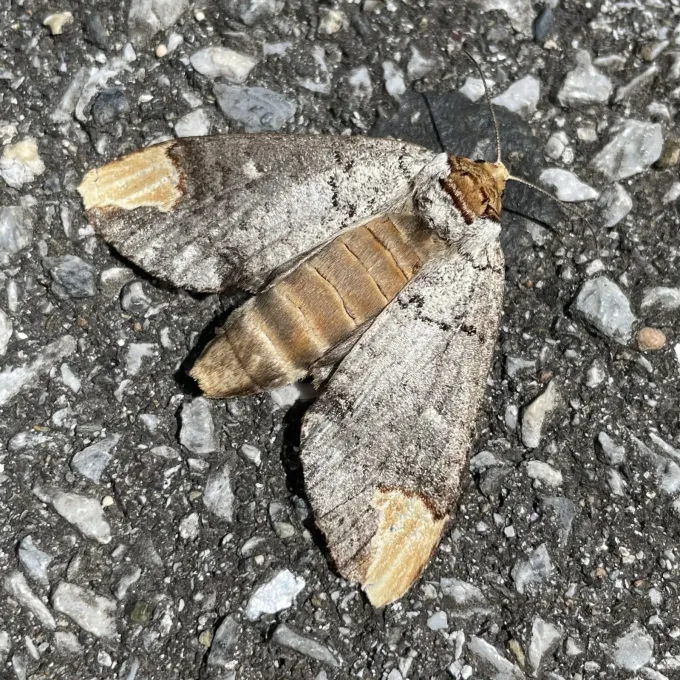
Description
How to identify
The Lesser puss moth (Phalera minor) belongs to the Notodontidae family within the order Lepidoptera. These moths are primarily nocturnal and have evolved cryptic coloration that provides excellent camouflage against tree bark during the day.
Adult moths typically possess a wingspan ranging from 40 to 50 mm. The forewings display intricate grayish-brown patterns with darker transverse lines, closely mimicking the texture and appearance of wood.
The caterpillars are the most visible stage of the pest. They are characterized by a distinct appearance, often with longitudinal stripes and sparse hairs, which vary in color throughout their larval development stages.
The life cycle involves complete metamorphosis, consisting of four distinct stages: egg, larva, pupa, and adult. This biological strategy allows the species to survive varying environmental pressures throughout the year.
Overwintering occurs in the pupal stage. The pupae reside in the soil within robust, protective cocoons, which help them survive extreme winter temperatures and remain shielded from subterranean predators.
What it damages
As an oligophagous pest, the Lesser puss moth larvae feed specifically on the foliage of woody plants. They possess strong mandibles that allow them to consume large portions of the leaf tissue efficiently.
Primary target crops include pome and stone fruits such as apples, pears, plums, and cherries. When orchard resources are scarce or populations are high, they may infest forest trees like birch or oak.
Larval feeding causes significant defoliation, which reduces the plant's capacity for photosynthesis. This depletion directly impacts the tree's health, vigor, and potential for future fruit development.
In cases of severe infestation, early leaf fall occurs, which places the tree under significant stress and reduces its ability to accumulate energy reserves for successful overwintering.
The cumulative damage caused by repeated infestations can lead to stunted growth, particularly in young orchard trees, making them susceptible to secondary infections and opportunistic pests.
When it appears
The flight period of adult moths typically commences in late spring, around May or June. During this time, they engage in mating and oviposition, usually targeting the undersides of leaves for egg placement.
The most intense larval feeding occurs during the mid-to-late summer months. This is when caterpillars are most active and visible on the canopy, causing the most noticeable damage to orchards.
Once mature, the caterpillars descend to the soil to pupate. In warmer climate zones, the species may complete two generations within a single growing season.
Developmental rates are strictly temperature-dependent; warmer weather accelerates the larval growth cycle, potentially leading to more rapid population increases in late summer.
Pupae remain dormant in the soil throughout the winter months, awaiting the onset of spring temperatures to trigger the emergence of the next generation of adult moths.
Signs of infestation
The initial sign of a Lesser puss moth infestation is the presence of skeletonized leaves or irregularly bitten leaf margins. Young larvae tend to feed gregariously, leaving only the midribs and veins behind.
Frass (larval excrement) accumulation on leaves and on the ground beneath the canopy is a definitive indicator of an active feeding colony above.
Careful inspection of the lower leaf surfaces may reveal egg clusters, which are organized and typically appear as round or oval masses prior to hatching.
As larvae reach their later instars, they disperse throughout the tree, making their presence known through obvious holes and missing leaf patches across the crown.
Observing birds feeding aggressively in the trees or using nocturnal spotlighting can also reveal the presence of caterpillars, as they become more active or visible at night.
Control measures
Mechanical control is effective for smaller garden infestations and involves the manual collection and destruction of egg clusters and visible larval groups from the foliage.
Cultivation practices, such as deep tilling or digging up the soil under the tree canopy in late autumn, are vital for disrupting the pupation site and destroying over-wintering pupae.
Biological control options, including the use of Bacillus thuringiensis, offer a targeted and environmentally friendly way to suppress larval populations without disrupting beneficial insect numbers.
Chemical intervention should be reserved for instances where the economic damage threshold is reached, utilizing approved insecticides applied during the peak window of egg hatch.
- Regular tree canopy pruning to improve airflow and ease of monitoring.
- Encouraging natural predators like predatory wasps and insectivorous birds.
- Deployment of light traps for monitoring and adult moth population suppression.
- Adhering to strict timing for insecticide applications based on local phenological observations.
Taxonomy
- Latin name
- Phalera minor
- Order
- Lepidoptera (butterflies)
- Family
- Notodontidae
- EPPO code
- PHALMI
Discussion
No discussions yet — be the first.