
Brown prominent
Phalera fuscescens
Description
How to identify
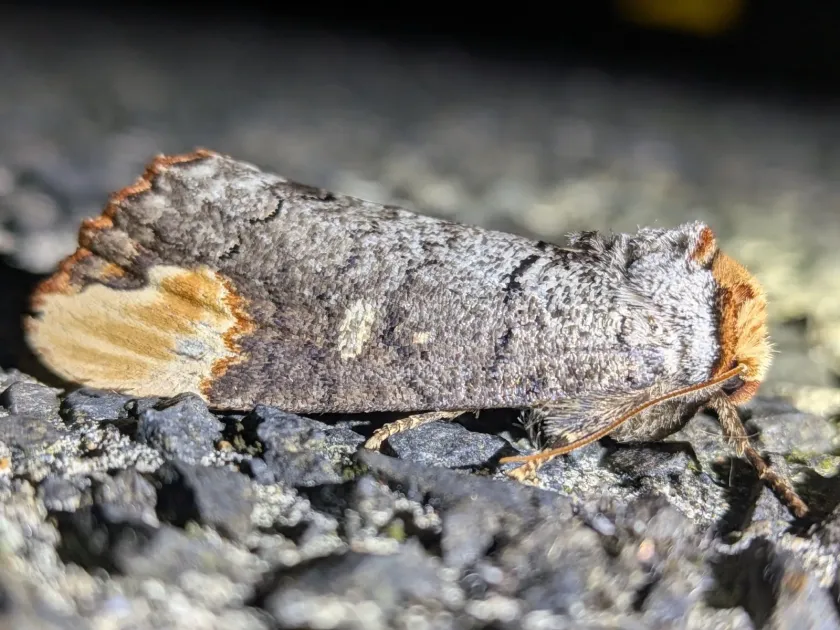
The brown prominent (Phalera fuscescens) is a moth species belonging to the family Notodontidae within the order Lepidoptera. Adults typically feature a wingspan ranging from 40 to 50 mm, with grayish-brown forewings adorned with complex patterns that act as camouflage against tree bark.
Caterpillars of this species are known for their distinct appearance, often characterized by longitudinal stripes and a sparse covering of hair. As they develop through several larval instars, they grow significantly in size while retaining typical family features such as dorsal bumps or tubercles.
The pest spends the winter in the pupal stage, residing in the soil at a shallow depth beneath the host plant. This life-cycle adaptation allows the species to survive harsh winter conditions by utilizing the protective environment of the soil layer.
Adult moths are nocturnal and are typically active during twilight hours. During the day, they remain stationary on branches or trunks, held in a position that mimics a broken twig, which provides excellent protection against predators.
The species completes one generation per year. Mass emergence occurs during the summer months, after which females lay clusters of eggs on the undersides of host leaves to ensure larvae have immediate access to food upon hatching.
What it damages
The caterpillars feed on the leaves of a wide range of deciduous trees. They are commonly observed on fruit trees such as apple, pear, and plum, as well as on various forest tree species, including birch, alder, and willow.
In their early instars, caterpillars live in communal groups, causing rapid destruction of leaf blades. They primarily feed on leaf margins or skeletonize the foliage, consuming the soft tissues and leaving only the robust veins intact.
During outbreaks, this pest can cause extensive defoliation across large portions of the tree canopy. This weakens the tree, reduces its energy reserves, and significantly diminishes the quantity and quality of the following season's fruit production.
Extensive damage to the foliage disrupts photosynthesis, which is essential for tree vigor and future bud development. A heavily defoliated tree becomes more susceptible to secondary infestations by other pests and pathogens like fungi.
Premature leaf drop, caused by severe caterpillar feeding, often leads to poor shoot maturation. This physiological stress can result in stunted growth and increased susceptibility to frost damage during the subsequent winter months.
Signs of infestation
The primary sign of a brown prominent infestation is the presence of caterpillar clusters on the underside of leaves. Early damage appears as localized patches of skeletonized leaf tissue where young larvae have been feeding collectively.
A significant indicator of active infestation is the presence of abundant frass (excrement) on the ground under the canopy. Dark, granular droppings are clear evidence that caterpillars are actively feeding in the upper parts of the tree.
Visual inspection of the canopy may reveal "bare" patches or stripped branches where leaves have been consumed almost entirely. Because caterpillars often feed in groups, damage is usually concentrated, making it easier to identify hotspots within the orchard.
Adult moths can be detected using light traps at night to monitor population levels. During autumn soil maintenance, pupae may also be found at a shallow depth, confirming the presence of the species in the area.
Wilting or premature yellowing of leaves, resulting from the destruction of the leaf apparatus, is a secondary sign that the tree is under heavy stress from larval feeding activity.
Control measures
Deep autumn tillage of the soil beneath host trees is a highly effective cultural control method. This practice disrupts pupal development and exposes the pupae to birds and harsh weather conditions, significantly reducing the next generation's population.
Hand-picking caterpillar clusters and removing egg masses is a practical approach for young trees or small garden environments. Regular scouting helps to catch and contain outbreaks before they can spread throughout the entire orchard.
Biological insecticides containing Bacillus thuringiensis are recommended for use at the first signs of larval activity. These treatments are highly effective against young caterpillars and have minimal impact on beneficial predatory insects.
Chemical insecticides should be reserved for severe outbreaks where the economic threshold is exceeded. When applying these chemicals, it is essential to follow local regulations and ensure timing coincides with the most vulnerable larval stages.
- Deploying light traps to monitor moth flight activity.
- Encouraging natural predators, such as insectivorous birds and parasitic wasps.
- Implementing good orchard hygiene to maintain overall plant vigor and resistance.
Taxonomy
- Latin name
- Phalera fuscescens
- Order
- Lepidoptera (butterflies)
- Family
- Notodontidae
- EPPO code
- PHALFU
Discussion
No discussions yet — be the first.