
Phalera assimilis
Phalera assimilis
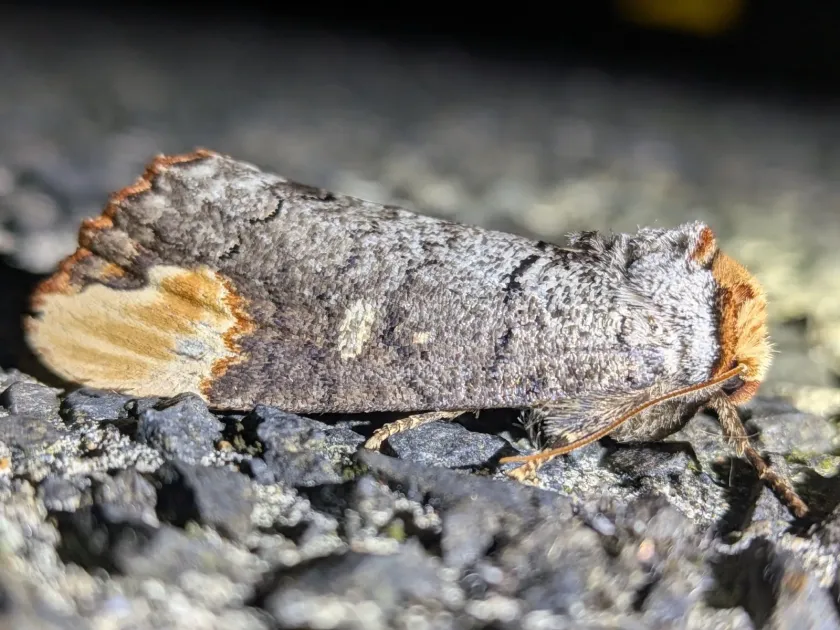
Description
How to identify
Phalera assimilis is a moth species belonging to the Notodontidae family. The adult moth has a wingspan of approximately 40–50 mm, featuring grey-brown forewings with patterns that resemble bark textures.
The larvae, or caterpillars, can grow up to 60 mm long. They possess a distinct appearance, often covered in sparse hairs and marked with yellow or orange dorsal stripes, serving as a warning to predators.
These insects undergo a complete metamorphosis. They typically overwinter as pupae in the soil, which provides insulation against cold winter temperatures.
There is usually one generation per year, with the life cycle synchronized with the seasonal growth of host plants.
Taxonomically, the species is closely related to other Phalera moths, requiring careful examination of markings for accurate field identification.
What it damages
Phalera assimilis is an oligophagous insect, primarily feeding on foliage from deciduous trees such as oaks, birches, and aspens.
In forest nurseries and plantations, the larvae can cause significant damage by consuming leaf tissue, often leaving only the midribs and veins.
Severe defoliation weakens the host trees, making them susceptible to secondary infections by fungi or opportunistic pests.
Persistent infestations over several consecutive seasons can lead to significant biomass loss and, in extreme cases, the death of young saplings.
The economic impact involves decreased timber production quality and the degradation of the aesthetic value of parkland and urban trees.
When it appears
Adult moths emerge in early summer, typically peaking in June, when environmental conditions are optimal for mating.
Females deposit eggs in compact clusters on the underside of leaves, providing a hidden location for the developing embryos.
The larval feeding stage occurs mainly during July and August, corresponding with the peak growth phase of the host trees.
After reaching maturity, the larvae descend to the ground to pupate, constructing protective cocoons in the topsoil.
Climatic factors, such as unusually warm springs, can trigger earlier emergence, which necessitates early scouting in affected areas.
Signs of infestation
The primary diagnostic sign is the presence of skeletonized leaves localized in specific areas of the tree canopy.
Young larvae feed in colonies, leading to concentrated damage on individual branches, which makes detection easier during the early stages.
An accumulation of larval frass (droppings) on the ground underneath the canopy indicates a high level of activity within the upper branches.
Close inspection of the underside of leaves during the spring reveals compact egg clusters, which are a strong indicator of an impending infestation.
Finding pupal cocoons in the soil around the base of the tree at the end of the season confirms the presence of the pest population for the following year.
Control measures
Physical control measures involve manually removing and destroying egg clusters and pruning branches hosting young larval colonies.
Pheromone traps are highly effective for monitoring adult moth populations and timing chemical applications accurately.
Chemical control using systemic or contact insecticides should target early larval instars to prevent widespread defoliation.
Biological control using microbial insecticides, such as Bacillus thuringiensis, is recommended to minimize environmental impact on non-target species.
Cultivating or tilling the soil around the base of the trees in late autumn destroys the overwintering pupae, effectively reducing the next generation's population.
Taxonomy
- Latin name
- Phalera assimilis
- Order
- Lepidoptera (butterflies)
- Family
- Notodontidae
- EPPO code
- PHALAS
Discussion
No discussions yet — be the first.