
Buff-tip moth
Phalera
Description
How to identify
The Buff-tip moth (Phalera bucephala) is a distinctive moth belonging to the Notodontidae family. Its appearance is a classic example of camouflage: when at rest, the moth resembles a broken birch twig, complete with metallic gold tips on its wings, which helps it hide from predators during the day.
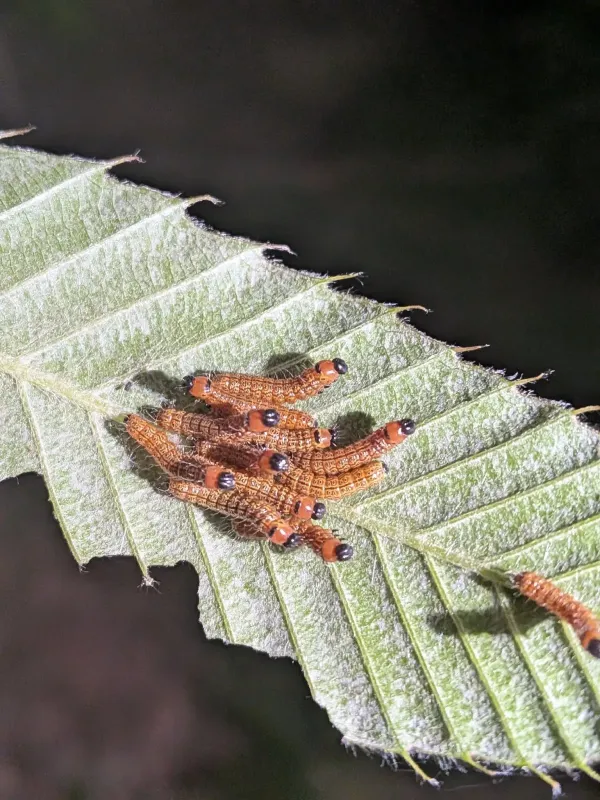
The larvae, or caterpillars, are large, reaching up to 60 mm in length. They are typically yellow or grey with black longitudinal stripes and sparse hairs. These caterpillars are notable for their gregarious behavior, especially during their early stages of development.
The life cycle of this species consists of one generation per year. They overwinter as pupae buried in the soil. Adults emerge during the summer months, typically in June and July, to mate and lay eggs on the leaves of host plants.
Because the larvae remain in groups for a significant portion of their lives, their presence is relatively easy to monitor during the summer season. Once they mature, they disperse throughout the tree canopy to continue feeding.
Understanding their biology is key to management. By identifying the timing of egg-laying and larval emergence, gardeners and farmers can intervene before the population reaches damaging levels.
What it damages
The Buff-tip moth larvae are foliage eaters that consume a wide variety of deciduous trees. Preferred hosts include birch, oak, lime, and hazel, but they are also frequently found on fruit trees such as apple, pear, and cherry.
Young larvae initially skeletonize the leaves, but as they grow, they move on to devouring entire leaves, leaving only the midribs behind. A large colony can strip a branch of all its foliage in a relatively short time.
In cases of heavy infestation, the entire tree can suffer from significant defoliation. This reduces the tree's ability to photosynthesize, which can severely weaken its health, reduce future fruit production, and make it more susceptible to environmental stress.
For young saplings or nursery trees, an attack by this moth can be particularly devastating. Repeated defoliation over consecutive seasons can cause branch dieback and, in extreme cases, the death of the entire tree.
Furthermore, weakened trees are often secondary targets for wood-boring insects and fungal diseases, which can capitalize on the plant's inability to defend itself due to nutrient exhaustion.
Signs of infestation
The most reliable sign of a Buff-tip moth infestation is the presence of clusters of caterpillars feeding on the edge of leaves. Because they stay together in the early stages, they are easily visible on the foliage of host trees.
Another indicator is the accumulation of frass (caterpillar droppings) on the ground underneath the tree or on the leaves below the colony. A large amount of frass suggests a mature colony is feeding above.
Visible damage to the canopy, such as patches of bare twigs and consumed leaves, confirms an established population. Inspecting these areas usually reveals the presence of the larvae or their shed skins.
Adult moths are often attracted to artificial light at night during the summer months. Seeing these moths near outdoor lights can be a warning to inspect your trees for egg clusters in the coming days.
Searching the undersides of leaves in early summer can reveal the egg batches laid by the females. Detecting and removing these clusters is the most efficient way to prevent an outbreak from starting.
Control measures
For small trees or garden settings, manual removal of the larval colonies is the most effective and eco-friendly method. Simply prune the infested branch or hand-pick the caterpillars and destroy them.
Biological control using formulations based on Bacillus thuringiensis is very effective against the young stages of the larvae. This approach is highly targeted and generally safe for beneficial insects and wildlife.
Chemical insecticides should only be used as a last resort in cases of severe infestation where the survival of the tree is at risk. Always choose products that are registered for use on ornamental or fruit-bearing trees.
Cultural practices, such as deep digging or turning over the soil beneath the trees in autumn, can help disrupt the pupation stage. This exposes the pupae to predators and frost, effectively reducing the population for the following year.
- Encourage natural predators such as birds and parasitic wasps in the garden.
- Monitor your trees regularly throughout the summer months.
- Keep trees healthy with proper pruning and watering to increase resilience.
Taxonomy
- Latin name
- Phalera
- Order
- Lepidoptera (butterflies)
- Family
- Notodontidae
- EPPO code
- PHALSP
Discussion
No discussions yet — be the first.