
Blue pine buprestid
Phaenops cyanea
Description
How to identify
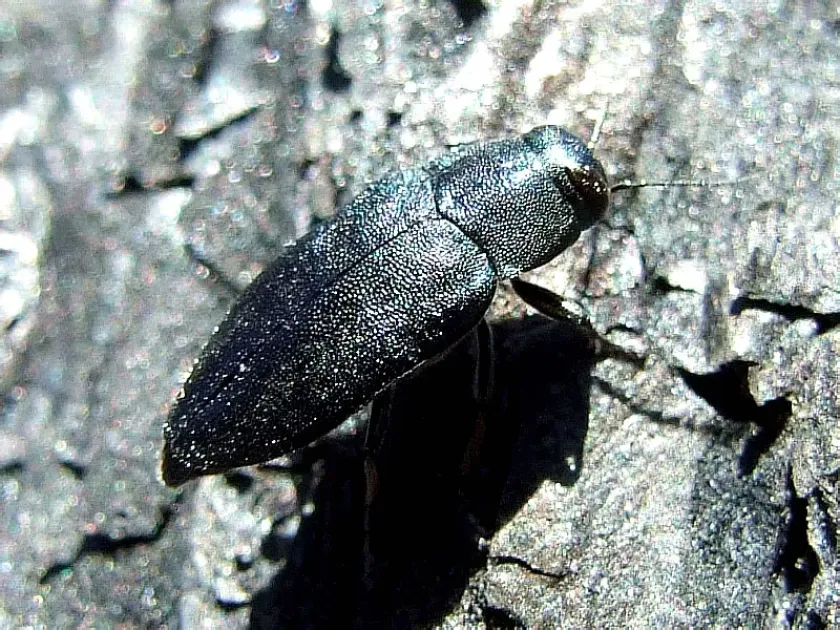
The blue pine buprestid (Phaenops cyanea) is a beetle species belonging to the Buprestidae family within the order Coleoptera. Adult beetles are characterized by a slender, metallic-colored body typically ranging from 7 to 11 mm in length.
Their coloration ranges from dark blue to greenish-blue with a distinct metallic luster. This appearance helps them blend into their natural environment while remaining visible when they move across tree bark in bright sunlight.
Larvae are white, legless, and have a noticeably widened thoracic segment. They are specialized wood-borers that develop entirely within the host tree's tissues, protected from the external environment.
Adult beetles are highly active on sunny days, during which they feed on pine needles before searching for suitable host trees. Proper identification of adults is essential for monitoring and early detection.
The species is a well-known pest in coniferous forests, particularly in regions where pine trees are frequently subjected to drought and thermal stress.
What it damages
The primary hosts of the blue pine buprestid are species of the genus Pinus, with Pinus sylvestris being the most commonly affected. The pest targets trees weakened by drought, fire, mechanical damage, or competitive stress.
Larvae damage the tree by creating winding galleries under the bark, consuming the cambium and phloem. This feeding activity disrupts the transport of nutrients, leading to the rapid decline of the tree.
In cases of high population density, these beetles can successfully attack and kill relatively healthy-looking trees. The damage usually begins in the upper part of the stem where the bark is thinner and easier to penetrate.
The resulting physiological stress causes the tree to turn yellow and eventually die, often within one or two growing seasons. This makes the blue pine buprestid a significant threat to forest stability and timber quality.
The degradation of the cambium leads to a total halt of sap flow, resulting in the rapid shedding of needles and the eventual death of the affected branches and stem.
When it appears
Adult beetle emergence typically begins in late spring and continues throughout the summer months, with activity peaking in June and July. Sunny and warm weather conditions are critical for their flight and mating.
After mating, females lay eggs in bark crevices. The larvae hatch and bore into the wood, where they spend the remainder of their development period, including the overwintering phase.
Pupation occurs in the spring within specially prepared chambers under the bark. After completing metamorphosis, the new generation of adults chews through the bark to emerge, leaving behind characteristic holes.
The life cycle generally lasts one year, although in colder northern latitudes, it may extend to two years. Monitoring these seasonal stages is vital for implementing effective management practices.
Climate change and prolonged heatwaves have been shown to increase the frequency and severity of outbreaks by creating more suitable conditions for larval survival.
Signs of infestation
The most reliable sign of an infestation is the presence of small, oval-shaped exit holes in the bark of pine trees. These holes are created when adults emerge after completing their life cycle.
Upon removing the outer bark, you will encounter the intricate, winding galleries left by the larvae. These tunnels are often tightly packed with boring dust, which confirms the activity of the buprestid larvae.
The tree's health declines visibly, starting with needle discoloration that progresses from yellow to reddish-brown. This change in color is often first noticeable in the canopy.
- Thinning of the crown due to premature needle fall.
- Small resin patches on the stem where the tree has attempted to defend itself.
- Bark peeling or flaking in localized areas where larval galleries are concentrated.
In advanced stages, the tree becomes completely desiccated, and the bark may begin to slough off in large patches, revealing the heavy internal damage caused by the larvae.
Control measures
The most effective management strategy is the prompt identification and removal of infested trees during the winter or early spring, before the new generation of beetles can emerge.
The use of trap trees, which are felled and placed strategically in the forest to attract egg-laying females, is a standard silvicultural method for population control.
Sanitation practices such as clearing logging residues and preventing the accumulation of deadwood are crucial for reducing the availability of breeding sites for the beetles.
Natural enemies, including woodpeckers and parasitic wasps, play a significant role in regulating buprestid populations and should be encouraged in forest management programs.
In high-value areas like botanical gardens or ornamental plantings, systemic insecticides applied via stem injections or targeted spraying can be utilized during peak flight periods to protect valuable trees.
Taxonomy
- Latin name
- Phaenops cyanea
- Order
- Coleoptera (beetles)
- Family
- Buprestidae
- EPPO code
- MELPCY
Discussion
No discussions yet — be the first.