
Sugarcane planthopper
Perkinsiella saccharicida
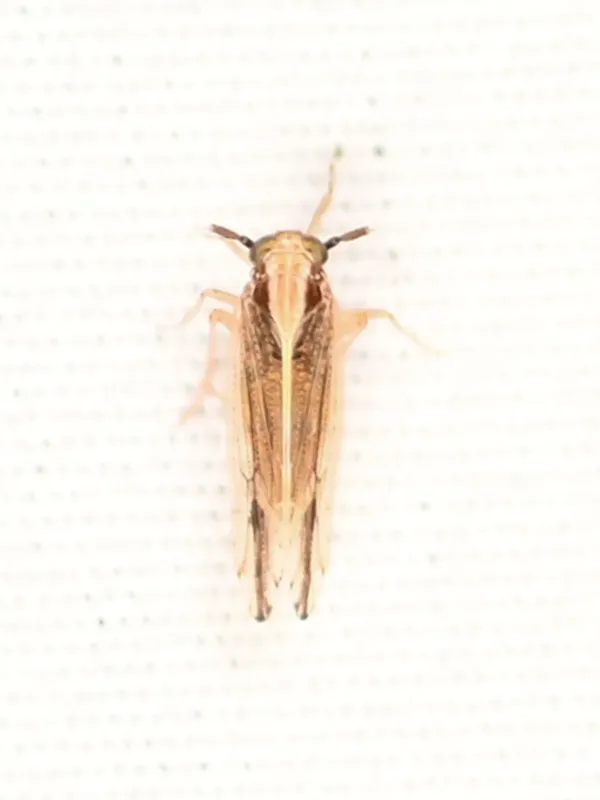
Description
How to identify
The sugarcane planthopper (Perkinsiella saccharicida) is a member of the Delphacidae family within the order Hemiptera. Adults are small insects, typically measuring about 5 mm in length.
The body color ranges from pale yellow to brown, often featuring distinctive dark markings on the wings. Adults possess well-developed transparent wings, enabling them to migrate over significant distances.
The life cycle progresses through egg, nymph (five instars), and adult stages. Females insert eggs into plant tissues using a specialized ovipositor, often creating visible scars on the leaves.
Nymphs resemble smaller, wingless versions of the adults. They begin feeding immediately upon hatching and undergo several molts before reaching maturity.
The duration of the life cycle is highly dependent on environmental conditions, with multiple generations possible per year in tropical and subtropical climates.
What it damages
This pest primarily attacks sugarcane, causing significant economic losses in commercial plantations by draining plant sap and stunting growth.
Beyond physical damage, Perkinsiella saccharicida is the primary vector of the Fiji leaf gall virus, a devastating disease that can destroy entire crops.
Feeding activities occur mainly on the leaves and stems, causing yellowing, leaf curling, and a reduction in photosynthetic capacity of the sugarcane plant.
Heavy infestations reduce the overall sugar content and biomass production, significantly lowering the market value of the harvested stalks.
Secondary infections often colonize the wounds made by the insects, further exacerbating the decline of the plant health and vigor.
Signs of infestation
A key indicator of infestation is the presence of honeydew secreted by the nymphs and adults, which leads to the growth of unsightly black sooty mold on the leaves.
Leaf yellowing and deformation are early signs of stress caused by the feeding activity of the planthoppers.
Close inspection of leaf midribs reveals small, brown slits or bumps where females have deposited their eggs into the plant tissue.
When disturbed, adult planthoppers exhibit characteristic jumping behavior, often aggregating in the leaf whorls or protected areas of the plant.
Stunted development and chlorosis in patches throughout the field are typical patterns indicating a localized outbreak of the pest.
Control measures
The most sustainable management approach is the cultivation of resistant sugarcane varieties that discourage feeding and oviposition.
Biological control methods are highly effective, utilizing natural predators such as the egg parasitoid Anagrus optabilis to suppress pest populations.
Sanitation practices, including the removal of alternative host weeds around field edges, are critical to reducing overwintering populations.
Chemical control with systemic insecticides is reserved for high-density outbreaks to protect natural enemy populations from unnecessary exposure.
- Deployment of yellow sticky traps for population monitoring.
- Strict adherence to quarantine protocols for new planting material.
- Regular field scouting to identify and treat hotspots before the pest spreads.
Taxonomy
- Latin name
- Perkinsiella saccharicida
- Order
- Hemiptera (bugs, aphids, leafhoppers)
- Family
- Delphacidae
- EPPO code
- PERKSA
Discussion
No discussions yet — be the first.