
Corn planthopper
Peregrinus maidis
Description
How to identify
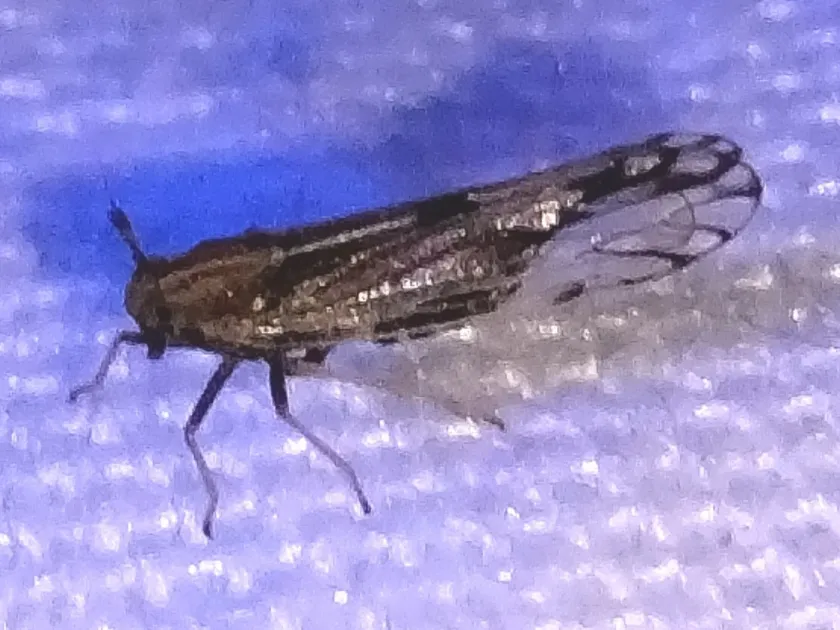
The corn planthopper, Peregrinus maidis, is a small insect belonging to the order Hemiptera and the family Delphacidae, commonly found in tropical and subtropical regions.
Adult planthoppers measure approximately 3–4 mm in length and exhibit wing polymorphism, meaning some individuals have fully developed wings (macropterous) while others have shortened ones (brachypterous).
Their coloration ranges from yellowish-brown to dark brown, providing excellent camouflage against the maize stalk and leaf sheaths where they typically reside.
The eggs are small, elongated, and are inserted by females into the leaf tissues or midribs of the host plant, making them difficult to detect without careful inspection.
Nymphs resemble smaller, wingless versions of adults and undergo five developmental stages before reaching maturity, often congregating in protected areas like the plant whorl.
What it damages
While maize is the primary host, this pest also targets sorghum and various wild grasses, which act as alternative hosts throughout the growing season.
The economic impact of the corn planthopper is primarily due to its role as a vector for various plant viruses, such as maize mosaic and maize stripe viruses.
Direct damage occurs when both adults and nymphs feed on the plant sap, leading to wilting, chlorosis, and a general reduction in plant vigor and biomass.
The accumulation of honeydew excreted by the insects encourages the growth of sooty mold, which reduces the leaf area available for photosynthesis.
Severe infestations result in stunted plant growth, deformed leaves, and significant yield losses, as the virus transmission often causes irreversible developmental issues.
When it appears
Population growth of the corn planthopper is highly temperature-dependent, with rapid life cycle completion occurring during warm and humid conditions.
The insects are most active during the early vegetative stages of maize, as they are attracted to the succulent, nutrient-rich tissues of young plants.
In regions with distinct dry and wet seasons, planthoppers migrate from wild grass reservoirs to newly planted maize fields as soon as the crop emerges.
Overwintering is typically achieved as adults on perennial grasses, allowing populations to rapidly rebound once environmental conditions become favorable.
Continuous cropping cycles in warmer climates allow for overlapping generations, maintaining a constant presence of the pest in the field throughout the year.
Signs of infestation
Initial signs of infestation appear as small, chlorotic stippling or spotting on the leaves where the insects have inserted their mouthparts to feed.
The presence of honeydew on the leaves, which often turns black due to the growth of sooty mold, is a clear visual indicator of a planthopper colony.
Virus-infected plants often exhibit mosaic patterns, yellowing, or reddening of the leaves, along with a characteristic stunted or dwarfed appearance.
- Presence of sticky honeydew on the foliage.
- Deformation or curling of young developing leaves.
- Significant shortening of internodes in infected plants.
Disturbing the foliage often causes the adults to jump or fly, which is a common way to confirm their presence in the whorl or leaf axils.
Control measures
Cultural control, such as the removal of wild grass hosts and weeds surrounding maize fields, is essential to minimize the primary reservoirs of the pest and viruses.
The use of resistant or tolerant maize hybrids is considered the most effective long-term strategy for managing the viral diseases transmitted by planthoppers.
Seed treatments with systemic insecticides provide early-season protection, significantly reducing the chances of virus transmission during the vulnerable seedling phase.
Strategic timing of planting to avoid peak migration periods can reduce the risk of early colonization and subsequent viral infection of the young crop.
Integrated Pest Management (IPM) programs involving biological control agents and targeted insecticide applications are recommended to maintain populations below economic thresholds.
Taxonomy
- Latin name
- Peregrinus maidis
- Order
- Hemiptera (bugs, aphids, leafhoppers)
- Family
- Delphacidae
- EPPO code
- PERGMA
Discussion
No discussions yet — be the first.