
Corn delphacid
Peregrinus
Description
How to identify
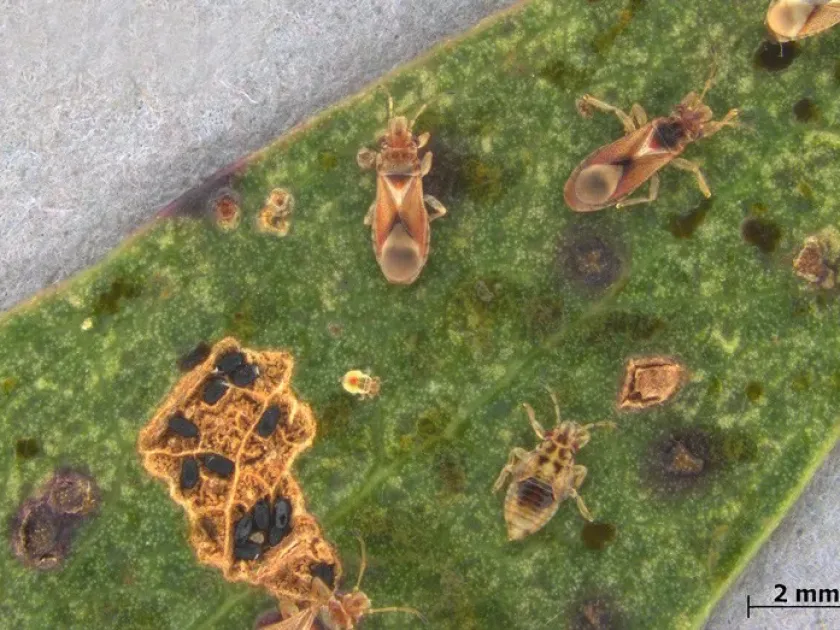
The corn delphacid (Peregrinus maidis) belongs to the Delphacidae family, order Hemiptera. This insect is small in size and can exhibit two distinct forms: macropterous (long-winged) and brachypterous (short-winged).
Adults typically reach 3–4 mm in length. Their coloration ranges from light yellow to brown, featuring characteristic dark markings on the wings, which are held flat along the body.
Nymphs resemble the adults in general appearance but are significantly smaller and lack fully developed wings. They undergo several instars, gradually increasing in size during their development.
This species prefers secluded habitats, often hiding within leaf whorls, inside tightly rolled young leaves, or under the husks of corn ears, making early detection difficult.
The insect is highly agile and capable of quick flight between plants when disturbed, a behavior common among most members of the planthopper family.
What it damages
The primary host plant for this pest is maize (Zea mays). To a lesser extent, it can also infest sorghum, sugarcane, and various wild grass species found near agricultural fields.
Damage is caused by both adults and nymphs feeding on plant sap by piercing the epidermis of leaves and stems with their specialized piercing-sucking mouthparts.
The most severe impact is the transmission of viral diseases, specifically Maize mosaic virus and Maize chlorotic dwarf virus, for which this insect acts as an efficient vector.
Feeding activities result in loss of plant turgor, stunted growth, and developmental delays, often leading to substantial yield losses during the early stages of crop growth.
Heavy infestations in leaf whorls produce large amounts of honeydew (excrement), which promotes the growth of sooty mold, ultimately interfering with the plant's photosynthetic capacity.
When it appears
The pest population thrives in warm and humid climatic conditions. Optimal temperatures for reproduction typically range between +25 and +30 degrees Celsius.
The life cycle from egg to adult takes approximately 20–25 days under favorable conditions, allowing the insect to complete multiple generations within a single growing season.
In tropical and subtropical regions, reproduction occurs year-round, although population peaks often coincide with periods of active maize growth and sufficient soil moisture.
Overwintering occurs on residues of host grasses or in protected micro-habitats where favorable temperatures are maintained throughout the colder months.
Dispersion across fields is facilitated by wind currents and active flight, particularly during the early vegetative stages when maize seedlings are most vulnerable.
Signs of infestation
The first sign of infestation is the appearance of yellow or necrotic spots on the foliage where the insects have pierced the plant tissue to feed.
Distortion of young leaves is frequently observed, where foliage becomes twisted or develops abnormal shapes as the plant exhibits stunted, dwarf-like growth.
The presence of sticky honeydew on leaf surfaces and the subsequent appearance of black sooty mold are clear indicators of active planthopper colonies.
Inspecting the inner leaf whorls often reveals clusters of insects that scatter rapidly when the plant is disturbed or touched.
- Yellowing along leaf margins.
- Delayed tassel emergence.
- Wilting of specific patches within the field.
Control measures
The most important cultural control method is the removal of grassy weeds, which serve as alternate hosts and virus reservoirs during the off-season.
Maintaining spatial isolation between new plantings and older, infested maize fields is recommended to limit the immigration of adult insects.
Using seeds treated with systemic insecticides provides crucial protection for young seedlings against early colonization during the most vulnerable growth stages.
During active vegetative growth, if infestation thresholds are reached, contact and systemic insecticides are employed to suppress nymphal populations.
Continuous monitoring using yellow sticky traps is an effective strategy to detect the arrival of migrants, allowing for timely decision-making regarding chemical intervention.
Taxonomy
- Latin name
- Peregrinus
- Order
- Hemiptera (bugs, aphids, leafhoppers)
- Family
- Delphacidae
- EPPO code
- PERGSP
Discussion
No discussions yet — be the first.