
Rice skipper
Pelopidas agna
Description
How to identify
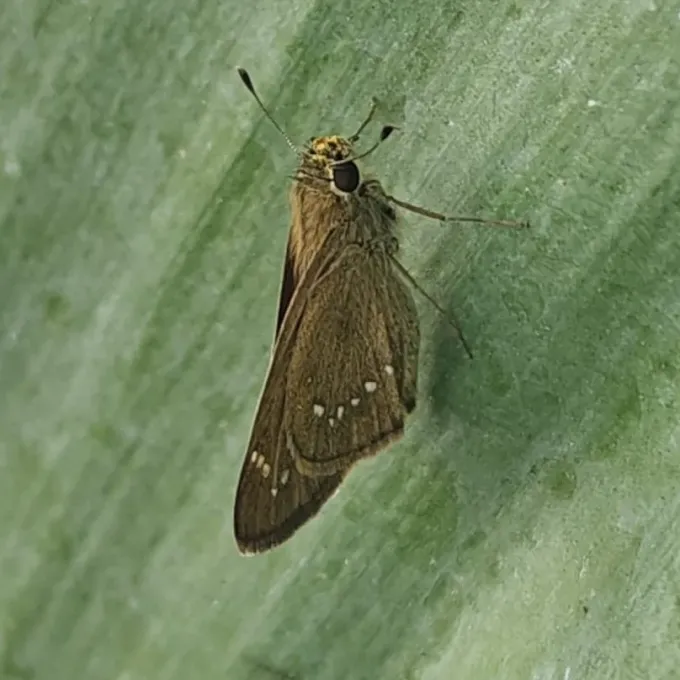
The rice skipper (Pelopidas agna) is a butterfly belonging to the Hesperiidae family. Adult specimens have a wingspan of approximately 35–40 mm and are characterized by dark brown wings with distinctive translucent light spots on the forewings.
Larvae (caterpillars) of this species have a cylindrical, greenish body that tapers towards both ends. The head is typically brown or black. Mature larvae can reach 30–35 mm in length, making them easily observable on host plants.
Pupae are elongated and greenish, providing effective camouflage among rice leaves. They are securely attached to the leaf surface with silk threads, often within a folded leaf edge.
Systematically, this species belongs to the order Lepidoptera, family Hesperiidae, and genus Pelopidas. It is a common pest in tropical and subtropical regions, specifically adapted to grass hosts.
Accurate identification is based on wing patterns and venation. Regular field scouting is essential for differentiating this species from other similar skipper butterflies found in paddy fields.
What it damages
The primary host for rice skipper larvae is rice (Oryza sativa). While the pest prefers younger plants, it can infest crops throughout various growth stages, potentially leading to significant yield losses.
In addition to rice, the rice skipper develops on various grassy weeds, such as barnyard grass (Echinochloa crus-galli). These weeds serve as alternative hosts and reservoirs for the pest population.
Damage is caused by larvae feeding on leaf blades. They consume the edges of leaves, moving toward the central midrib, which significantly reduces the photosynthetic surface area of the plant.
Heavy infestations can lead to total defoliation, hindering the plant's ability to fill grains. This negatively impacts the 1000-grain weight and overall crop productivity of the paddy.
Damaged leaves are also more susceptible to secondary infections by pathogenic fungi and bacteria, as open wounds provide entry points that further weaken the rice plants.
When it appears
The development cycle of the rice skipper is highly dependent on temperature and humidity. In tropical and subtropical climates, the pest can complete several generations within a single growing season.
Butterflies are most active during the day and prefer sunny conditions for mating and oviposition. Eggs are laid singly on the upper surface of host plant leaves.
The development of one generation typically takes 3 to 5 weeks. This short cycle allows the population to increase rapidly as the rice crop approaches the booting and flowering stages.
Overwintering in warmer regions may occur at the pupal stage or as mature larvae within plant debris, which should be considered during the planning of agricultural management practices.
Monitoring for adult butterflies using light traps or visual inspections should commence early in the season, soon after rice emergence, to prevent large-scale outbreaks.
Signs of infestation
The main sign of an infestation is the presence of characteristic leaf feeding, where the edges of leaves are chewed. Larvae often fold the leaf edge using silk, creating a protective tube where they hide during the day.
- Presence of folded or silk-bound rice leaves.
- Observation of larvae inside these leaf rolls.
- Frass (excrement) deposits on leaf surfaces near feeding sites.
- Exposed leaf midribs following severe herbivory.
- Wilting or chlorosis of parts of the leaf blade.
The presence of large numbers of adult butterflies with a fast, darting flight pattern is a strong indicator of high risk for the upcoming crop growth stages.
Detecting folded leaves at an early stage allows for localized intervention, preventing the pest from spreading throughout the entire paddy field.
Control measures
Effective management begins with controlling grassy weeds within and around paddy fields, as these are the primary sites for oviposition and larval development.
Biological control using Bacillus thuringiensis-based formulations is recommended, as it effectively targets younger larvae while minimizing harm to beneficial insects and natural predators.
If the population density exceeds the economic threshold (usually when 10–15% of the leaf area is damaged), the application of registered contact insecticides is advised for effective suppression.
Natural enemies, such as parasitic wasps (hymenopterans), play a crucial role in regulating populations. Conserving these biological agents is an essential component of an integrated pest management strategy.
Implementing crop rotation and ensuring optimal planting dates helps to reduce the vulnerability of rice plants during their most critical growth phases, effectively managing the pest pressure.
Taxonomy
- Latin name
- Pelopidas agna
- Order
- Lepidoptera (butterflies)
- Family
- Hesperiidae
- EPPO code
- PELOAG
Discussion
No discussions yet — be the first.