
South American palm weevil
Paysandisia archon
Description
How to identify
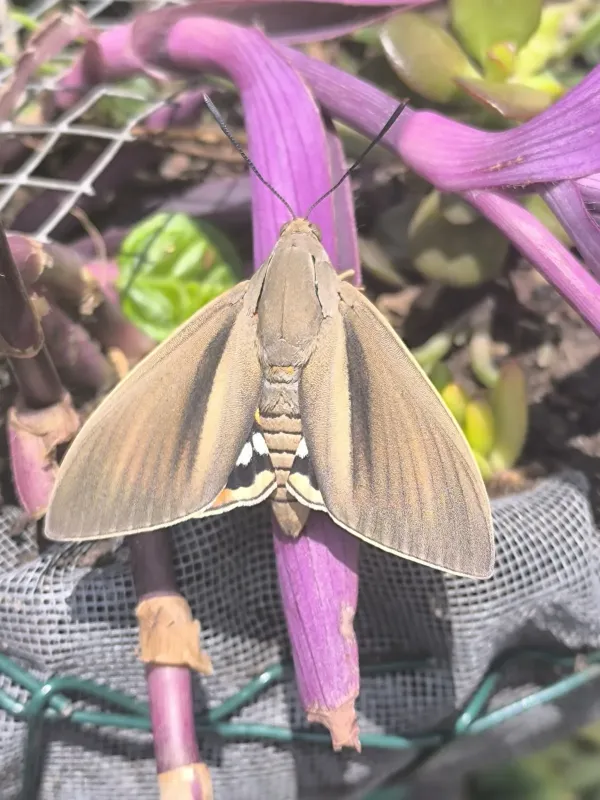
The South American palm weevil (Paysandisia archon) is a striking moth belonging to the Castniidae family. Despite its moth classification, it is active during the day, making it highly visible during the breeding season.
The adults are large, with a wingspan of up to 110 mm. Their forewings are brown with cryptic patterns, while the hindwings are brightly colored with red, black, and white markings, which are visible during flight.
The life cycle consists of egg, larva, pupa, and adult stages. The larvae are the primary damaging stage, as they tunnel through the internal fibers of palm trees, often remaining hidden for long periods.
The pupal stage occurs within the palm trunk, where the larva constructs a robust cocoon made of chewed wood fibers and silk. This cocoon serves as a protective shell during the metamorphosis process.
As an invasive species in various parts of the world, Paysandisia archon lacks natural predators, which allows its population to explode rapidly in areas where host palm trees are abundant.
What it damages
The larvae are highly destructive, feeding on the internal tissues of various palm species. They create large, irregular galleries that disrupt the vascular system and structural integrity of the palm.
The pest targets a wide range of host plants, including popular landscape palms such as Trachycarpus fortunei and Chamaerops humilis. No palm species is entirely immune to its attacks.
The most severe damage occurs when the larva reaches the apical meristem, or the "heart" of the palm. Destruction of this growing point results in the certain death of the tree.
Secondary infections from fungi and bacteria often follow the larvae's tunnels, leading to accelerated rotting of the trunk. This weakened state makes the tree susceptible to wind damage and physical collapse.
Economic losses are immense, as affected trees often need to be felled and destroyed. This pest has forced many cities to implement strict quarantine and management programs for their palm populations.
When it appears
The adult flight period typically occurs during the warmer months, ranging from June to September. They are most active on sunny, hot days, which is when mating and egg-laying take place.
Females are prolific, laying their eggs individually on the palm crown, in bark crevices, or near the base of the petioles. A single female can deposit hundreds of eggs throughout her lifespan.
Upon hatching, larvae immediately bore into the trunk. The larval stage can be long, often spanning several months or even over a year, depending on the climate and the tree's health.
The moths are highly mobile and can cover significant distances, spreading the infestation to new areas. This rapid dispersal capability makes early containment very difficult.
Pupation generally occurs as temperatures increase in the spring and early summer. The adult moth then chews its way to the exterior of the trunk to complete its cycle and emerge.
Signs of infestation
One of the earliest signs of infestation is the presence of sawdust-like frass (excrement and wood particles) accumulating at the base of the trunk or on the palm fronds.
Developing leaves may emerge with characteristic symmetrical holes or notched edges. This occurs when the larva feeds on the leaf tissue while it is still tightly furled inside the apical bud.
A yellowing or wilting canopy is a serious warning sign, often indicating that the infestation is advanced. In severe cases, the entire crown of the palm may collapse or become detached from the trunk.
Depressions or soft spots on the bark may indicate tunneling activities underneath. These areas are often where the moth enters or where the pupal chamber is located.
In the final stages, the palm stops producing new growth. If the terminal bud is destroyed, the tree loses its ability to regenerate, and the entire canopy will eventually turn brown and die.
Control measures
Effective management requires an integrated approach that focuses on prevention and early detection. Monitoring is the most critical component of any successful control program.
Systemic insecticides, particularly those applied via trunk injections, are effective at targeting larvae inside the tree. This method ensures the chemical reaches the internal tunnels where larvae feed.
Biological control using entomopathogenic nematodes is a sustainable option. These microscopic organisms seek out and parasitize larvae within the galleries, significantly reducing the pest population.
Good horticultural practices, such as removing infested material and properly disposing of it, help prevent the spread. Debris should be chipped, burned, or buried to kill any remaining larvae or pupae.
- Using pheromone traps for mass trapping of males.
- Regular preventive spraying during the peak flight season.
- Improving palm vigor through adequate fertilization and watering.
- Applying protective pastes to pruning wounds to prevent egg-laying.
Taxonomy
- Latin name
- Paysandisia archon
- Order
- Lepidoptera (butterflies)
- Family
- Castniidae
- EPPO code
- PAYSAR
Discussion
No discussions yet — be the first.