
Giant palm borer
Castnia linus
Description
How to identify
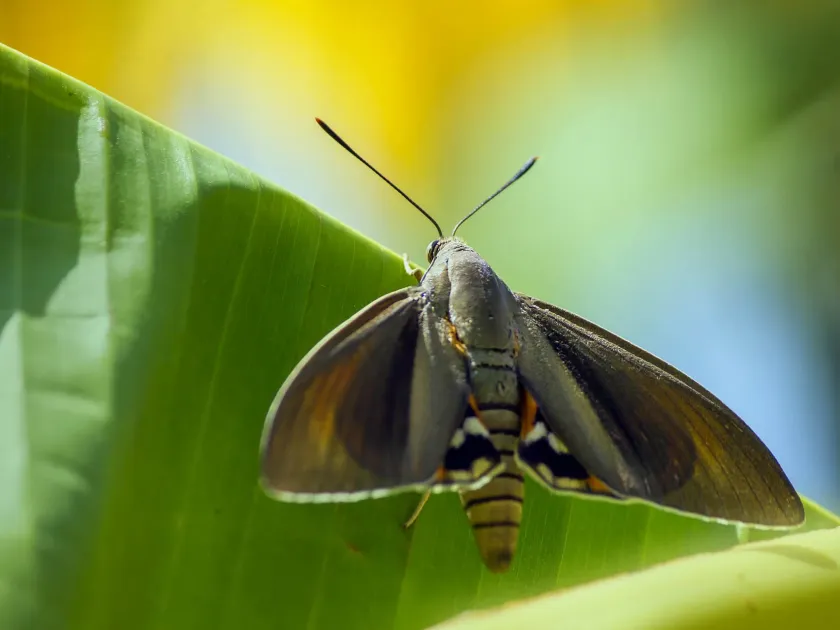
The giant palm borer (Castnia linus) is a large moth belonging to the Castniidae family, characterized by a wingspan that can reach up to 12 centimeters in width.
Unlike many other moths, it is often active during the day, displaying bright patterns on its hind wings that contrast with the more camouflaged forewings.
The larval stage, which acts as the main pest, is a thick, pale-colored caterpillar with a strong head capsule, perfectly adapted to boring through wood.
Adult moths feature a spindle-shaped body and clubbed antennae, which are typical morphological characteristics used to differentiate this species from other lepidopterans.
The life cycle is closely synchronized with the growth cycles of host palms, allowing the moth to complete its development under favorable tropical conditions.
What it damages
The pest primarily targets a wide range of palm species, including economically important crops like coconuts and dates, as well as various ornamental palms.
The larvae are internal feeders, tunneling into the stems and leaf stalks, which disrupts the transport of nutrients and water throughout the plant structure.
Chronic infestation results in stunted growth, leaf discoloration, and eventually the death of the crown if the apical meristem is severely damaged.
In landscaping, the damage is not only physiological but also structural, often leading to the collapse or disfigurement of valuable palm specimens.
The tunnels created by larvae provide ideal entry points for secondary pathogens, such as fungi and bacteria, which can accelerate the decline of the host plant.
Signs of infestation
One of the earliest indicators is the presence of frass (sawdust-like excrement) collecting at the base of the tree or at the junctions of leaf bases.
Yellowing and wilting of the fronds, particularly starting from the lower or middle sections of the canopy, suggest that internal damage is already significant.
The "collapse" of the central spear leaf is a critical diagnostic sign, indicating that the larvae have destroyed the plant's main growing point.
Physical inspection of the trunk may reveal entry holes or softened areas where the internal tissue has been extensively consumed by the developing larvae.
Adult moths can occasionally be observed resting on palm trunks during the day, which can be an indication of an active breeding population in the area.
Control measures
Management focuses on early detection and physical removal of infested plant material, which should be destroyed immediately to prevent further infestation.
Systemic insecticides, applied via trunk injection or root drenching, are often necessary to reach larvae protected deep inside the palm stem.
Pheromone traps are highly effective tools for monitoring adult moth populations, allowing growers to time their control interventions precisely.
Biological control strategies involving entomopathogenic nematodes have shown promise in laboratory and field trials as a targeted, environmentally friendly solution.
- Regular inspections of palm trunks for frass.
- Prompt disposal of infested palm debris.
- Use of registered systemic chemical treatments.
Taxonomy
- Latin name
- Castnia linus
- Order
- Lepidoptera (butterflies)
- Family
- Castniidae
- EPPO code
- CASTLH
Discussion
No discussions yet — be the first.