
Paysandisia archon
Paysandisia
Description
How to identify
Paysandisia archon, commonly known as the palm moth or palm borer, is a diurnal moth belonging to the family Castniidae, native to South America and invasive in Europe.
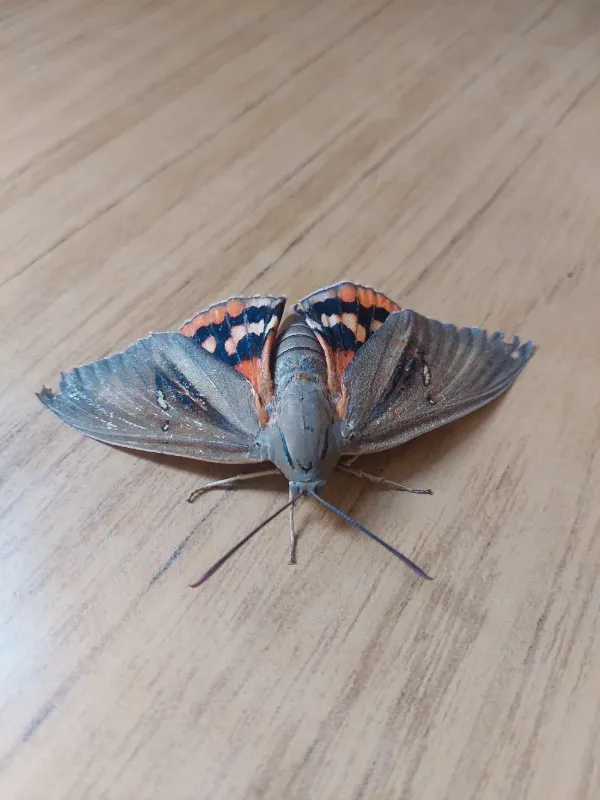
The adult moth is large, with a wingspan ranging from 8 to 11 centimeters. The forewings are brown with subtle markings, while the hindwings are bright red with distinctive black and white spots.
Despite being a moth, it is highly active during sunny hours, displaying a rapid and erratic flight pattern similar to that of a butterfly, often mistaken for a hawk-moth.
The larvae are stout, creamy white, and can reach lengths of up to 90 millimeters, characterized by a hardened, dark-brown head capsule used for tunneling.
Pupation occurs within the palm stem inside a robust, fibrous cocoon constructed from wood debris, which serves as a highly effective protective barrier.
What it damages
This pest exclusively targets palm species (Arecaceae). Popular ornamental species like Trachycarpus fortunei, Chamaerops humilis, and Phoenix canariensis are particularly susceptible.
The larvae are wood-boring and cause extensive damage by creating tunnels in the palm heart, trunk, and leaf bases, effectively disrupting the plant's vascular system.
Severe infestations lead to the death of the apical meristem (the growth point), causing the entire crown of the palm to collapse and the tree to die within a short period.
The tunnels also introduce opportunistic pathogens, leading to secondary bacterial or fungal infections that further accelerate the decline of the palm tree.
Due to the hidden nature of the larvae, damage is often detected only when the palm shows irreversible signs of stress, such as crown yellowing or sudden leaf drop.
When it appears
The flight period for adults typically begins in late spring and continues through the summer months, peaking during periods of high temperature and sunlight.
Females are prolific egg-layers, depositing eggs in crevices of the trunk or near the leaf bases using a telescopic ovipositor to insert them deep into the fibers.
The developmental cycle of the palm borer is long, generally spanning 1 to 2 years, influenced by regional climatic conditions and host availability.
Wintering occurs primarily in the larval stage, deep within the protective tissues of the palm stem, which provides insulation against cold temperatures.
The emergence of the next generation of adults happens in late spring, creating visible, oval-shaped exit holes on the surface of the trunk.
Signs of infestation
Visible frass (excrement) resembling sawdust or wood chips at the base of leaves is the most reliable indicator of an active larval infestation inside the stem.
Young, unopened leaves often display a series of symmetric holes, which indicate that the larva has chewed through the tightly folded leaf structure.
The wilting and premature drying of the spear leaf (the newest, central leaf) is a critical sign of severe damage to the plant's terminal growing point.
Distortion of the crown shape and localized patches of decaying wood are also common indicators of structural damage caused by heavy larval activity.
- Sawdust-like frass accumulation near leaf axils.
- Symmetrical holes across the width of emerging leaves.
- Sudden yellowing or collapse of the central spear leaf.
Control measures
Effective control requires a multi-pronged approach starting with regular inspections to identify the pest during the early stages of infestation.
Pheromone traps are essential for monitoring adult populations and can help reduce the number of breeding males in infested urban or nursery areas.
Systemic insecticides are the most common chemical solution, applied through crown drenching or stem injections to reach the larvae feeding internally.
Biological control methods, such as the application of entomopathogenic nematodes (Steinernema carpocapsae), are effective if applied directly into the larval tunnels.
In cases of irreversible damage, infested palms must be removed and incinerated to eliminate the reservoir of larvae and prevent further spread to healthy plants.
Taxonomy
- Latin name
- Paysandisia
- Order
- Lepidoptera (butterflies)
- Family
- Castniidae
- EPPO code
- PAYSSP
Discussion
No discussions yet — be the first.