
Paederus fuscipes
Paederus fuscipes
Description
How to identify
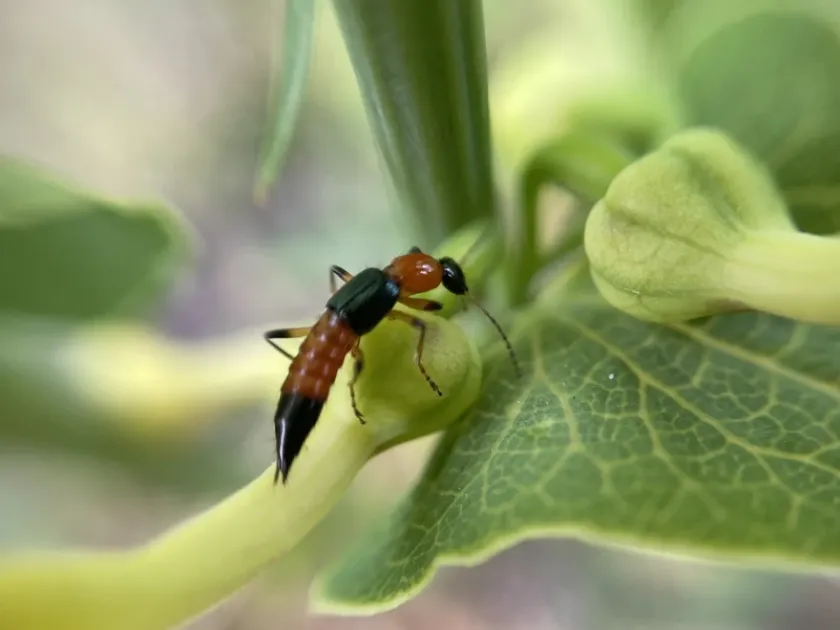
Paederus fuscipes is a species of rove beetle (family Staphylinidae). The adult beetle is easily identified by its striking coloration: the head and the posterior portion of the abdomen are black with a metallic blue sheen, while the pronotum and the base of the abdomen are bright orange.
The body is slender and elongated, measuring about 7–10 mm in length. Although they have well-developed wings and are capable of flight, they spend much of their time on the ground, moving rapidly through plant debris and moist soil surfaces.
The larvae are similar in appearance to the adults but lack wings and have softer, less pigmented bodies. They are highly mobile and thrive in moist environments, often hiding in the upper layers of the soil or near the plant base.
The life cycle consists of four stages: egg, three larval instars, pupa, and adult. The duration of each stage is highly dependent on environmental factors, particularly temperature and humidity, with multiple generations possible per year.
It is crucial to note that these beetles contain pederin, a potent blistering agent. Crushing the beetle on human skin can cause severe dermatitis and skin lesions, necessitating caution when handling or monitoring these insects.
What it damages
The primary concern regarding Paederus fuscipes is its impact on rice cultivation. While adults are essentially predators, they can become phytophagous when populations spike, causing damage to seedlings and young leaves, which impairs plant development.
Direct damage occurs when beetles feed on plant tissues, leading to lesions that can stunt plant growth. Furthermore, these beetles can act as vectors for various plant pathogens, introducing infections into the crop through their feeding punctures.
In addition to rice, they are found in fields of other cereal and leguminous crops. They tend to aggregate in areas with dense vegetation that retains high humidity, which is their preferred microclimate for both feeding and reproduction.
The damage to the crop is often secondary, as the weakened plant becomes more susceptible to bacterial and fungal infections. In high-density populations, the cumulative effect of beetle feeding can significantly reduce crop yield.
In agricultural settings, the economic threshold is reached when the beetle density poses a risk of widespread plant tissue damage or when the vector activity threatens the overall health of the field.
When it appears
The activity of Paederus fuscipes is strictly regulated by environmental conditions. They become most active during periods of high humidity and warm temperatures, typically following rainy spells or intensive irrigation cycles.
Adults overwinter in protected sites such as leaf litter, soil crevices, or under stones. As temperatures rise in the spring, they emerge to search for suitable mating sites and moisture, often recolonizing agricultural fields early in the season.
Peak populations usually coincide with the vegetative stage of crops like rice. During this time, the lush canopy provides the humidity required for survival, leading to a surge in the number of generations.
As the season progresses toward autumn, beetle activity gradually decreases. They start seeking overwintering shelters to survive the colder months, moving away from the fields toward more stable, protected environments.
Monitoring programs often use light traps to track beetle presence, as Paederus fuscipes is strongly attracted to light sources at night. This provides growers with early warning signals of rising population levels.
Control measures
Management of Paederus fuscipes focuses on integrated pest management (IPM) practices. Cultural control is the most effective approach, particularly through the removal of crop residues and field debris, which are essential overwintering habitats.
Water management plays a critical role in rice paddies. By optimizing irrigation schedules and avoiding excessive soil saturation, farmers can disrupt the moist environment necessary for the development of the beetle's larval stages.
Chemical control should be applied only when the economic threshold is exceeded. Selective insecticides are preferred to manage adult populations while attempting to preserve natural predators that keep the beetle count in check.
Enhancing field biodiversity by supporting natural enemies like birds and other insect predators helps maintain a balanced ecosystem, effectively reducing the need for intensive chemical applications.
- Conduct deep plowing to destroy overwintering sites.
- Utilize light traps to reduce the density of adult beetles.
- Improve field drainage to reduce the humidity levels that favor larval development.
Taxonomy
- Latin name
- Paederus fuscipes
- Order
- Coleoptera (beetles)
- Family
- Staphylinidae
- EPPO code
- PAEDFU
Discussion
No discussions yet — be the first.