
Paederus alfierii
Paederus alfierii
Description
How to identify
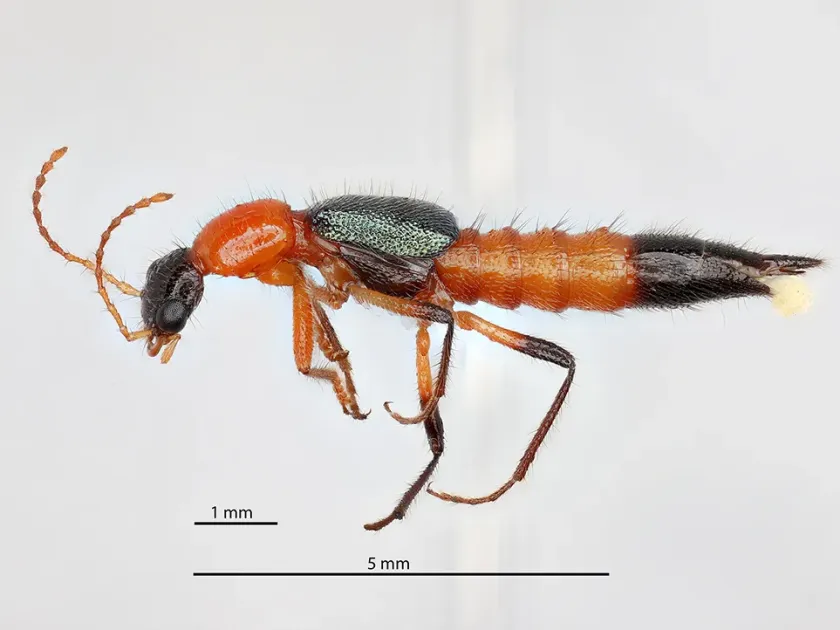
Paederus alfierii belongs to the Staphylinidae family within the Coleoptera order. These are small, slender beetles characterized by a distinct, vivid orange or red pronotum and elytra, contrasted by a black head and abdomen with a metallic sheen.
Adult beetles typically reach 7–10 mm in length. Their bodies are elongated and cylindrical, featuring shortened elytra that conceal well-developed wings, enabling active movement in search of food sources.
The larvae lead a cryptic lifestyle and resemble small, segmented caterpillars. They are highly mobile and are commonly found dwelling in soil layers or on the surface of dense vegetation.
A defining trait of the Paederus genus is the presence of the potent toxin paederin in their hemolymph. This organic compound causes severe dermatitis in humans upon contact with the beetle, making them a hazard for agricultural workers.
These beetles prefer humid environments and tend to congregate near riverbanks, irrigated fields, and areas with standing water, where conditions are optimal for their development.
What it damages
While many staphylinids act as beneficial predators, Paederus alfierii can become a pest in agroecosystems, causing damage to tender plant tissues when population density becomes high.
Significant damage is typically observed in vegetable and industrial crops under high humidity. Beetles may consume young foliage and damage growth points, resulting in stunted plant development.
The harm is often compounded by the difficulty of performing manual labor in infested fields due to the insects' toxicity, which necessitates strict safety precautions during cultivation.
Increased damage levels are most frequently recorded in greenhouses and irrigated parcels, where the microclimate facilitates rapid population outbreaks.
Symptoms of damage include leaf deformation and the appearance of necrotic spots, which develop at the sites where the beetle’s mandibles have injured the plant tissue.
When it appears
The activity of Paederus alfierii is heavily influenced by temperature and moisture levels. In southern regions, mass flight is observed from late spring through early autumn.
Population peaks usually occur following heavy rainfall or intensive irrigation, as the soil moisture provides the necessary conditions for larval growth and development.
During hot and dry spells, the beetles retreat to the lower levels of vegetation or burrow into the soil mulch to survive until favorable conditions return.
The life cycle encompasses an egg stage, three larval instars, a pupal stage, and the adult phase. In warm climates, the species is capable of producing multiple generations per season.
Adults overwinter in the soil, under plant debris, or within earth cracks, which provide sufficient protection against extremely low winter temperatures.
Control measures
The primary control strategy is agrotechnical: managing irrigation schedules to avoid soil waterlogging, which significantly reduces the attractiveness of the area to these beetles.
Timely weed management in crop rows and field margins is essential, as these areas serve as primary breeding grounds and refuges for the population.
The use of insecticides requires careful consideration, as this species often exhibits high resistance, making contact-based chemical treatments difficult to implement effectively.
Biological control methods are recommended, including the conservation and introduction of natural enemies such as predatory mites and entomopathogenic fungi.
Field staff must be strictly trained in safety protocols, including the use of appropriate protective gear, to minimize the risk of skin contact with the beetles' toxic hemolymph.
Taxonomy
- Latin name
- Paederus alfierii
- Order
- Coleoptera (beetles)
- Family
- Staphylinidae
- EPPO code
- PAEDAL
Discussion
No discussions yet — be the first.