
Paederus rove beetle
Paederus
Description
How to identify
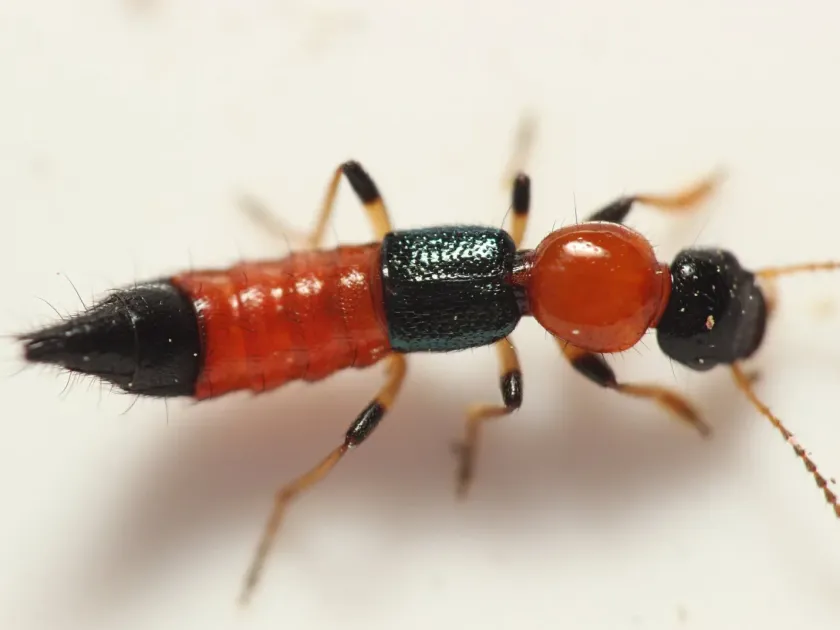
The Paederus rove beetle (genus Paederus) belongs to the family Staphylinidae, order Coleoptera. These are small predatory beetles characterized by their vivid coloration, usually a striking combination of blue, black, and orange-red.
Adults have an elongated body, typically measuring between 7 and 10 mm. The head, elytra, and the tip of the abdomen are often dark blue or black with a metallic sheen, while the pronotum and part of the abdomen remain bright red.
These beetles are cryptic, preferring moist habitats, the edges of water bodies, dense vegetation, and leaf litter. They are active runners and are frequently found on the soil surface near crop fields.
Their life cycle involves complete metamorphosis: egg, larva, pupa, and adult. Females lay eggs in moist soil, and the larvae are also predators that undergo several developmental stages.
It is crucial to note that the primary biological trait of this genus is the presence of pederin, a toxic substance in their hemolymph that causes severe dermatitis in humans upon contact, although the beetle itself is considered a beneficial predator rather than a crop pest.
What it damages
Although adult Paederus beetles are primarily predators that feed on smaller insects, their presence in crops is concerning due to the concentration of toxins.
Damage to crops stems from physical contact during massive aggregations, as well as potential contamination of produce with their hemolymph containing pederin.
They are found in crops such as cereals, vegetables, and technical plants, particularly when there is a high abundance of aphids or other small invertebrates that serve as their prey.
Indirect damage arises from the complexity of implementing control measures, which must be carefully managed to prevent exposing field workers to the beetle's toxins.
During outbreaks, these beetles can hinder agricultural operations, making manual labor in the fields hazardous without adequate personal protective equipment.
When it appears
The activity of the Paederus rove beetle is directly linked to humidity and ambient temperature, with peak activity occurring during the warmer months.
Mass appearance is typically observed in the second half of summer, particularly after periods of heavy rainfall, which create favorable breeding conditions.
In the evenings and at night, adults are highly active and are often attracted to artificial light sources, leading to aggregations near farm buildings.
They overwinter as adults in the soil, under plant debris, or in soil cracks, resuming activity in the spring when temperatures remain consistently high.
Population dynamics correlate closely with moisture levels in the plant root zone and the availability of small soil-dwelling arthropods as a food source.
Control measures
The primary control strategy involves maintaining sound agronomic practices, such as preventing excessive soil moisture and removing plant debris that provides shelter for the beetles.
The use of insecticides is only justified when population numbers exceed critical thresholds, as these beetles are largely beneficial as natural enemies of other crop pests.
When working in fields where Paederus is present, personnel must wear protective clothing and gloves to avoid contact with the pederin toxin.
Inter-row cultivation is an effective method that disrupts wintering sites and larval development while promoting the drying of the topsoil layer.
- Ensure optimal drainage in the fields.
- Remove harvest residues promptly.
- Use light traps away from work zones.
- Apply targeted biological agents to avoid harming beneficial entomofauna.
Taxonomy
- Latin name
- Paederus
- Order
- Coleoptera (beetles)
- Family
- Staphylinidae
- EPPO code
- PAEDSP
Discussion
No discussions yet — be the first.