
Plume moth
Oxyptilus
Description
How to identify
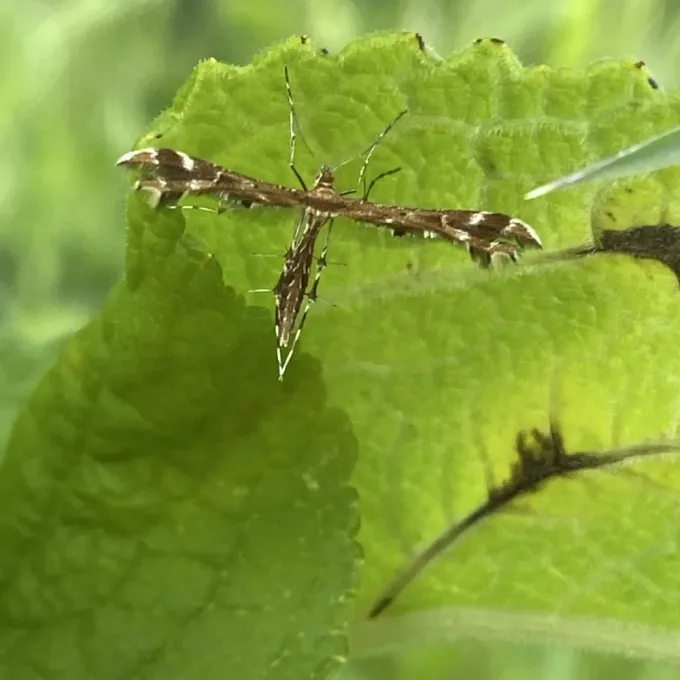
Plume moths (family Pterophoridae) are small nocturnal moths identified by their unique wing structure. The forewings are typically split into two lobes, and the hindwings into three, resembling bird feathers.
When at rest, these insects fold their wings tightly against their bodies, making them nearly invisible on plant stems, where they mimic dry grass or debris.
The body is thin and elongated, featuring long "spurs" on the legs characteristic of this family. The wingspan for most species of the genus Oxyptilus ranges from 15 to 25 millimeters.
The larvae are cylindrical and covered in short hairs. Their color varies from pale green to reddish, which provides excellent camouflage among the tissues of the host plant.
Systematically, the genus Oxyptilus belongs to the order Lepidoptera. They undergo a complete metamorphosis, including egg, larva, pupa, and adult stages.
What it damages
These pests favor plants from the Asteraceae and Geraniaceae families. They are frequently found in agricultural settings, particularly on medicinal herbs and ornamental crops.
The larvae specialize in feeding on the reproductive organs of plants. They bore into buds, flowers, and young ovaries, consuming the contents and preventing the plant from developing properly.
During mass outbreaks, the pest can destroy a significant portion of the inflorescences, leading to total loss of seed yield or the ornamental value of the plants.
Some species also target leaves, skeletonizing them or pulling them into loose "nests" held together by silk. These shelters protect the larvae from adverse weather and natural predators.
Damaged plant parts wilt rapidly, become deformed, and accumulate larval frass, which creates an environment conducive to fungal and bacterial infections.
When it appears
The flight of adult moths usually occurs during the summer, from June to August, when mating and egg-laying on host plants take place.
The life cycle of a single generation takes 4 to 6 weeks, depending on temperature. In warmer climates, the pest can produce up to two generations per growing season.
Insects typically overwinter as late-stage larvae or pupae in plant litter, dry stems, or under tree bark near feeding sites.
In early spring, when the weather stabilizes, overwintered larvae become active and begin feeding on young shoots while preparing for pupation.
Pupation generally occurs in the open—on stems or the underside of leaves—where the pupa is secured by a silken girdle.
Signs of infestation
The primary sign of infestation is the presence of holes in flower buds and premature wilting of inflorescences that appear hollow upon inspection.
The presence of silk threads on shoot tips indicates that a larva has constructed a feeding or pupation site in the area.
Frass in the form of small dark granules on leaves and flowers is a clear symptom of larval activity inside the buds or blooms.
Deformed flowers, failure to open, or partially eaten petals also point to a plume moth infestation.
During dusk, one might notice a characteristic erratic flight pattern of moths over the bushes, signaling the need for monitoring and potential intervention.
Control measures
Agricultural practices include regular weeding to remove host reservoirs and autumn soil tillage to destroy overwintering stages.
Biological control involves using products based on Bacillus thuringiensis, which effectively target young larval stages.
Chemical control is justified during high population density and includes applying systemic and contact insecticides during the larval hatching period.
Pheromone traps are useful for tracking the flight dynamics of the adults, allowing for precision treatments when the insects are most vulnerable.
It is essential to prune and destroy heavily infested inflorescences promptly to prevent larvae from migrating to neighboring healthy plants.
Taxonomy
- Latin name
- Oxyptilus
- Order
- Lepidoptera (butterflies)
- Family
- Pterophoridae
- EPPO code
- OXYPSP
Discussion
No discussions yet — be the first.