
Collared scops owl
Otus bakkamoena
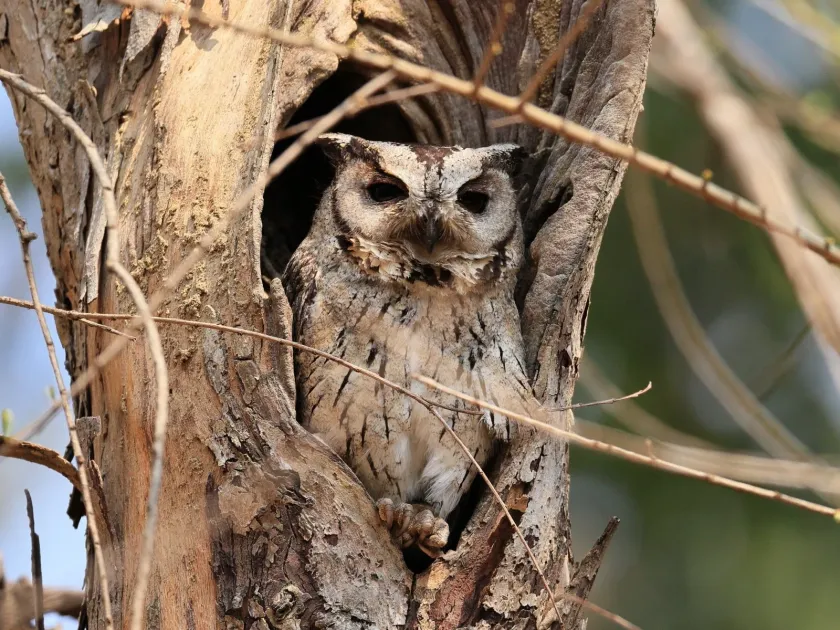
Description
How to identify
The collared scops owl (Otus bakkamoena) is a small species of bird of prey belonging to the order Strigiformes and the family Strigidae. It is easily recognized by its distinct ear tufts and a prominent facial disk.
The plumage is typically grayish-brown with subtle patterns, providing excellent camouflage against tree bark. An adult owl generally measures between 23 and 25 centimeters in height and weighs up to 200 grams.
A key identifying feature is the dark collar or band on the back of the neck, which distinguishes this species from other small owls. Their eyes are usually brown or yellowish, set within a well-defined facial structure.
While often confused by laypeople due to their nocturnal habits, they are highly beneficial to agricultural ecosystems and should not be considered pests.
These owls are primarily nocturnal hunters, which allows them to effectively target prey that is active during the nighttime, including various small rodents.
What it damages
The collared scops owl causes absolutely no damage to agricultural crops. They are not granivorous and do not consume any plant matter, nor do they harm fruits or vegetables.
On the contrary, they are considered valuable allies for farmers. By predating on small rodents, they significantly reduce the damage caused to crop roots, stems, and stored grains.
Their diet also includes large insects, such as beetles and locusts, which often pose a threat to various crops during the growing season.
The presence of these owls contributes to natural pest management, helping to maintain ecological balance and reducing the need for chemical rodenticides.
In conclusion, treating this bird as a pest is scientifically incorrect; it acts as an essential biological agent that supports crop health and sustainability.
When it appears
The collared scops owl is a resident species, meaning it stays in its habitat throughout the entire year. Breeding activity is most intense during the spring and summer months.
During the winter, they tend to remain near sheltered areas like windbreaks or hedgerows, where they can continue to hunt despite colder temperatures.
Their activity patterns are strictly nocturnal, with most hunting taking place from dusk until dawn, coinciding with the peak activity periods of common agricultural pests.
Changes in weather between seasons do not cause these birds to migrate, as they are well-adapted to the local environment and the year-round availability of prey.
Continuous presence on the farm ensures ongoing pressure on pest populations, providing long-term benefits to the agricultural environment.
Signs of infestation
The most common sign of their presence is the rhythmic, repetitive hooting sound made during the night, which is often the first indicator that a pair is nesting nearby.
Pellets — small, compressed masses of indigestible fur and insect remains — can often be found at the base of trees where the owls frequently roost during the day.
Direct daytime observation is difficult due to their exceptional camouflage, but they may occasionally be glimpsed in shadows or thick foliage.
A noticeable decrease in rodent burrow activity on a farm can often be attributed to the successful hunting of predators like the collared scops owl.
Identifying the birds in natural cavities or tree hollows provides proof of their residence and confirms that the local habitat is healthy and supporting predators.
Control measures
No control measures against the collared scops owl are necessary, as they are beneficial birds. Efforts should instead focus on conservation and attracting them to the area.
- Preserve mature trees with natural cavities to provide nesting sites for the owls.
- Avoid the use of dangerous rodenticides that can cause secondary poisoning to birds of prey.
- Install owl nesting boxes in areas where natural tree cavities are scarce.
- Maintain hedgerows and forest strips to support the natural habitat of these predators.
- Adopt integrated pest management (IPM) strategies that prioritize the preservation of beneficial wildlife.
Taxonomy
- Latin name
- Otus bakkamoena
- Family
- Strigidae
- EPPO code
- OTUSBA
Discussion
No discussions yet — be the first.