
Horned Mason Bee
Osmia cornuta
Description
How to identify
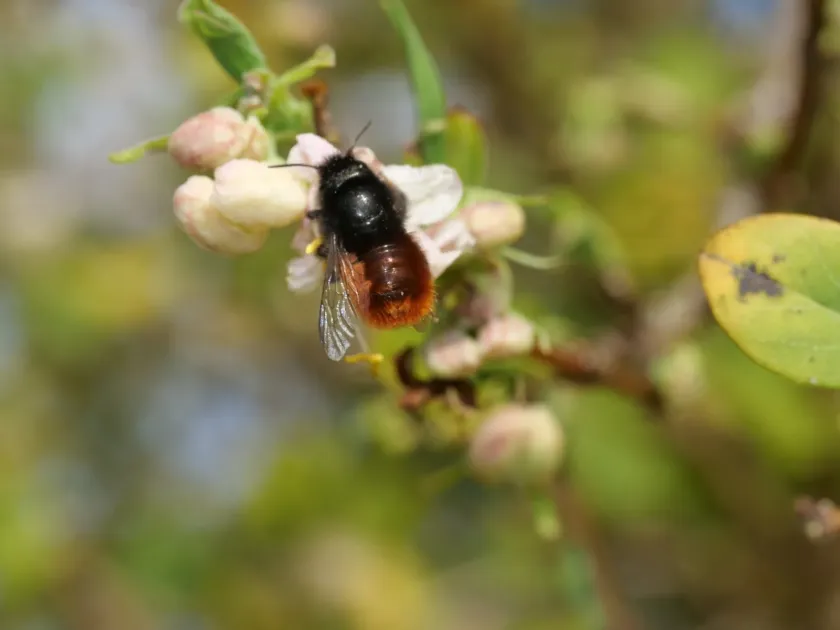
The Horned Mason Bee (Osmia cornuta) is a solitary bee species within the Megachilidae family. It is easily identified by its vibrant ginger-colored abdomen and dark, dense hairs on the thorax, which give it a robust, fuzzy appearance.
The species gets its name from two horn-like protrusions located on the female's head. These appendages are used during nest building, specifically for manipulating the mud used to seal individual brood cells.
These bees emerge quite early in the spring, often as soon as temperatures hit the 12-14 degree Celsius mark. Their early start makes them vital for pollinating fruit trees that blossom while other bees remain dormant.
The life cycle of the Horned Mason Bee is rapid and synchronized with the early spring bloom. After mating, females spend their brief adult lives securing nesting sites and provisioning cells with pollen.
Nesting behavior involves finding existing cavities, such as hollow reeds, bamboo stalks, or natural holes in dead wood. Once a site is chosen, the female creates a series of mud-walled chambers for her larvae.
What it damages
It is crucial to clarify that the Horned Mason Bee is not a plant pest. In modern agronomy, it is classified as a highly beneficial pollinator, instrumental in boosting the productivity of various orchard crops.
Misconceptions regarding their status as pests usually stem from their habit of nesting in human-made structures or hollow woody plants. However, this activity is purely architectural and does not damage the plant's health.
These bees do not feed on foliage, stems, or fruit, nor do they spread plant diseases. Their impact on agricultural systems is entirely positive, as they facilitate the cross-pollination necessary for successful fruit sets.
Commercial orchardists often deploy nesting blocks to increase the density of these bees. This practice is standard for enhancing yield quality in crops like cherries, almonds, apricots, and plums.
There is no economic damage associated with this insect species. The energy invested by the bee in building its nest does not reduce the yield or vegetative vigor of the surrounding crops.
Control measures
Since the Horned Mason Bee is a beneficial insect, no control measures are required. Farmers are encouraged to promote their presence as a natural and cost-effective method to improve crop yield.
If nest building in specific buildings or wood frames is undesirable, the simplest control measure is to seal all gaps, holes, and cracks with caulk or paint. This prevents the bees from establishing their nests in those locations.
The use of insecticides in the orchard during the bloom season is strongly discouraged. Pesticide applications can decimate local populations of these bees, leading to significantly lower pollination rates and reduced harvests.
To discourage excessive nesting in sensitive areas, remove artificial nesting materials such as reed bundles or cardboard tubes at the end of the season. This limits the available sites for next year's generation.
Managing the Horned Mason Bee effectively involves integrating it into the farm’s biodiversity strategy. By protecting their nesting sites and avoiding harmful chemicals, growers can enjoy the full pollination potential of this species.
Taxonomy
- Latin name
- Osmia cornuta
- Order
- Hymenoptera
- Family
- Megachilidae
- EPPO code
- OSMACO
Discussion
No discussions yet — be the first.