
Leafcutter bee
Megachile
Description
How to identify
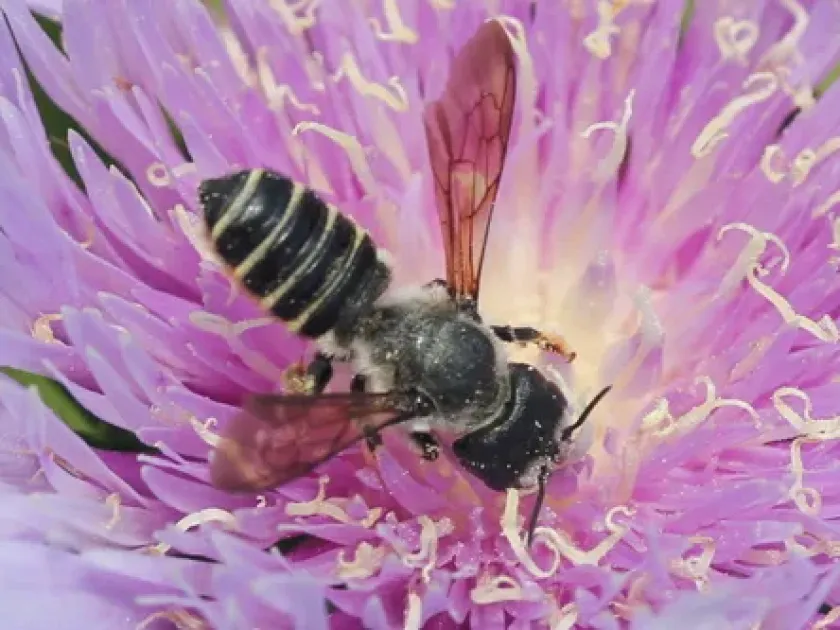
The leafcutter bee (genus Megachile) is a solitary insect that is generally robust in build, with a dense covering of hair on its body, particularly on the underside of the abdomen.
Unlike honey bees, leafcutter bees do not live in large colonies with a queen; instead, each female is responsible for building her own individual nest.
They are famous for their unique nesting habit: they cut neat circular or oval pieces of leaves to construct thimble-shaped cells for their larvae.
Adult bees are typically 8-15 mm in length and often exhibit distinct transverse bands on their abdomens, which are visible when they are foraging for pollen or nesting material.
Though they possess stingers, they are remarkably non-aggressive and will rarely sting unless handled roughly, making them generally safe to have in the garden environment.
What it damages
Leafcutter bees target a wide range of broad-leaved plants, favoring those with flexible, nutrient-rich leaves that are easy to cut without tearing.
Roses, lilac bushes, wisteria, and certain legumes are among the most frequently attacked plants in residential and commercial landscapes.
The damage is strictly mechanical: the bees remove portions of the leaf blade, which can reduce the total photosynthetic area of the plant if the infestation is severe.
In most garden settings, the damage is primarily cosmetic and rarely threatens the overall health or survival of well-established shrubs and trees.
However, for young nursery stock or prize-winning rose bushes, the aesthetic impact can be significant, prompting growers to seek ways to deter the bees.
When it appears
Leafcutter bees are most active during the warmer months, typically from late spring through mid-summer, depending on the local climate and temperature.
The adults emerge from their dormant state when spring temperatures consistently support foraging, and they work rapidly to establish nests for the new generation.
They follow a univoltine life cycle, meaning there is only one generation per year, so the period of active leaf-cutting is limited to several weeks or months.
During the fall and winter, the bees remain as developing larvae within their protected, leaf-lined cells, safe from the elements until the cycle restarts next spring.
Longer, warmer summers may allow for a slightly longer period of activity, but they generally cease foraging once temperatures drop significantly in the late summer.
Signs of infestation
The most telltale sign of a leafcutter bee infestation is the presence of perfectly circular or oval notches cut from the edges of leaves.
These cuts have clean, smooth edges, distinguishing them from the ragged, irregular damage caused by caterpillars, beetles, or slugs.
If you observe the plant closely, you might find the nest itself, which looks like a cigar-shaped roll of leaf fragments tucked into a hollow stem or crevice.
Large quantities of missing leaf sections on a single shrub, such as a rose bush, indicate that the bees have found a preferred source of nesting material.
Because they are efficient workers, a small number of bees can cause noticeable cosmetic damage to a plant in a very short period of time.
Control measures
Because leafcutter bees are highly effective pollinators and are generally not destructive enough to kill plants, lethal control methods are strongly discouraged.
- Cover sensitive or high-value plants with light netting or mesh during the peak period of bee activity to prevent access to the leaves.
- Provide alternative nesting habitats nearby to encourage the bees to build their nests away from your most prized ornamental plants.
- Seal hollow stems or holes in wood near sensitive areas to reduce the number of available nesting sites for the bees.
- Apply homemade repellents like garlic or chili sprays, which may deter bees from selecting specific leaves for their nesting material.
- Maintain plant health through appropriate irrigation and soil nutrition, enabling the plants to withstand minor leaf loss without losing vigor.
Taxonomy
- Latin name
- Megachile
- Order
- Hymenoptera
- Family
- Megachilidae
- EPPO code
- MEGCSP
Discussion
No discussions yet — be the first.