
Mason bee
Chalicodoma muraria
Description
How to identify
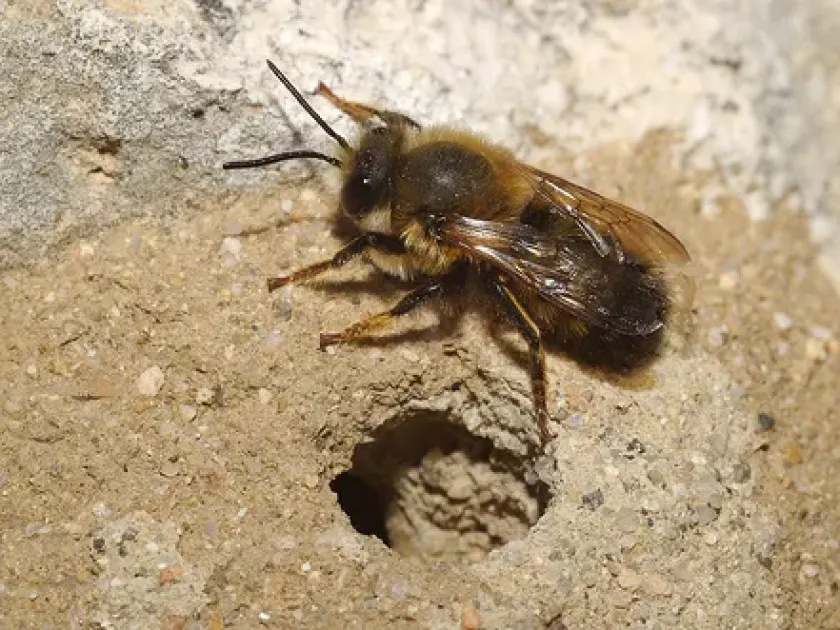
The mason bee (scientific name: Chalicodoma muraria) is a solitary insect belonging to the Megachilidae family. Measuring approximately 12–15 mm, these bees are known for their robust, hairy bodies that often appear dark or metallic.
These bees do not live in hives. Instead, the female builds individual nests, typically using a mixture of soil, sand, and saliva to create durable, stone-like compartments where she lays her eggs.
Unlike honey bees, mason bees are generally non-aggressive towards humans and pets, as they lack the instinct to defend a large colony or queen.
Their life cycle is highly synchronized with the spring flowering season, as they need to secure food sources for their larvae immediately after emerging from hibernation.
The larvae overwinter in a prepupal state inside their hardened clay cells, emerging as adults when temperatures consistently rise in the spring.
What it damages
The primary concern regarding mason bees in agriculture is not the consumption of leaves, but the physical structural damage they cause while creating nest sites.
Females may excavate hollow stems or chew through tender plant tissue to establish their nests, which can weaken the integrity of the plant or lead to branch dieback.
The collection of mud and nesting materials from leaf surfaces often results in mechanical damage to the foliage, disrupting the plant's natural photosynthesis process.
In nurseries or areas with young saplings, the bees' tendency to nest in small stems can lead to the obstruction of nutrient transport, causing the shoot to wither or break.
Although they are beneficial pollinators, their nesting habits can become problematic when they choose to build on or inside valuable ornamental plants or young fruit trees.
Signs of infestation
The most distinctive sign of mason bee activity is the presence of clay-like, rock-hard pellets on walls, fence posts, or the stems of woody plants.
If you observe small, circular holes in plant stems plugged with mud or grit, it indicates that a mason bee has occupied that space to raise its brood.
Surface scarring on leaves, where the plant's epidermis has been scraped away for building material, is a common indicator that bees are active nearby.
During warm spring days, observing buzzing activity around crevices or plant stems confirms the presence of nesting mothers gathering resources.
Physical breakage or sudden wilting of specific branches often reveals the location of these concealed nests, which may be blocking internal vascular pathways.
Control measures
Mechanical removal of the clay nests is the most sustainable approach. Clearing these structures during the winter months prevents the next generation from emerging in the garden.
Using protective netting or physical barriers around delicate young stems can effectively prevent bees from selecting those plants as nesting sites.
Chemical control should be avoided whenever possible, as mason bees are highly efficient and beneficial pollinators for many fruit-bearing crops.
Promoting plant health through regular pruning and adequate hydration ensures that the plant can better recover from any minor mechanical stress caused by bees.
Provide "trap nests" or designated areas with suitable mud sources away from sensitive crops to encourage the bees to build their nests in controlled, non-damaging locations.
Taxonomy
- Latin name
- Chalicodoma muraria
- Order
- Hymenoptera
- Family
- Megachilidae
- EPPO code
- CHCDMU
Discussion
No discussions yet — be the first.