
European wool carder bee
Anthidium florentinum
Description
How to identify
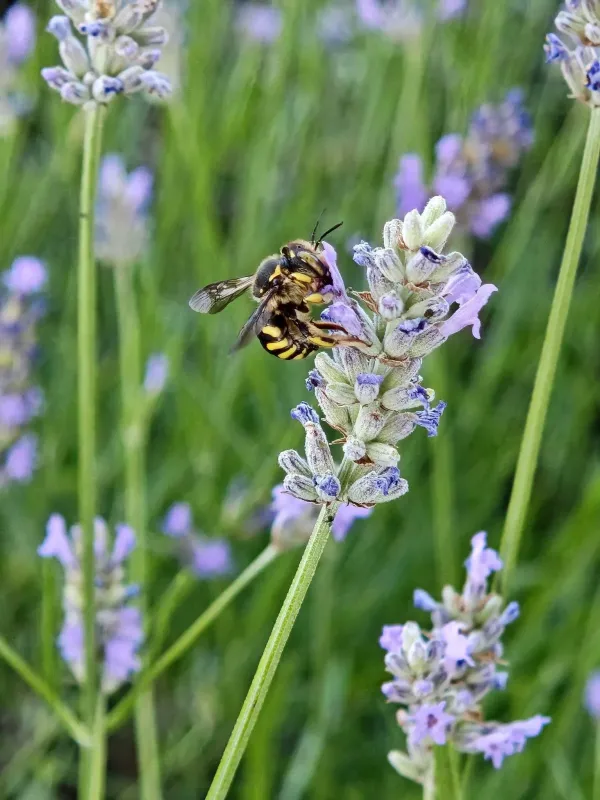
The European wool carder bee (Anthidium florentinum) belongs to the Megachilidae family, order Hymenoptera. It is a solitary bee that resembles a wasp due to its distinctive yellow-and-black abdominal pattern.
Females are biologically adapted to harvest plant hairs (trichomes) from woolly or pubescent plants, which they use as nesting material for their brood cells in cavities.
Unlike honey bees, these insects are solitary and do not maintain a colony or hive, yet their continuous foraging for "wool" creates significant aesthetic and physical stress for garden plants.
Males are well-known for their territorial nature, vigorously defending patches of flowers from other insects, which makes them highly visible during the peak of summer.
It is often mistaken for a harmless pollinator because it visits flowers for nectar, while its damaging activities usually go unnoticed until visible leaf destruction appears.
What it damages
The primary targets for this bee are plants with dense, soft pubescence on their leaves and stems, which provide the essential materials for their nest construction.
Commonly affected garden species include Stachys byzantina (lamb's ear), various Salvia species, Lavandula, and certain rose varieties that possess fine hairs on their foliage.
While the bee does not consume the plant tissues, the act of forcefully stripping the epidermal hairs causes mechanical damage and impairs the plant's physiological functions.
Damaged leaves often exhibit stunted growth, edge necrosis, and deformation, significantly reducing the visual appeal and overall vigor of ornamental plants.
In nurseries or high-value landscapes, repeated damage can render plants unsellable or lead to the slow decline of decorative perennial beds.
Signs of infestation
The hallmark sign of infestation is the appearance of semi-circular or irregular bare patches on pubescent leaves, where the hair has been completely scraped away.
Affected leaves appear tattered, with distinct "bald" spots that turn brown or necrotize over time, giving the foliage a distressed and unsightly appearance.
You may also observe longitudinal scarring on stems or petioles where the bee has been actively collecting hair for its nest lining.
During warm, sunny hours, one can observe the female bee working on the leaf surface, moving rapidly and making a characteristic buzzing sound as she harvests the fibers.
The presence of these specific hairless areas on otherwise fuzzy plants is a definitive indicator of Anthidium florentinum activity in your garden area.
Control measures
Managing the European wool carder bee involves non-chemical approaches, as there are no targeted pesticides specifically intended for this solitary bee species.
Strategic planting is recommended: placing "trap plants" (highly attractive woolly species) in corners of the garden can divert the bees away from your prized ornamental displays.
Physical barriers such as fine netting or protective covers are effective for shielding young, vulnerable plants during the peak flight season in late spring and summer.
Reducing suitable nesting sites, such as filling deep cracks in old wooden fences, removing hollow stems, or sealing holes in masonry, can decrease the local population.
Chemical insecticides should be strictly avoided to prevent the accidental killing of essential pollinators, as the damage from this bee is primarily cosmetic rather than systemic.
Taxonomy
- Latin name
- Anthidium florentinum
- Order
- Hymenoptera
- Family
- Megachilidae
- EPPO code
- ANTDFL
Discussion
No discussions yet — be the first.