
Wool carder bee
Anthidium
Description
How to identify
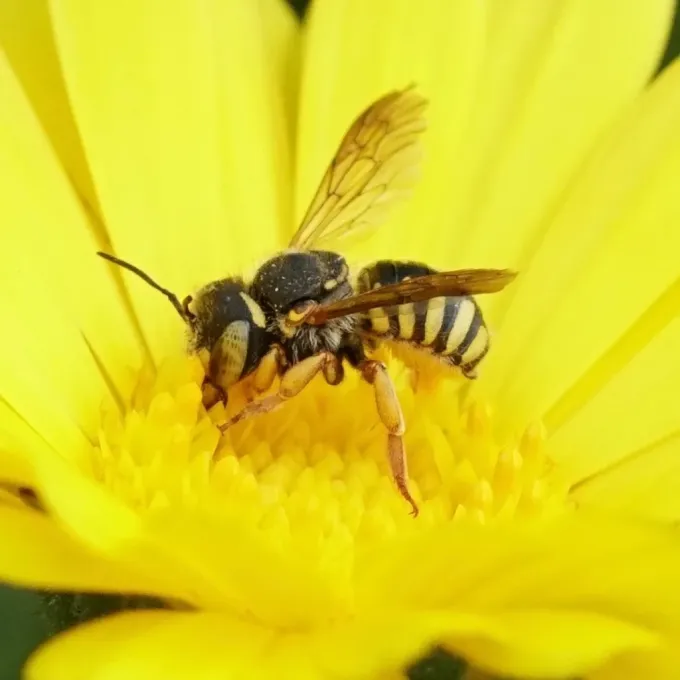
The wool carder bee (genus Anthidium) is a member of the Megachilidae family. These solitary bees are often mistaken for wasps due to their distinctive yellow and black abdominal markings.
Males are generally larger than females and are known for their territorial behavior, often patrolling specific patches of flowers to ward off other insects.
They are easily identified by their unique behavior of scraping trichomes (hairs) from fuzzy plants, which they use to line their nest cells.
Unlike social honey bees, these bees do not live in colonies; each female is responsible for constructing and provisioning her own individual nest.
Their bodies are covered in dense hair, which helps them collect and carry the plant fibers necessary for building protective cocoons for their larvae.
What it damages
The damage to plants occurs when the female bee uses her mandibles to scrape off the epidermal layer and hairs from the leaves of various plants.
Plants with fuzzy or pubescent leaves, such as Stachys byzantina, lavender, sage, roses, and various geraniums, are the most frequent targets.
This feeding behavior results in ragged, jagged leaf edges or bald patches that significantly mar the appearance of ornamental plants in gardens and nurseries.
While the actual physiological damage to the plant is usually minimal, the aesthetic impact can be severe enough to make plants unsuitable for sale.
It is important to note that the damage is strictly caused by the need for nesting material, not by direct consumption of leaf tissue as food.
When it appears
Wool carder bees are most active during the late spring and summer months when floral resources are abundant and plant growth is vigorous.
The life cycle begins when the female identifies a suitable nesting site, such as a hollow stem, a crack in wood, or a natural cavity.
Throughout the season, the female makes several nesting trips, carefully gathering plant fuzz and packing it into the chosen cavity to create several larval cells.
Inside these cells, the larvae hatch, consume the provided pollen and nectar provisions, and eventually pupate before the onset of colder weather.
The bees overwinter as prepupae or adults, emerging the following spring to restart the cycle, which is synchronized with the blooming period of their host plants.
Signs of infestation
The primary sign of a wool carder bee infestation is the presence of irregular, notched, or "shaved" edges on the leaves of plants with noticeable hairs.
Observation of the plants during the day often reveals the bees in action, as they hold the gathered plant fibers in a small ball underneath their thorax.
Small, neatly plugged holes in stems or wooden structures near the affected plants are clear indicators of nesting activity by these insects.
The lack of common insect excrement or large-scale leaf skeletonization helps distinguish the damage from that caused by caterpillars or beetles.
The damage is typically localized, appearing more frequently on specific plants that are highly attractive to the bees for their nesting materials.
Control measures
Because wool carder bees are efficient pollinators, extensive control measures are rarely recommended, and the use of harsh insecticides should be avoided.
For ornamental gardens, the most effective strategy is to choose plant varieties with smooth leaves, which are not targeted by these bees.
Physical protection, such as using horticultural fleece or fine netting during the peak period of bee activity, can successfully prevent damage to young plants.
- Removing dry, hollow stems near gardens to limit available nesting sites.
- Providing alternative, less valuable fuzzy plants to act as a distraction for the bees.
- Using manual harvesting or organic repellents if the aesthetic damage becomes unbearable.
Ultimately, a balance should be maintained to benefit from their pollination services while protecting the most sensitive ornamental species in the garden.
Taxonomy
- Latin name
- Anthidium
- Order
- Hymenoptera
- Family
- Megachilidae
- EPPO code
- ANTDSP
Discussion
No discussions yet — be the first.