
Horn-faced bee
Osmia cornifrons
Description
How to identify
The horn-faced bee, known scientifically as Osmia cornifrons, is a solitary bee belonging to the family Megachilidae. It is widely recognized for its high efficiency in pollinating fruit trees.
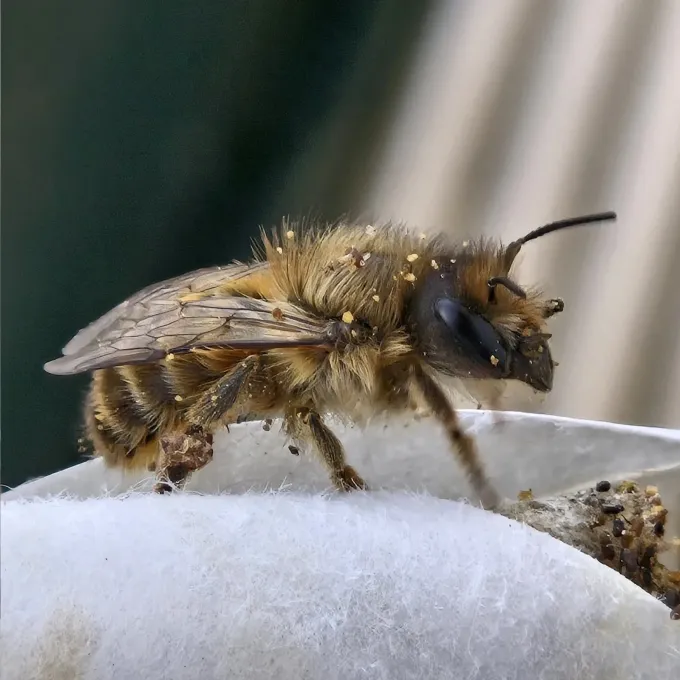
Adults have a dense, reddish-brown pubescence that gives them a fuzzy appearance, resembling small bumblebees. They measure approximately 10 to 12 millimeters in length.
Females are identified by two small horn-like projections on their heads. These structures are used to help scrape mud for building nest partitions.
Males are typically smaller with paler hair on the face and longer antennae. The abdominal coloration ranges from dark brown to blackish tones.
Unlike honey bees, they do not live in colonies. They operate individually, with each female responsible for constructing and provisioning her own series of nesting cells.
What it damages
The horn-faced bee is generally classified as a beneficial insect rather than a pest. It is intentionally introduced in many agricultural regions to improve fruit set.
However, because they nest in small cavities, they may occasionally use holes in wooden buildings or structural gaps, which some homeowners view as unwanted activity.
They do not cause damage to plant tissue, leaves, or fruits. Their primary impact on the environment is the intensive transfer of pollen between blossoms.
Structural damage is minimal and limited to the clearing of existing small cracks in wood. They lack the jaw strength to cause significant architectural harm.
Their interaction with humans is peaceful; they are non-aggressive and generally ignore people unless they are directly handled or their nests are disturbed.
When it appears
The lifecycle of Osmia cornifrons is strictly tied to early spring temperatures. They typically emerge from their winter cocoons in March or April.
Male bees emerge first, waiting for the females. Once mated, females begin the process of searching for suitable nesting sites and gathering pollen and nectar.
The active life span of an adult bee is short, lasting only about six to eight weeks. During this time, they work vigorously to ensure the survival of their offspring.
The larvae develop throughout the summer inside the mud-sealed cells. By autumn, they pupate and transform into adults inside their cocoons.
They overwinter as fully developed adults within their protective cocoons, ready to emerge once the spring bloom arrives, perfectly synchronized with fruit tree flowering.
Signs of infestation
The most common sign of their presence is a series of small, round holes in wood or reeds, which are effectively plugged with mud.
If you see clay-like caps or seals on the ends of small tubes or crevices, it is a clear indicator that a bee has established a nest inside.
During warm spring days, you may observe bees flying rapidly in and out of these holes, often with visible clumps of yellow pollen on their abdomens.
The lack of leaf-cutting damage (unlike leafcutter bees) indicates that the nesting material used is strictly mud and soil-based.
An audible, consistent buzzing near specific nesting structures is common during the height of their reproductive season as they finish filling their cells.
Control measures
As Osmia cornifrons is highly valued for pollination, standard "control" usually focuses on site management rather than elimination of the species.
To discourage them from nesting in house structures, seal gaps in wood siding or paint the exterior surfaces to make them less attractive for excavation.
Installing "bee hotels" or nesting tubes in remote areas of the garden encourages the population to settle in designated, helpful locations.
Chemical pesticide use must be strictly avoided during the bloom period to prevent mass mortality of these essential pollinators.
- Set up artificial nesting tubes.
- Seal structural cracks with caulk.
- Avoid broad-spectrum insecticides during spring.
Taxonomy
- Latin name
- Osmia cornifrons
- Order
- Hymenoptera
- Family
- Megachilidae
- EPPO code
- OSMICO
Discussion
No discussions yet — be the first.