
Red mason bee
Osmia bicornis
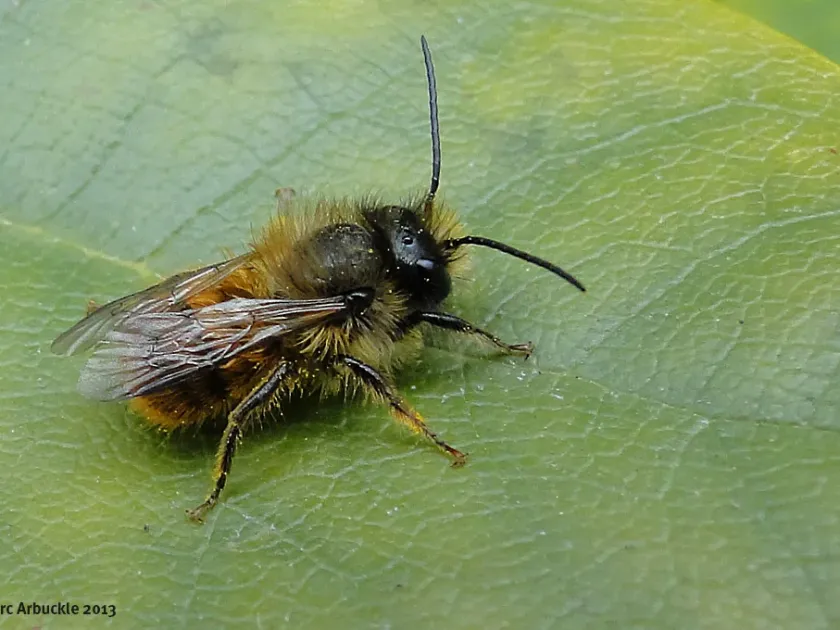
Description
How to identify
The red mason bee (Osmia bicornis) belongs to the Megachilidae family. It is a solitary bee species known for its rusty-red appearance, which gives it a distinct look compared to honeybees.
These bees do not have a queen or a colony hierarchy in the traditional sense; instead, every female works independently to construct and provision her own nest cells.
Adults are typically active in early spring, and they are recognized as very efficient pollinators for various fruit trees and early-blooming flowering plants.
Although they are beneficial for agriculture, their habit of nesting in man-made structures makes them problematic for homeowners when they target building materials.
The species is characterized by high adaptability, allowing it to colonize diverse environments, from natural hollow stems to masonry gaps and wooden wall structures.
What it damages
The damage caused by the red mason bee is primarily aesthetic and structural, occurring when bees excavate or enlarge holes in wooden components or soft mortar.
Females use their strong mandibles to create nesting tunnels in soft woods, foam blocks, or older crumbling mortar, which can weaken the integrity of these materials over time.
In cases of heavy infestation, the cumulative damage from numerous nesting tunnels can lead to the degradation of siding, window frames, and decorative wooden elements.
These nesting activities can also facilitate the entry of moisture and fungi into the construction materials, potentially accelerating the decay process of wood.
While the bees do not consume the wood or mortar, the physical damage inflicted during nest building requires proactive maintenance to prevent long-term degradation.
When it appears
The active flight season for the red mason bee typically begins in early spring, often as early as March, depending on regional temperature increases.
The emergence of males precedes that of females, and the main activity, including mating and nest provisioning, usually concludes by the end of May or early June.
During this period, females are highly active, constantly flying back and forth to their chosen nesting sites with pollen loads and building materials like mud.
After the eggs are laid and the cells are sealed, the adult bees die, marking the end of their brief life cycle above ground for that year.
The remaining time of the year is spent in the larval and pupal stages, safe within their protective cocoons until the cycle restarts the following spring.
Signs of infestation
The most common sign of infestation is the appearance of small, circular holes (roughly 6–10 mm in diameter) on the exterior walls or wooden structures.
Often, these openings are sealed with a "plug" of mud or clay, which is a clear indicator that the bee has finished provisioning the cell and the offspring are developing.
Fine dust or debris found below these holes is typical, resulting from the bee's efforts to drill or expand the tunnel into the substrate.
In sunny weather, homeowners may notice increased bee activity around specific spots on a building, which confirms a chosen nesting site.
Multiple sealed holes clustered together suggest an established nesting colony that will likely grow if the site remains accessible in subsequent seasons.
Control measures
Managing the red mason bee around buildings involves physical exclusion and maintenance to make structures less attractive for nesting purposes.
Maintaining a good layer of high-quality paint or wood varnish prevents the bees from easily penetrating the surface of wooden elements.
Sealing gaps in brickwork, masonry, or around window frames with mortar or sealant effectively eliminates the nesting sites bees are searching for.
Providing alternative nesting sites, such as "bee hotels" placed well away from the house, can successfully divert the bee population to a controlled area.
- Applying protective exterior paint or wood sealants.
- Caulking and sealing all gaps and crevices in walls.
- Installing wire mesh over ventilation holes.
- Setting up bee hotels to encourage nesting away from buildings.
- Regular inspections of wooden siding and exterior facades.
Taxonomy
- Latin name
- Osmia bicornis
- Order
- Hymenoptera
- Family
- Megachilidae
- EPPO code
- OSMARU
Discussion
No discussions yet — be the first.