
Green Burmeister Mantis
Orthodera burmeisteri
Description
How to identify
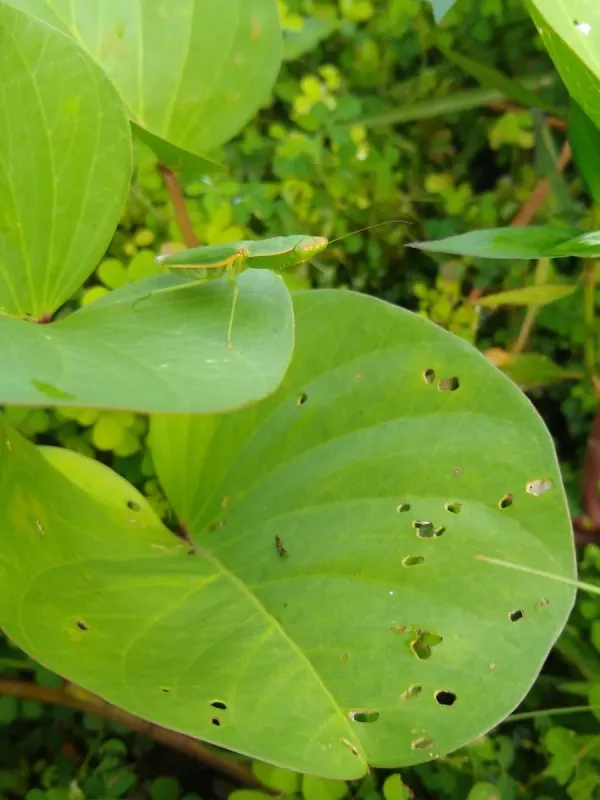
The Green Burmeister Mantis (Orthodera burmeisteri) is a member of the Mantidae family, recognizable by its vivid green coloration, which provides excellent camouflage within foliage.
Adults feature specialized raptorial forelegs designed to capture prey rapidly. Their highly mobile heads can rotate 180 degrees, allowing for precise tracking of movement within the agricultural landscape.
The insect possesses large, compound eyes located on the sides of the head for excellent depth perception. Well-developed wings enable adults to migrate actively in search of hunting grounds or mating partners.
Sexual dimorphism is evident; females are significantly larger and heavier than males, possessing broad abdomens for producing oothecae—protective egg cases attached to host plants.
Nymphs resemble smaller versions of adults but lack functional wings. They undergo several molting stages, gradually increasing in size while developing towards maturity.
What it damages
While mantises are predators, they are considered detrimental in agricultural settings due to their consumption of beneficial pollinators, specifically honeybees and bumblebees.
High densities of Orthodera burmeisteri in orchards or seed fields can cause significant losses in pollinator activity, leading to reduced fruit set and crop yield.
In greenhouse operations where bumblebees are used for tomato or cucumber pollination, the mantis acts as a nuisance predator by capturing foraging bees at hive entrances.
Because they are non-selective opportunistic predators, they impact the balance of beneficial insects within the agro-ecosystem, often disrupting integrated pest management programs.
Their preference for dense vegetation makes decorative gardens and perennial crops ideal habitats where they can sustain long-term hunting pressure on local pollinator populations.
When it appears
The life cycle begins in spring when nymphs hatch from overwintered oothecae following stable temperature increases.
Summer is the peak development phase for nymphs. During this time, they become increasingly active as they grow, requiring consistent protein intake to reach the adult stage.
Adult activity peaks in mid-to-late summer, coinciding with the mating season. During this period, their hunting frequency is highest, placing the most pressure on pollinator populations.
In autumn, adults deposit oothecae on plant stems or structures, ensuring the species survives until the following season before the adult population expires.
Climatic factors such as spring moisture and average summer temperatures dictate the speed of development, with warmer seasons leading to faster life cycle completion.
Signs of infestation
Visual identification of adult mantises waiting in ambush on flowers or leaves is the primary indicator of their presence on the farm.
The discovery of papery, light-colored oothecae on branches, stems, or greenhouse structures provides clear evidence of a successful local breeding population.
A sudden decline in pollinator activity or "disappearance" of bees in the absence of chemical pesticide usage often suggests the presence of efficient predators like mantises.
The presence of chitinous insect remains beneath popular hunting spots (dense flowering clusters) is a classic sign of mantis feeding activity.
In managed greenhouse environments, finding mantises near bumblebee hive entrance holes or vents is a definitive sign of an immediate threat to pollinator services.
Control measures
Mechanical destruction of oothecae during the winter dormancy period is the most effective and eco-friendly way to manage the population without affecting other insects.
Installing fine-mesh screens over greenhouse vents prevents mantises from entering the facility, protecting bumblebee colonies from direct predation.
Maintaining clear borders and removing dense weeds around crops reduces the number of suitable ambush locations, effectively driving the predators away from sensitive areas.
Chemical control is generally discouraged because it is non-specific and destroys beneficial insect populations, potentially worsening the pest situation by removing natural checks.
Integrated management focusing on monitoring and exclusion is the best practice for agricultural professionals dealing with Orthodera burmeisteri in pollinator-dependent crops.
Taxonomy
- Latin name
- Orthodera burmeisteri
- Family
- Mantidae
- EPPO code
- ORTDBU
Discussion
No discussions yet — be the first.