
Oligota
Oligota oviformis
Description
How to identify
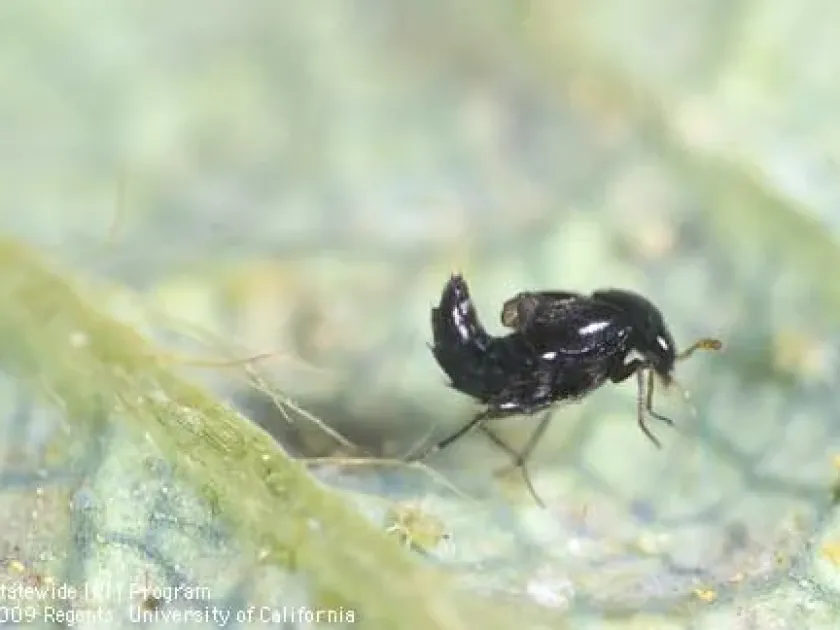
Oligota (Latin: Oligota oviformis) belongs to the Staphylinidae family (rove beetles), order Coleoptera. These are extremely small beetles, usually measuring between 1 and 2 millimeters in length.
The insect's body has a distinct oval shape, which is reflected in its scientific name oviformis. Their coloration is predominantly dark, ranging from brown to almost black, making them difficult to detect on leaf surfaces.
Oligota larvae lead a concealed life; they are highly mobile and possess an elongated body shape, which is typical for many members of the rove beetle family.
Adult beetles are characterized by their agility and active hunting behavior, allowing them to spread quickly across infested crop areas.
Morphological identification of the species requires the use of magnification tools, as they possess the typical rove beetle structure with short elytra, leaving the final abdominal segments exposed.
What it damages
In agronomy, Oligota is often associated with spider mite populations. Under certain environmental conditions, they can cause damage to the vegetative parts of various vegetable crops.
The most susceptible crops to such infestations are those prone to spider mite attacks: cucumbers, tomatoes, peppers, and various ornamental plants grown in greenhouse conditions.
Damage manifests as microscopic punctures in leaf tissues, which subsequently lead to necrotic spots and a decrease in the plant's photosynthetic capacity.
During mass outbreaks, this pest can cause premature yellowing and leaf abscission, which significantly impacts the total yield of commercial produce.
The pest poses a particular threat to nurseries, where damage to young plants leads to stunted growth and loss of the commercial appeal of the planting material.
When it appears
The activity of Oligota is directly dependent on temperature and humidity levels within the greenhouse or open field during the summer months.
The most favorable period for reproduction is the active vegetation phase of agricultural crops, coinciding with the peak population of their food source.
In greenhouses, maintaining a stable temperature above 20 degrees Celsius allows the pest to complete its life cycle continuously throughout the year.
In open fields, mass emergence is observed from June to August, when stable warm weather facilitates the development of several consecutive generations.
Autumn temperature drops lead to a decrease in metabolism and prompt the insects to seek overwintering sites in plant debris or the topsoil layer.
Signs of infestation
The primary sign of infestation is the presence of tiny light-colored stippling on the underside of leaves, which eventually merge into bleached areas.
The appearance of fine webbing between nodes indicates the parallel development of spider mite populations, which Oligota often follows.
Under detailed inspection with a magnifying glass, adults can be spotted; they react to the slightest disturbance by quickly hiding in leaf axils.
Larvae leave behind excrement in the form of dark spots, which impairs the condition of the foliage and reduces the market value of the produce.
In advanced cases, leaf curling, deformation, and gradual necrosis are visible, visually resembling severe damage by other pests without the presence of natural enemies.
Control measures
An effective control strategy for Oligota involves an integrated approach combining agrotechnical, biological, and chemical methods to suppress population levels.
Strict adherence to crop rotation and thorough disinfection of greenhouses after each production cycle is necessary to remove all plant debris where adults may hide.
- Application of specialized insecto-acaricides when economic injury levels are exceeded.
- Utilization of biological control agents to manage populations in integrated pest management systems.
- Regular monitoring of population density using yellow sticky traps.
Chemical treatments should be applied during early morning or late evening hours to minimize plant stress and ensure even coverage of the leaf surface.
It is recommended to rotate the use of pesticides with different active ingredients to prevent the development of resistance within the pest population.
Taxonomy
- Latin name
- Oligota oviformis
- Order
- Coleoptera (beetles)
- Family
- Staphylinidae
- EPPO code
- OLGOOV
Discussion
No discussions yet — be the first.