
Oligota
Oligota minuta
Description
How to identify
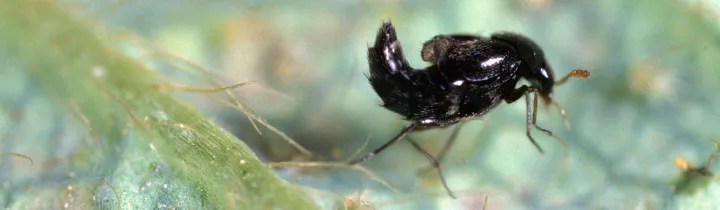
Oligota minuta is a minute species of rove beetle belonging to the family Staphylinidae. Adults are exceptionally small, typically measuring between 1.0 and 1.5 mm in length, making them difficult to spot without magnification.
These beetles possess a compact, dark-colored body, often black or deep brown, with characteristic shortened elytra that expose several abdominal segments. Despite their size, they are active and move quickly across the foliage.
The larvae are also tiny and exhibit high mobility, which is crucial for searching out prey within the dense webs of mites. Their anatomy is perfectly adapted for hunting in complex environments.
In the context of integrated pest management, Oligota is recognized as a beneficial insect. It is a specialized predator rather than a plant pest, and it plays a vital role in biological control programs.
Correct identification often requires expert entomological skills, as many staphylinid species look superficially similar, necessitating structural analysis of the antennae and genitalia.
What it damages
Oligota minuta does not cause damage to plants. It is not a phytophagous insect and does not feed on any parts of agricultural crops, such as leaves, roots, or fruit.
Its primary ecological function is the predation of spider mites (Tetranychidae), including the common greenhouse spider mite. Both adults and larvae are voracious predators of these pests.
By actively consuming mite eggs and motile stages, Oligota significantly reduces pest populations, thereby preventing economic damage to a wide range of vegetable and ornamental crops.
The presence of this predator is a sign of a balanced agro-ecosystem where natural enemies are actively keeping plant-feeding mites under control.
Classifying this beetle as a pest is a common misconception often resulting from finding the insect in close proximity to damaged plant tissue caused by mites.
When it appears
The seasonal occurrence of Oligota is closely linked to the lifecycle of their spider mite prey. They become active when temperatures rise in the spring and summer.
Populations tend to reach their peak during the mid-to-late summer months, coinciding with the rapid reproductive cycles of spider mites in warm, dry weather conditions.
As a multi-generational species, the abundance of Oligota throughout the season is directly dependent on the availability of sufficient food resources within the crop canopy.
With the onset of autumn and cooling temperatures, the adults enter hibernation sites, typically seeking shelter in the soil or within decaying organic matter.
The emergence in the following spring is triggered by rising soil and air temperatures, allowing the predator to align its cycle with the appearance of new mite generations.
Signs of infestation
Visible signs of Oligota presence include the stabilization of mite infestations, where the population of spider mites ceases to grow or shows a significant decline.
Under close inspection with a hand lens, one might observe the remnants of consumed mite eggs or vacant mite skins, which indicate successful predation.
In commercial greenhouse settings, the presence of these beetles is often detected through the use of yellow or blue sticky traps, which serve as an effective monitoring tool.
While the beetles themselves are hard to spot, their contribution to a mite-free crop is often the only indicator of their effective work in the field or greenhouse.
Absence of typical mite-related leaf mottling or extensive webbing on plants, despite previous mite pressure, strongly suggests the presence of effective predatory populations.
Control measures
Control measures are not intended for the eradication of Oligota, as they are essential beneficial organisms that should be conserved and encouraged.
The primary strategy is the avoidance of broad-spectrum pesticides, which are lethal to rove beetles and can trigger secondary outbreaks of spider mites due to the elimination of their natural enemies.
When chemical intervention against mites is necessary, growers should select acaricides that have demonstrated compatibility with beneficial predatory insects.
Preserving field margins and maintaining areas of non-crop vegetation can provide necessary refugia for these beetles, ensuring their survival and long-term population stability.
In greenhouse agriculture, the deliberate release of Oligota as a biological control agent can be an effective component of a comprehensive IPM strategy.
Taxonomy
- Latin name
- Oligota minuta
- Order
- Coleoptera (beetles)
- Family
- Staphylinidae
- EPPO code
- OLGOMI
Discussion
No discussions yet — be the first.