
Plume moth
Oidaematophorus
Description
How to identify
Plume moths belong to the family Pterophoridae, order Lepidoptera. These unique moths are characterized by wings divided into narrow, plume-like lobes, giving them their distinctive appearance.
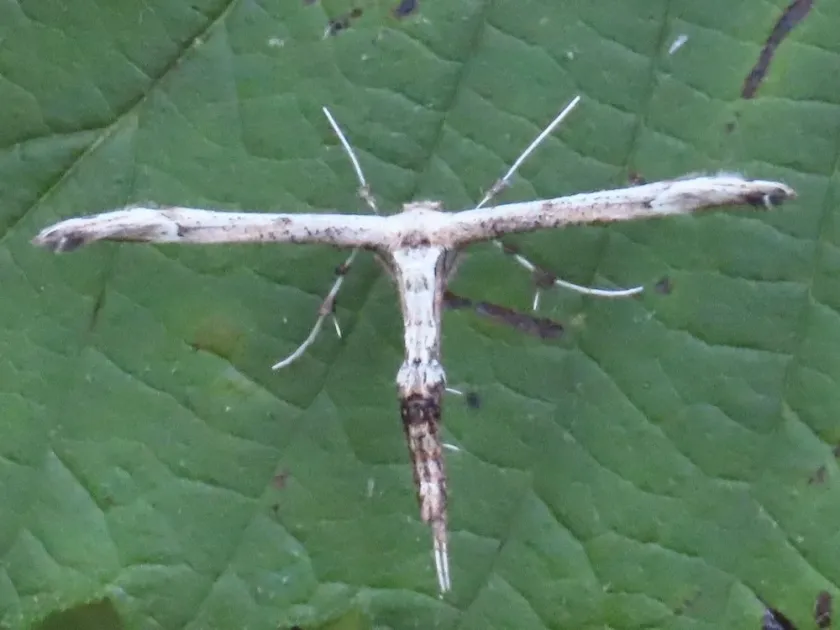
When at rest, the moth folds its wings tightly against its body, assuming a 'T' shape or a thin stick-like silhouette, making it nearly invisible against plant stems.
The adult body is slender and elongated, with long legs covered in fine spines. Their coloration is typically cryptic, featuring shades of brown, gray, or tan to blend into their environment.
Plume moth caterpillars usually possess cylindrical bodies, often densely covered with hairs or setae. Depending on the species, they may vary in color from green to brown, frequently displaying longitudinal stripes.
The wingspan of most species ranges from 15 to 30 millimeters, allowing these insects to be easily transported by wind currents across garden plots or fields.
What it damages
Plume moths are primarily oligophagous, preferring plants from the Asteraceae, Convolvulaceae, and Rosaceae families. Some species are specialized pests of berry crops and ornamental plants.
The caterpillars primarily target the generative organs of plants: buds, flowers, and young fruit sets. This activity directly reduces yields and causes significant fruit deformation.
In cases of high infestation, the larvae can damage foliage by skeletonizing leaves or boring deep holes, which severely compromises the plant's overall vigor and immunity.
Damage is most prevalent in nurseries and dense plantings where the microclimate facilitates rapid development of multiple successive generations.
Injured plant tissues serve as entry points for secondary fungal and bacterial infections, which proliferate in the presence of larval frass and debris.
When it appears
Adult flight typically begins in late spring or early summer, influenced by regional temperature patterns and the successful overwintering of pupae in plant debris.
Females deposit eggs singly or in small clusters, usually on the underside of leaves or near the base of inflorescences, ensuring immediate access to food for hatching larvae.
The larval feeding period lasts approximately 3 to 4 weeks, after which they pupate either on the plant, anchored by silk threads, or within the top layer of soil beneath the host plant.
Depending on climatic conditions, one or two generations may occur per season, making the pest particularly damaging during the peak of summer.
The overwintering stage commonly consists of a pupa or a late-instar larva, sheltered in dry grass or leaf litter until the following spring.
Signs of infestation
A primary indicator is the presence of characteristic silken webs on flowers and buds, used by the caterpillar to bind plant parts together for protection.
Stunted growth of terminal shoots and malformed inflorescences are clear signs of larval presence feeding within the plant's delicate tissues.
Dark, granular frass deposits on leaves beneath the flower buds serve as a distinct indicator of nocturnal or crepuscular larval activity.
Gradual wilting and premature dropping of buds before blooming often signify that a larva has consumed the internal structure of the reproductive organs.
During evening inspections, adults can be observed displaying flight activity near host plants, often attracted to specific garden vegetation.
Control measures
The primary control method is cultural management: diligent sanitation through the removal of plant debris and the eradication of weeds that host the pest.
Biological control using Bacillus thuringiensis formulations is effective against young larvae, providing protection without the risk of accumulating toxins in the fruit.
When populations exceed economic thresholds, the application of systemic or contact insecticides approved for use on specific crops is recommended.
Regular monitoring using light traps allows for the early detection of adult emergence, enabling timely preventative spray applications.
Integrated biological protection involves fostering a garden environment that supports entomophagous insects, such as predatory bugs and parasitic wasps, to naturally limit plume moth populations.
Taxonomy
- Latin name
- Oidaematophorus
- Order
- Lepidoptera (butterflies)
- Family
- Pterophoridae
- EPPO code
- OIDASP
Discussion
No discussions yet — be the first.