
Green soldier fly
Odontomyia viridula
Description
How to identify
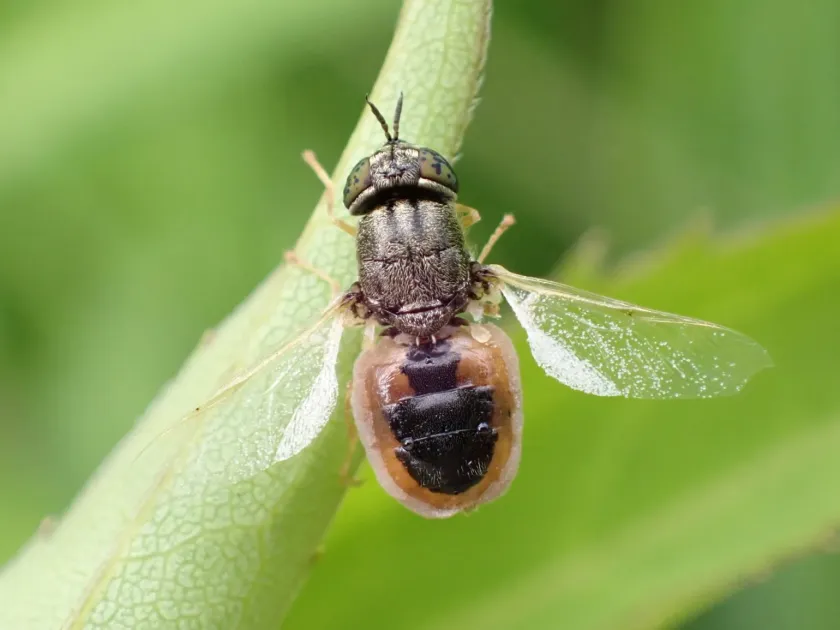
The green soldier fly (Odontomyia viridula) belongs to the Stratiomyidae family within the order Diptera. Adults are characterized by a vibrant green or yellow-green abdomen with distinctive black markings.
The larvae are elongated and flattened, protected by a tough, leathery cuticle that allows them to thrive in moist or semi-aquatic environments.
The life cycle undergoes complete metamorphosis, passing through egg, larval, pupal, and adult stages. The larval stage is the most significant period of growth and development.
Adult flies are diurnal and are often observed near water bodies or blooming vegetation, where they feed on nectar and pollen, acting as non-pests in their adult stage.
The species' biology is strictly correlated with high humidity, explaining why infestations are typically concentrated in poorly drained, swampy areas.
What it damages
While adults are harmless, the larvae are considered potential agricultural pests. They primarily feed on decaying organic matter but will attack live roots and tubers under saturated soil conditions.
Crops most susceptible to damage include root vegetables, tubers, and young seedlings of cereals grown in fields with persistent waterlogging issues.
Larval feeding creates tunnels in the roots, causing physical injury and facilitating the entry of opportunistic bacteria and fungi that lead to root rot.
This damage results in reduced water and nutrient uptake, stunted plant growth, and in severe cases, the death of the crop plant.
The economic impact is highly dependent on environmental factors, as wet summers promote rapid population growth and expansion of the pest across agricultural fields.
When it appears
Adults emerge from late spring through summer, generally between May and August, when they mate and lay eggs in moist soil or damp organic debris.
The larvae overwinter in the soil or protected organic layers, demonstrating high tolerance to cold temperatures due to their robust physiological structure.
Typically, there is one generation per year, although favorable moisture conditions can facilitate continuous breeding cycles in warmer climates.
The peak of larval activity coincides with the mid-summer period, which often aligns with the crucial growth phases of many agricultural crops.
As autumn approaches, larvae move deeper into the soil profile for overwintering, significantly reducing their impact on surface-level plant parts.
Signs of infestation
The primary indicator of an infestation is localized wilting of plants in low-lying, damp areas of the field that remain saturated after rainfall.
Careful inspection of the root zone will reveal gray larvae and characteristic cavities or tunnel-like lesions on the roots or tubers.
A high density of adult green soldier flies surrounding a field serves as a warning sign of a potential larval population present in the soil.
Secondary symptoms include the development of rotting patches on roots, which may be misidentified as purely fungal diseases if the larval damage is overlooked.
Stunted development and chlorosis in specific patches of the field are classic signs of root damage caused by soil-dwelling fly larvae.
Control measures
The most effective management strategy is land drainage improvement to prevent water accumulation and eliminate the moist habitat required for the larvae.
Agronomic practices, such as deep plowing in autumn, help expose larvae to surface conditions, natural predators, and lower temperatures, reducing their population.
Implementing strict crop rotation protocols disrupts the pest's life cycle and prevents the continuous buildup of larval populations in the soil.
Chemical control is rarely the primary option and is only recommended when infestation thresholds are exceeded, focusing on soil-applied insecticides.
- Installation of land drainage systems;
- Deep autumn plowing;
- Strategic crop rotation;
- Management of soil water levels;
- Targeted insecticide application if needed.
Taxonomy
- Latin name
- Odontomyia viridula
- Order
- Diptera (flies)
- Family
- Stratiomyidae
- EPPO code
- ODNMVI
Discussion
No discussions yet — be the first.