
White-tailed deer
Odocoileus virginianus
Description
How to identify
The white-tailed deer (Odocoileus virginianus) is a medium-sized ungulate belonging to the family Cervidae and the order Artiodactyla, widely distributed across North America.
The name comes from the characteristic white underside of its tail, which is raised like a flag when the deer is alarmed or running away from danger.
Adult deer exhibit seasonal coat color changes: reddish-brown during the summer months and grayish-brown during the winter for better camouflage.
Males develop antlers that are branched and arched, which they shed annually, while females are smaller and lack antlers, both having keen senses.
They are primarily crepuscular animals, meaning they are most active during dawn and dusk, which is when they typically invade agricultural lands.
What it damages
White-tailed deer cause extensive economic loss by grazing on primary crops such as corn, soybeans, wheat, and alfalfa throughout the growing season.
In orchards, deer browse on foliage, buds, and twigs, significantly inhibiting the growth and development of young fruit and nut-bearing trees.
Deer damage the bark of saplings by rubbing their antlers against the trunk, which can effectively girdle the tree and cause its premature death.
Trampling through crops causes physical destruction of stalks and soil compaction, often leading to reduced yields and lower quality of the harvest.
The cumulative effect of foraging often results in significant harvest losses, forcing farmers to seek expensive exclusion and mitigation strategies.
When it appears
Deer activity patterns are closely linked to the nutritional needs of the herd and the availability of preferred forage throughout the calendar year.
During the spring, deer move into fields to graze on tender young shoots, posing a threat to newly planted crops and early season vegetable growth.
In summer, the pressure intensifies as lactating does and fawns look for high-energy food sources, causing heavy damage to soybeans and corn crops.
Autumn feeding provides deer with necessary energy reserves before winter, often leading them to raid fields for remaining produce and late-season vegetation.
Winter is the period of greatest tree damage, as deer rely on woody browse, such as buds and bark, due to the scarcity of accessible green fodder.
Signs of infestation
The presence of deer is easily confirmed by identifying their tracks in the soil, which are heart-shaped and consist of two pointed hoof prints.
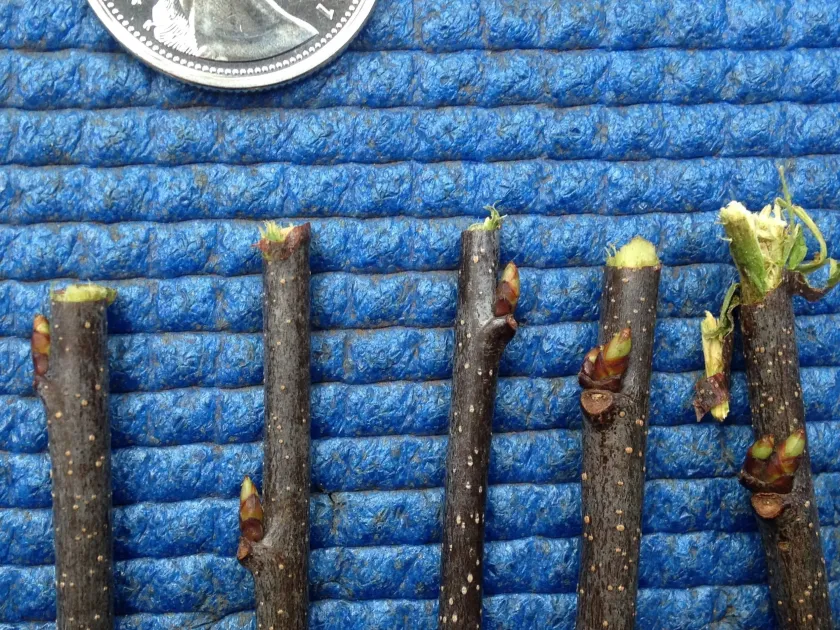
Plants damaged by deer exhibit a ragged, torn appearance at the point of consumption, as deer lack upper incisors and must pull the vegetation away.
Scat, in the form of small, dark, cylindrical pellets found in clusters near the feeding site, serves as a clear indicator of their recent occupancy.
Browse lines, where vegetation is stripped at a specific height consistent with the deer's reach, are visible along the edges of woods and plantations.
- Raggedly bitten stems and leaves
- Bark rubbed off the lower trunk
- Deer droppings in field tracks
- Characteristic hoof prints
Control measures
Physical exclusion through the installation of high-tensile woven wire fences, at least 8 feet tall, is the most effective method for long-term protection.
Repellents based on odor or taste can be applied to crops to discourage foraging, though their efficacy often diminishes after rainfall or as plants grow.
Scare tactics, such as motion-activated sprinklers, propane cannons, or noise-making devices, provide temporary deterrents to keep herds away from fields.
Developing landscape buffers by planting vegetation that deer find unpalatable around the perimeter can discourage entry into sensitive crop areas.
Integrated management, combining fencing with habitat modification and population control measures, remains the best approach for high-value agricultural areas.
Taxonomy
- Latin name
- Odocoileus virginianus
- Family
- Cervidae
- EPPO code
- ODOCVI
Discussion
No discussions yet — be the first.