
Axis deer
Axis axis
Description
How to identify
The Axis deer (Axis axis), also known as the chital, is a species of deer native to the Indian subcontinent. It has been introduced to many parts of the world, where it often thrives and creates significant challenges for agricultural sectors.
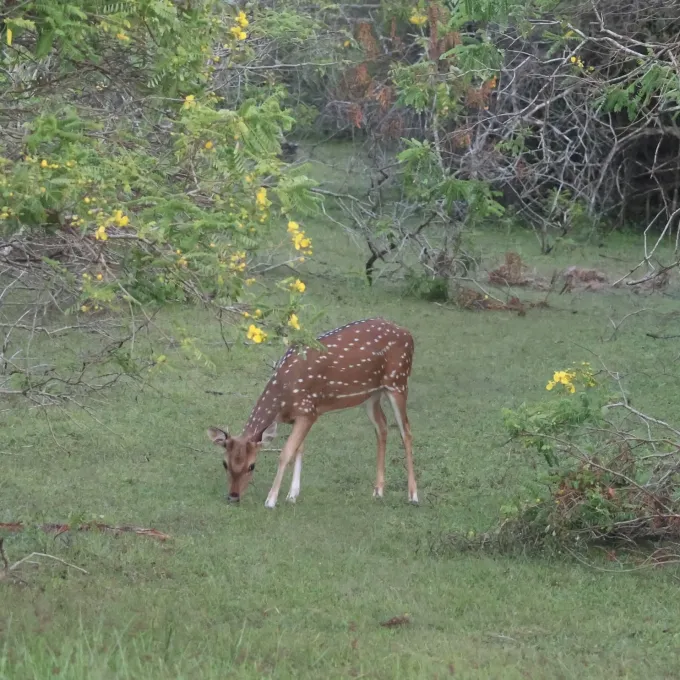
These animals are characterized by their reddish-brown coat covered in white spots, which remain visible throughout their lives. Males possess impressive three-tined antlers, which add to their distinct silhouette.
They are gregarious animals, living in herds that can range from a few individuals to large groups. This social structure allows them to exert intense grazing pressure on specific areas of agricultural land.
Axis deer are highly adaptable to various environments, ranging from forests to open farmlands. Their ability to switch food sources quickly makes them particularly successful in colonizing new agricultural territories.
Their reproduction is not strictly seasonal, allowing them to produce offspring throughout the year under favorable conditions, leading to rapid population growth and sustained pressure on local farmers.
What it damages
Axis deer are opportunistic grazers and browsers that consume a wide variety of agricultural crops, including wheat, rice, corn, and legumes. They often target young, succulent shoots, effectively destroying the plant before it matures.
Beyond direct consumption, the heavy trampling by large herds of deer leads to significant soil compaction and the destruction of seedlings. This structural damage to the field can be as costly as the loss of the crop itself.
In orchards and tree plantations, Axis deer are known to strip bark from young trees. This ringing behavior can kill saplings or leave them vulnerable to secondary pathogens, severely impacting long-term yield.
They also pose a threat to livestock farming by outcompeting domestic animals for limited pasture resources. By consuming high-quality grasses, they reduce the available forage for cattle and sheep.
Infrastructure damage is another consequence of their presence. They often break through fences, damage irrigation lines, and disrupt farm layouts while moving between forested areas and crop fields.
When it appears
Their impact on agriculture is highly seasonal in temperate regions, peaking during the spring growth phase when crops are tender and highly attractive. This is the period of highest risk for many farmers.
During dry summer months, when natural food and water in forests become scarce, Axis deer frequently move into agricultural fields in search of succulent produce, causing extensive damage in a short timeframe.
In the autumn, as crops reach maturity and harvest time approaches, the deer move to consume higher-energy food sources. This can result in significant losses of grain and vegetable harvests.
In regions with mild climates, the activity of Axis deer can continue year-round. They show no dormancy, meaning farmers must maintain defensive measures continuously throughout the growing cycle.
The peak feeding times usually coincide with the late evening and early morning hours. Monitoring these patterns is essential for determining the most effective time to implement deterrent strategies.
Signs of infestation
The most reliable sign of Axis deer presence is their distinctive cloven-hoof prints. The prints are usually larger than those of small ruminants and are often found along paths leading into fields.
Plants damaged by deer exhibit irregular, torn edges. Unlike insects that leave holes, deer physically pull and tear vegetation, often leaving exposed stems that are frayed or crushed.
Droppings left in small, dark, rounded pellets are common indicators of their presence. These are typically found in clusters near the edges of crops or along their established travel corridors.
Debarked trunks of trees are a clear sign of browsing. Scrape marks from antlers on the trunks also indicate the presence of mature males, often occurring in or near wooded sections of the farm.
Large, barren, or trampled patches of soil within a crop indicate bedding areas or heavily grazed spots, highlighting exactly where the deer have been concentrating their activities.
Control measures
Physical exclusion is the most effective long-term management strategy. High-tensile fences, at least 2 meters in height, are necessary to prevent these agile jumpers from accessing sensitive crop areas.
Deterrent devices, such as motion-activated light systems and noise-generating cannons, are commonly used. To maintain effectiveness, it is crucial to vary the patterns and locations of these deterrents.
Chemical repellents applied to the perimeter of crops can create a temporary barrier. These treatments work by smell or taste but require frequent reapplication, especially after rain or heavy dew.
Integrated farm management, including the removal of brush and tall weeds around field edges, reduces the cover for deer, making the area less attractive for them to hide and feed.
- Installation of game-proof fencing
- Strategic use of scare devices
- Application of taste-based repellents
- Population control in coordination with wildlife agencies
Taxonomy
- Latin name
- Axis axis
- Family
- Cervidae
- EPPO code
- AXISAX
Discussion
No discussions yet — be the first.