
European roe deer
Capreolus capreolus
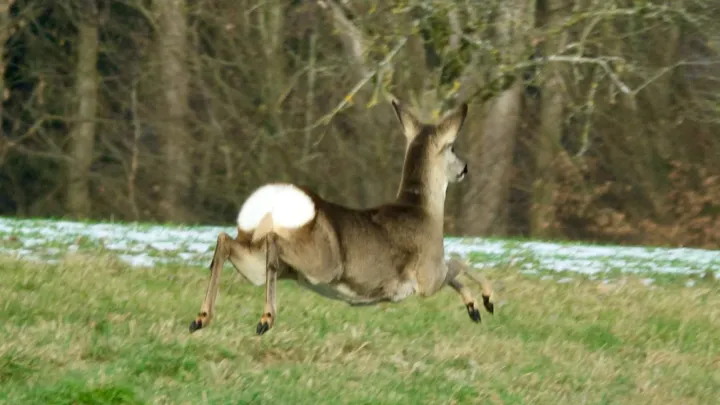
Description
How to identify
The European roe deer (Capreolus capreolus) belongs to the Artiodactyla order and Cervidae family. It is a small, agile deer known for its reddish-brown summer coat and grayish winter fur.
Adults stand about 75–80 cm at the shoulder and typically weigh between 20 and 30 kg. They are highly adaptive animals, thriving in mosaic landscapes of forests and fields.
Roe deer have excellent senses of hearing and smell, allowing them to remain elusive while foraging in agricultural areas.
The species displays territorial behavior, particularly during the breeding season, which influences their movement patterns across farmland.
Their ability to jump high and run fast makes them capable of navigating various types of terrain, including fenced agricultural zones.
What it damages
Roe deer cause significant damage to agriculture, primarily by grazing on winter cereal crops such as wheat and rye during the cold season.
In orchards, roe deer consume the buds and young shoots of fruit trees, leading to stunted growth and potential tree mortality.
Forestry operations suffer when roe deer strip the bark from young saplings, which disrupts nutrient flow and leaves the trees vulnerable to disease.
The browsing of lateral shoots in conifer plantations significantly hampers reforestation efforts and reduces the economic value of timber.
The destruction of tender crops in early spring can lead to substantial yield losses if the local population density is high.
When it appears
Winter is the period of highest risk, as natural food sources in forests become scarce, forcing deer into fields to feed on winter crops.
Springtime arrival is also critical, as young, nutrient-rich plant sprouts attract roe deer to newly planted fields.
Summer grazing typically occurs during twilight hours, when deer emerge from forests to feed on various succulent crops.
The severity of damage fluctuates with weather patterns, as harsh winters often correlate with increased pressure on agricultural lands.
Seasonal migration between summer and winter habitats dictates the frequency and intensity of roe deer damage to specific plots.
Signs of infestation
The presence of roe deer can be confirmed by their distinct, small, pointed hoof prints measuring about 4–5 cm in length.
Look for ragged, uneven browsing marks on the edges of leaves and shoots, which distinguish deer feeding from mechanical damage.
Scraped bark on the lower trunks of young trees, often caused by bucks rubbing their antlers, is a clear indicator of their presence.
- Small, dark, oval-shaped droppings left in piles near feeding sites.
- Well-worn paths or trails running from forest cover into crop fields.
- Flattened vegetation where deer have bedded down during the day.
Control measures
Installing high-tensile mesh fencing at least 2 meters high is the most effective long-term solution for protecting orchards and nurseries.
Chemical repellents that emit odors unpleasant to deer can be applied to crops to discourage browsing during vulnerable growth stages.
Auditory and visual deterrents, including motion-activated lights and sound devices, can help protect small fields from nighttime intrusions.
Implementing sacrificial feeding plots at the edge of forests can lure deer away from valuable primary crops during peak feeding times.
In cases of severe economic loss, farmers should coordinate with local wildlife agencies to discuss population management strategies.
Taxonomy
- Latin name
- Capreolus capreolus
- Family
- Cervidae
- EPPO code
- CAPRCA
Discussion
No discussions yet — be the first.