
Moose
Alces alces
Description
How to identify
The moose (Alces alces) is the largest member of the deer family (Cervidae), belonging to the order Artiodactyla. Adult individuals have a massive body, long legs, and a distinctive hump at the withers. Males possess large, often palmate antlers that are shed annually during the winter season.
Moose lead a largely sedentary lifestyle, performing only minor seasonal migrations in search of food. In agricultural landscapes, they are primarily crepuscular, making monitoring difficult. Given their massive size, they can easily breach standard agricultural fencing.
The species is well-adapted to temperate climates and forested areas. Its high mobility allows it to quickly locate food sources, which makes the moose a serious risk factor for commercial nurseries and young forest plantations adjacent to wooded areas.
The biology of the moose is characterized by high nutritional needs. A single adult consumes large amounts of plant biomass daily, which, during periods of winter food scarcity, leads to the widespread destruction of valuable tree species.
For agronomists, identifying the moose as a pest is based on characteristic hoof prints and specific methods of bark and twig stripping. They are capable of causing damage not only to crops and trees but also to field infrastructure, such as destroying protective windbreaks and fences.
What it damages
The primary diet of the moose consists of trees and shrubs, making them a significant threat to young forest cultures. Species like pine, spruce, willow, aspen, and birch are heavily affected, as are the shoots of young fruit trees if plantations are located near forests.
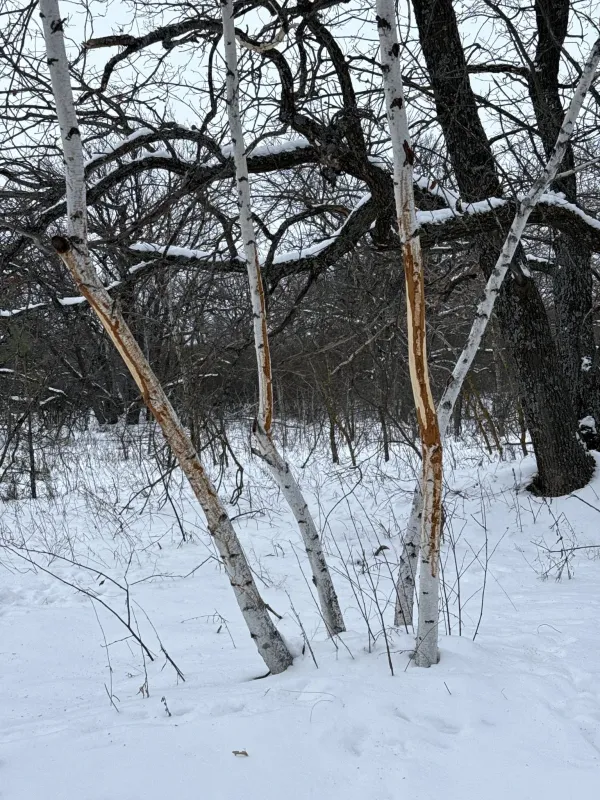
During winter, moose strip bark and prune thin branches, often killing young saplings. Ring-barking cuts off nutrient transport within the tree, causing the plant to dry out and die completely by the following spring.
In agricultural fields, moose can cause damage to grain crops, vegetables, and berry plantations. They trample crops while creating paths and consume succulent plant parts, which significantly reduces total yields and the market quality of the produce.
Damage to the leading terminal shoots of young trees results in multi-stemmed growth and loss of commercial timber quality, which is critical for forestry enterprises focused on straight-stem production.
Furthermore, trees damaged by moose become susceptible to secondary pests and fungal infections. Pathogens enter the tree through bark wounds, causing internal rot and leading to the eventual decline of entire forest belts.
When it appears
Maximum damage occurs during the autumn-winter period when snow cover limits access to herbaceous plants. During this time, moose are forced to switch to woody forage, focusing on bark and coniferous needles.
The spring season is also dangerous because young, succulent shoots of trees and shrubs become an attractive source of vitamins and minerals. Moose frequently browse terminal buds, arresting the height development of young trees.
During summer, animals shift to a more varied diet, including aquatic plants and field grasses. While damage to forest stands is less critical, pressure on grain and industrial crops in open fields increases.
Seasonality dictates the strategy for protection: the peak of defensive measures should be scheduled for late autumn, before the onset of winter conditions, to prevent initial damage to saplings.
Weather conditions significantly impact activity: in harsh winters with heavy snow, moose concentrate on smaller areas, completely destroying young growth in those specific high-density zones.
Signs of infestation
- Browsed terminal shoots and stripped lateral branches on young trees.
- Vertical incisor marks on tree bark, characteristic of winter feeding.
- Large, deep hoof prints in soft soil or snow near damaged areas.
- Broken tops of saplings located at the height of an adult moose.
- Presence of typical rounded droppings near feeding sites.
Control measures
The most effective method is the mechanical fencing of fields and nurseries using wire mesh or specialized high-tensile fencing at least 2.5 meters tall, which prevents physical contact between the animals and the plants.
The use of repellents with offensive odors or bitter tastes helps protect individual saplings and valuable trees. These formulations are applied to the bark or upper portions of the plant, reducing their attractiveness to moose.
Automated light and sound deterrents can temporarily drive animals away from fields, although these devices require regular frequency changes to prevent moose from habituating to the stimuli.
Agronomic strategies include creating "diversionary" feeding plots at the edge of forest массивов. Planting crops that are highly attractive to moose in winter helps lure them away from young forest plantations and valuable agricultural crops.
Managing population density through regulated hunting in cooperation with local wildlife agencies is an essential tool for long-term control, ensuring moose numbers remain within sustainable limits in agricultural regions.
Taxonomy
- Latin name
- Alces alces
- Family
- Cervidae
- EPPO code
- ALCSAL
Discussion
No discussions yet — be the first.