
European roe deer
Capreolus
Description
How to identify
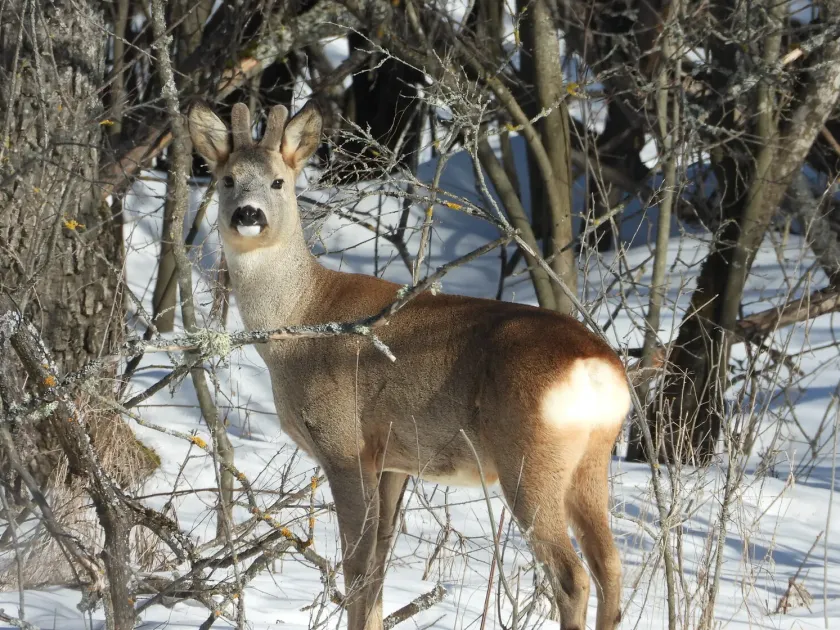
The European roe deer (Capreolus capreolus) is a small, agile deer species belonging to the family Cervidae. They have a distinct reddish-brown coat in summer and greyish-brown in winter.
Adults typically reach a shoulder height of 75–80 cm and weigh between 20 and 30 kg. Males possess small, branched antlers which they shed annually after the breeding season.
They are characterized by high sensory acuity, with excellent hearing and smell, allowing them to detect potential threats and retreat quickly from fields.
The species exhibits a unique reproductive cycle with delayed implantation, ensuring that fawns are born in late spring when food resources are most abundant.
European roe deer are highly adaptable, occupying various habitats ranging from dense forests to large-scale agricultural landscapes near human settlements.
What it damages
Roe deer cause significant damage to winter crops, especially during late winter and early spring when natural vegetation is scarce or covered by snow.
In silviculture and orchards, they frequently browse on the bark and terminal buds of young tree saplings, which can stunt tree growth or cause total mortality.
Mechanical damage is also common, as deer herds trample young plants while traversing fields, which decreases plant density and harms overall harvest potential.
During the growing season, they may consume succulent parts of commercial crops like rapeseed, sunflowers, or corn, particularly during the milky stage.
The impact is often concentrated on field edges bordering forested areas, where deer can easily retreat after feeding, making perimeter defense crucial.
When it appears
Winter (November through April) is the peak season for crop damage, as roe deer rely on winter grain as an accessible and nutritious food source.
Early spring is another critical window when new growth of clover, grasses, and winter crops is highly palatable, attracting deer to open agricultural fields.
Autumn brings sporadic damage to remaining vegetable patches as deer prepare for winter by consuming high-energy food sources available on agricultural land.
Summer damage is generally lower due to the availability of natural forest forage, though localized damage may increase during periods of severe drought.
The severity of seasonal impact is heavily dependent on weather; harsh winters with deep snow force deer to move out of the forest and onto agricultural plains.
Signs of infestation
The presence of roe deer is easily identified by their hoof prints, which are pointed and typically appear in pairs, marking their paths across muddy or soft soil.
Browsing damage is distinct from rodents; plant stems and leaves will have torn, jagged edges rather than the smooth, clean cuts left by smaller mammals.
On woody plants, vertical grooves on the bark caused by their teeth are common, along with the complete loss of terminal buds on young saplings.
Droppings are characteristic, often appearing as small, dark, cylindrical pellets found in clusters along trails or resting spots near the edge of the woods.
Well-worn trails through crops, leading from woodland cover into the heart of a field, serve as a primary indicator of established deer traffic patterns.
Control measures
Physical exclusion remains the most effective control method, involving the installation of high-tensile wire fences or netting at least 2 meters in height.
Chemical repellents applied to tree stems or perimeter vegetation can deter deer by scent or taste, providing temporary relief during peak feeding times.
Visual and acoustic deterrents, such as motion-activated lights, sonic devices, or reflective streamers, can keep deer away from small or high-value garden plots.
Creating lure crops or sacrificial food plots inside the forest can distract deer away from valuable agricultural fields, reducing the pressure on the harvest.
Integrated management, including hunting regulation and working with local wildlife authorities, is essential for maintaining sustainable populations near farm land.
Taxonomy
- Latin name
- Capreolus
- Family
- Cervidae
- EPPO code
- CAPRSP
Discussion
No discussions yet — be the first.