
Mule deer
Odocoileus hemionus
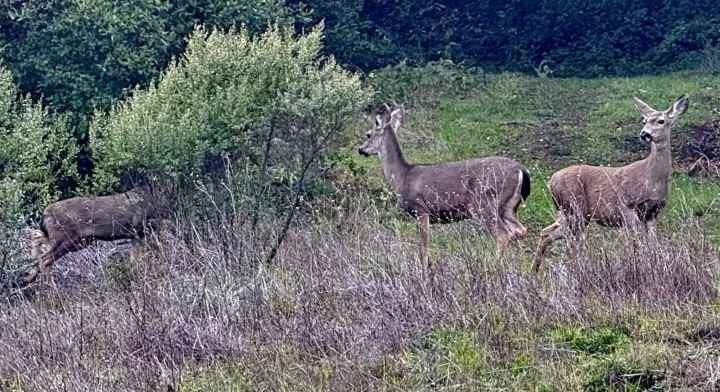
Description
How to identify
The mule deer (Odocoileus hemionus) is a hoofed mammal belonging to the family Cervidae within the order Artiodactyla. It is distinguished by its large, mule-like ears and a characteristic rope-like tail with a black tip.
Adult mule deer typically stand about one meter tall at the shoulder. Their coat color changes from reddish-brown in the summer to a greyish-brown during the winter, providing camouflage in varied habitats.
These deer are highly adaptable, inhabiting landscapes ranging from forests and shrublands to open agricultural fields. Their ability to thrive near human activity makes them a constant concern for landowners.
Mule deer are social animals, often moving in small groups or herds. This behavior can lead to concentrated feeding on crops, rapidly depleting vegetation in specific parts of a field or orchard.
Their reproduction rate is high enough to allow populations to grow significantly if natural predators are absent. As a result, they can quickly become a dominant force affecting regional agriculture.
What it damages
Mule deer are considered significant pests in agriculture, particularly affecting fruit orchards, vineyards, and commercial vegetable gardens. They consume various plant parts, including buds, leaves, and stems.
Young fruit trees are particularly vulnerable, as deer browse on tender branches and twigs. Such feeding stunts growth and can lead to the death of young saplings, causing long-term financial loss.
In vegetable production, deer feed on leafy crops like lettuce, cabbage, and beans. They often browse the growing point of plants, which prevents further development and results in total crop loss for the affected individuals.
Trampling damage is another significant issue. As groups of deer move through a field, they can crush mature crops, especially grains, leading to reduced yield and harvest difficulties.
Vineyards face severe damage when deer consume grapes during the ripening stage. This not only destroys the harvest but also exposes the vine to disease through the open, chewed surfaces of the clusters.
When it appears
Mule deer are present throughout the year, though the type of damage they inflict changes with the seasons and the availability of natural forage in their surrounding habitats.
In the spring, deer prioritize new, nutrient-rich vegetative growth. This period is the most critical for agricultural crops, as they are at their most vulnerable state during initial germination and growth.
Summer months see deer frequenting irrigated areas, such as orchards and gardens, seeking moisture and succulent foliage. This is when they are most likely to feed on fruits and vegetables.
During the autumn, deer increase their calorie intake to prepare for winter, often targeting unharvested cereal fields or remaining vegetable crops to store fat for the cold season.
Winter brings the most severe threat to woody plants. With natural food sources scarce, deer rely heavily on woody stems and tree bark, often causing irreversible structural damage to trees and shrubs.
Signs of infestation
Evidence of mule deer presence is often identified by their tracks, which are heart-shaped and typically show two distinct toes, leaving clear impressions in soft soil or mud.
The browsing pattern is highly distinctive; because deer lack upper incisors, they pull and tear at vegetation, leaving ragged, frayed ends on stems rather than the clean cuts made by rabbits or insects.
Fecal pellets, which are dark, round, and usually found in clusters, provide strong evidence that deer have been frequenting the immediate vicinity of damaged crops.
Rubbing marks on tree trunks, where bucks have scraped off bark while sharpening their antlers, are common indicators of deer activity in an orchard throughout the autumn months.
Well-defined trails leading from forest edges into fields are clear signs of systematic usage. These paths are often kept clear by the constant movement of the herd to and from the feeding site.
Control measures
Physical fencing is the most effective long-term deterrent. Fences standing at least two meters tall are usually sufficient to prevent mule deer from jumping over and accessing protected areas.
Electric fencing, or "electric outriggers," can be installed around fields to deliver a mild shock to deer, teaching them to avoid the perimeter of the crop area.
Repellents, including scent-based and taste-based formulations, can be applied to crops. These work by making the plants unappealing to the deer, though they require frequent reapplication after rain.
Automated deterrent systems, such as motion-activated sprinklers or noise-emitting devices, can scare off deer, although their effectiveness often diminishes over time as animals habituate to the disturbances.
- Planting deer-resistant species like lavender or sage around field borders.
- Using plastic tree guards to prevent bark stripping on saplings.
- Removing brush or cover near fields to reduce hiding spots for deer.
Taxonomy
- Latin name
- Odocoileus hemionus
- Family
- Cervidae
- EPPO code
- ODOCHE
Discussion
No discussions yet — be the first.