
Devil's coach horse beetle
Ocypus
Description
How to identify
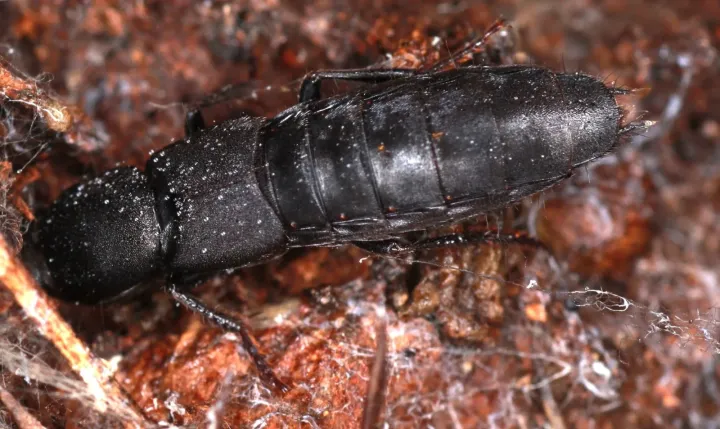
The Devil's coach horse beetle (Ocypus olens) is a prominent member of the Staphylinidae family, commonly known as rove beetles.
It is a large, predatory insect that typically measures between 20 mm and 30 mm in length, characterized by its elongated, matte black body.
Its most recognizable feature is the behavior of curving its abdomen upward when threatened, which makes it resemble a scorpion.
The beetle has short elytra that do not fully cover the abdomen, exposing several abdominal segments, which is a classic trait for the rove beetle group.
When disturbed, it produces a foul-smelling, milky secretion from glands at the end of its abdomen to deter potential predators.
What it damages
In agronomic terms, the Devil's coach horse beetle is classified as a beneficial insect rather than a crop pest.
It is an active predator that feeds on various soil invertebrates, including slugs, snails, earthworms, and larvae of harmful crop insects.
By consuming these pests, the beetle performs a vital role in biological control, helping to reduce damage to vegetable and ornamental plants.
The species is entirely carnivorous and does not feed on plant tissues, meaning it poses no risk to roots, stems, or leaves of agricultural crops.
Its presence in an agro-ecosystem is a sign of a balanced environment where natural enemies are actively managing pest populations.
When it appears
These beetles are most active during the warmer months, typically from spring through late autumn when temperatures are moderate.
They are primarily nocturnal, hunting during the night and seeking shelter under debris, wood, or stones during the daylight hours.
During the winter months, adult beetles hibernate in protected sites such as leaf litter, mulch, or crevices, often remaining dormant until spring.
The reproductive cycle is often completed in the autumn, leading to the development of larvae that also reside in the soil layers.
Active adults are frequently encountered during seasonal agricultural tasks, reflecting their continuous presence in fertile, well-managed soil.
Signs of infestation
There are no signs of "infestation" for this species, as it does not inflict damage to plant tissues or roots in the way traditional pests do.
Finding these beetles during routine garden inspections should be viewed as a positive indicator of biological activity and high soil quality.
Any sightings of the beetle are simply signs of its natural hunting activity, as it roams the soil surface looking for soft-bodied prey.
Because they are not pests, there is no requirement to monitor their populations as one would with harmful insects that threaten harvest yields.
A lack of chemical residues in the soil often supports higher populations of these beneficial predators, contributing to overall plant health.
Control measures
No control measures are necessary, as the Devil's coach horse beetle should be actively protected and encouraged in gardens and farms.
To preserve this beneficial population, avoid broad-spectrum insecticide applications that are lethal to beneficial arthropods.
Maintaining mulch layers and providing suitable habitat, such as undisturbed areas with organic debris, will ensure a stable presence of this predator.
Integrating biological control strategies instead of relying solely on chemicals helps sustain populations of Ocypus olens for long-term pest management.
- Reduce or eliminate the use of harmful pesticides.
- Maintain soil moisture and organic ground cover.
- Provide safe overwintering sites like wood piles or dense foliage.
Taxonomy
- Latin name
- Ocypus
- Order
- Coleoptera (beetles)
- Family
- Staphylinidae
- EPPO code
- OCYPSP
Discussion
No discussions yet — be the first.