
Coxcomb prominent
Notodonta ziczac
Description
How to identify
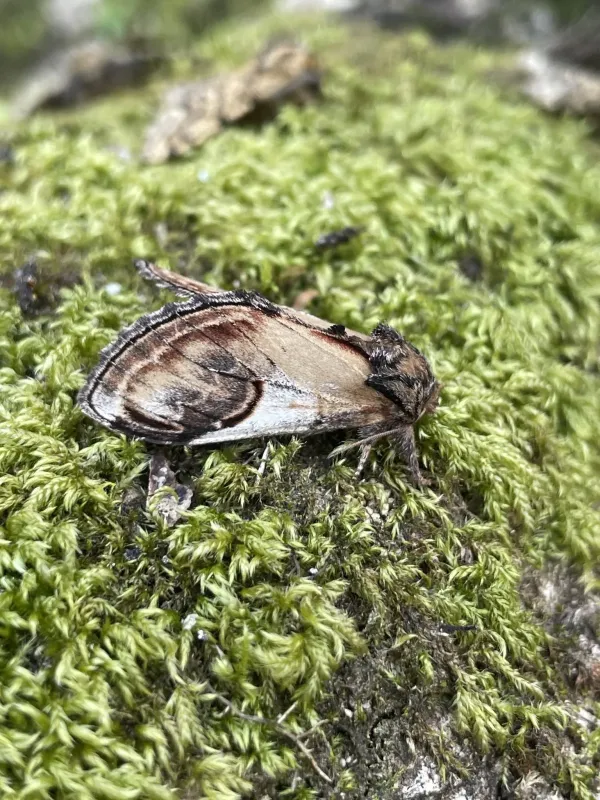
The Coxcomb prominent (Notodonta ziczac) is a moth belonging to the Notodontidae family. The adult moth has a wingspan of 40–50 mm, featuring brownish-grey forewings with a distinct zigzag pattern that provides camouflage against tree bark.
The larvae are highly distinctive, reaching up to 50 mm in length. They possess prominent humps on their bodies, and when threatened, they lift both the anterior and posterior ends, mimicking a dry twig or debris.
Larval coloration varies from shades of green to brown-grey, allowing them to blend seamlessly with the foliage and twigs of their host plants, which makes them difficult to spot during the day.
The pupae are dark brown, robust, and protected by dense cocoons. They typically overwinter in the soil or among leaf litter, emerging as adults in late spring or summer depending on local temperatures.
The life cycle can consist of one or two generations per year, with the emergence of moths usually occurring between May and August, synchronized with the active growth phase of the host trees.
What it damages
The primary host plants for the Coxcomb prominent are trees in the Salicaceae family. Poplars, including aspens, and various willow species are the most frequently targeted plants.
In nurseries and young plantations, the feeding activity of these caterpillars can be severe, causing significant defoliation that hinders the development of the trees during their most crucial growth years.
The pest often affects decorative plantings, where even partial defoliation can ruin the aesthetic value of the trees. Repeated infestations lead to reduced vigor, making the trees susceptible to secondary stressors.
Large colonies of caterpillars can strip foliage from entire branches, leading to a visible reduction in photosynthesis, which stunts tree growth and can result in premature leaf drop.
Economic damage is typically observed in forestry operations, where heavy defoliation reduces the annual biomass increment of poplar timber, necessitating management interventions.
Signs of infestation
Evidence of an infestation usually begins with visible leaf damage. Younger caterpillars skeletonize the leaves, consuming the tissue between veins, while older larvae consume the entire leaf blade.
Frass (caterpillar droppings) accumulating on the leaves or the ground beneath the tree canopy is a clear indicator of active feeding. Careful inspection of the underside of leaves often reveals the larvae.
Significant defoliation is the most obvious sign. If trees appear thin or have branches stripped of leaves in mid-summer, it is likely that a defoliator like the Coxcomb prominent is present.
During the day, search for caterpillars by looking for their characteristic bent, twig-like posture on branches. They are experts at hiding and will stay motionless if disturbed, which is a common defensive behavior.
In cases of severe outbreaks, the presence of the larvae can be detected by the sound of feeding or by the presence of silken threads that the caterpillars use to secure themselves to the leaves.
Control measures
Mechanical control is effective for small-scale infestations: manually collecting larvae or pruning affected branches can prevent the spread if the infestation is caught early.
Biological control using microbial insecticides, such as Bacillus thuringiensis (Bt), is highly effective. These treatments specifically target the caterpillars while sparing beneficial insects and natural predators.
Chemical control involving approved insecticides may be necessary during severe outbreaks. Applications should be timed precisely to coincide with the hatching period of the larvae for maximum efficiency.
Encouraging natural enemies, such as insectivorous birds and parasitic wasps, plays a vital role in keeping populations of the Coxcomb prominent under the economic threshold in natural forest settings.
Cultural practices, including the removal of leaf litter where pupae overwinter and ensuring trees are adequately watered and fertilized, help improve overall tree resistance against defoliating pests.
Taxonomy
- Latin name
- Notodonta ziczac
- Order
- Lepidoptera (butterflies)
- Family
- Notodontidae
- EPPO code
- NOTDZI
Discussion
No discussions yet — be the first.