
Nomada ruficornis
Nomada ruficornis
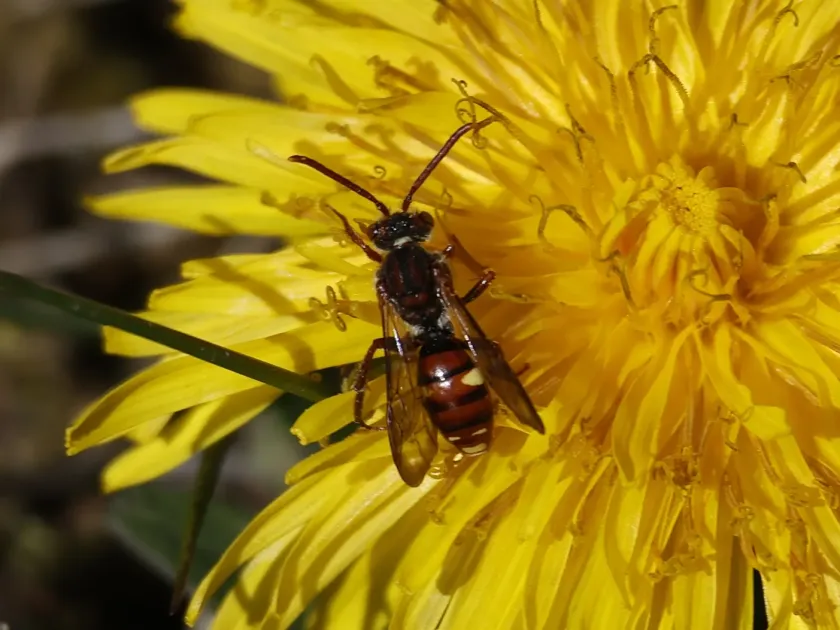
Description
How to identify
Nomada ruficornis is a species of cuckoo bee belonging to the family Apidae. These insects are often misidentified as wasps due to their appearance.
Adult specimens typically range from 8 to 12 mm in length. They feature a black and yellow striped abdomen that mimics common social wasps.
The name "ruficornis" refers to the distinct reddish antennae found in females, which is a key diagnostic feature for species identification.
They possess very little hair compared to typical honey bees and lack the pollen-carrying structures such as scopa on their legs.
Their bodies are characterized by heavy puncturing, particularly on the head and thorax, which contributes to their robust and sturdy appearance.
What it damages
Nomada ruficornis does not feed on plant tissues directly; however, it poses a significant threat to agricultural productivity by targeting pollinators.
The species is a kleptoparasite that invades the nests of Andrena bees, which are essential for the pollination of orchards and vegetable crops.
By consuming the food provisions and killing the larvae of these pollinators, the parasite significantly reduces the efficacy of natural pollination.
A decline in the Andrena bee population leads to lower fruit set and yield in various entomophilous crops like apples, cherries, and strawberries.
This disruption of the pollinator life cycle can have negative economic implications for farmers who rely on wild bees for crop success.
When it appears
The adult Nomada ruficornis emerges in early spring, typically around April, coinciding with the activity of their primary host, the Andrena bee.
The peak period for their reproductive activity occurs between May and June, during the most intensive flowering stage of many agricultural plants.
During this time, the female is highly active in searching for host burrows, patrolling the ground for access to underground nest cells.
While adults visit flowers to feed on nectar, they do not participate in organized pollination tasks and are essentially non-contributory to crop fertilization.
The cycle ends as the summer heat progresses, with the subsequent generation remaining in the soil as larvae until the next spring season.
Signs of infestation
Visible signs of infestation include heightened activity near ground-nesting sites, where Nomada individuals are seen scouting for entry points.
A noticeable decrease in the abundance of Andrena bees flying around their nest entrances is a strong indicator of successful parasitism in the area.
In the fields, growers might observe a lack of fruit or seed development despite ideal weather conditions and high floral availability during the spring.
One can also observe individual Nomada bees flying low over the soil, exhibiting a characteristic investigative behavior typical of brood parasites.
The presence of abandoned or disturbed nest chambers in the ground, upon excavation, serves as evidence of the parasite's developmental impact.
Control measures
Chemical control is not recommended for this species because insecticides usually cause more harm to the essential pollinators than to the parasite.
The best strategy involves protecting and maintaining suitable nesting habitats for wild bees by leaving patches of undisturbed, bare soil.
Farmers should avoid broad-spectrum pesticide applications, especially during the peak flowering season, to ensure the survival of beneficial bee populations.
Promoting local biodiversity by planting native floral borders can support healthy bee colonies, making them more resilient to parasitic pressure.
Integrated Pest Management (IPM) practices focusing on biological conservation are the most effective way to mitigate the damage caused by Nomada ruficornis.
Taxonomy
- Latin name
- Nomada ruficornis
- Order
- Hymenoptera
- Family
- Apidae
- EPPO code
- NOMDRU
Discussion
No discussions yet — be the first.