
Nomada bee
Nomada
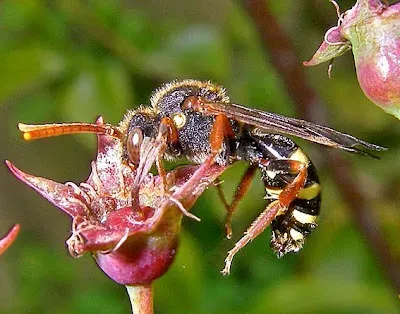
Description
How to identify
The Nomada genus, commonly known as cuckoo bees, comprises a vast group of solitary insects that exhibit striking resemblance to wasps or hoverflies.
These bees belong to the family Apidae and are easily identified by their relatively smooth, hairless bodies, which are typically marked with yellow, red, or black patterns.
A key distinguishing feature is the complete absence of pollen-collecting structures, such as scopa or corbiculae, as they do not provide food for their offspring.
Adult Nomada bees range from 5 mm to 15 mm in length and utilize their wasp-like appearance as a form of Batesian mimicry to deter potential predators.
Because there are hundreds of species within this genus, accurate identification to the species level often requires examination of specific wing venation or abdominal patterns.
What it damages
Nomada bees do not inflict direct damage on agricultural crops, as they do not feed on plant foliage, roots, or fruit during any stage of their life cycle.
However, they act as cleptoparasites, meaning they target the nests of other solitary bees, particularly those in the genus Andrena, to deposit their eggs.
The Nomada larva consumes the egg or larva of the host bee and subsequently feeds on the pollen and nectar stores gathered by the host for its own offspring.
By reducing the survival rate of these vital solitary pollinators, Nomada populations can indirectly lead to a decline in pollination efficiency on a field or garden scale.
In high densities, these parasites can significantly impact the stability of native pollinator populations, which are essential for many insect-pollinated crops.
When it appears
The adult Nomada activity is precisely synchronized with the phenology of their specific host bee species, which primarily nest during the early spring season.
Peak activity typically occurs from April through May, matching the time when host bees begin digging and provisioning their subterranean nesting burrows.
They are most active on warm, sunny days when they can be seen hovering near potential nesting sites, waiting for the host to leave the nest unguarded.
The life cycle concludes with the Nomada larva overwintering within the host's nest cell as an adult or a prepupa, ready to emerge the following spring.
Understanding this seasonal emergence is key to observing these bees, as their presence is usually transient and tied to the active period of their host species.
Signs of infestation
The presence of Nomada is frequently indicated by the sight of numerous wasp-like bees investigating patches of exposed, well-drained soil where solitary bees nest.
Observing bees flying slowly and methodically close to the ground, frequently landing at the entrance of nesting burrows, is a classic sign of cuckoo bee activity.
In fields with high parasitism rates, one might notice a lower than expected number of healthy solitary bees emerging during the peak bloom of target crops.
Direct nest inspection, if possible, might reveal the presence of Nomada larvae instead of the host species inside the provisions-filled cells.
General monitoring of pollinator activity levels can help establish if there is a shift in the local bee community toward parasitic species.
Control measures
Chemical control is never advised for Nomada, as any intervention aimed at these bees would likely kill the very beneficial pollinators they are parasitizing.
Effective management focuses on creating robust habitats for host bees, such as protecting nesting sites from heavy tillage and soil disturbance.
Ensuring a consistent supply of nectar and pollen throughout the season helps keep host bee populations healthy and better equipped to defend their nests.
Maintaining diverse wildflower borders promotes a healthy ecosystem where pollinators and their parasites can coexist without significant impact on crop yields.
Ultimately, the goal is to favor the health of the entire local bee community, as parasites like Nomada are a natural component of a functioning ecosystem.
Taxonomy
- Latin name
- Nomada
- Order
- Hymenoptera
- Family
- Apidae
- EPPO code
- NOMDSP
Discussion
No discussions yet — be the first.