
Boobook
Ninox
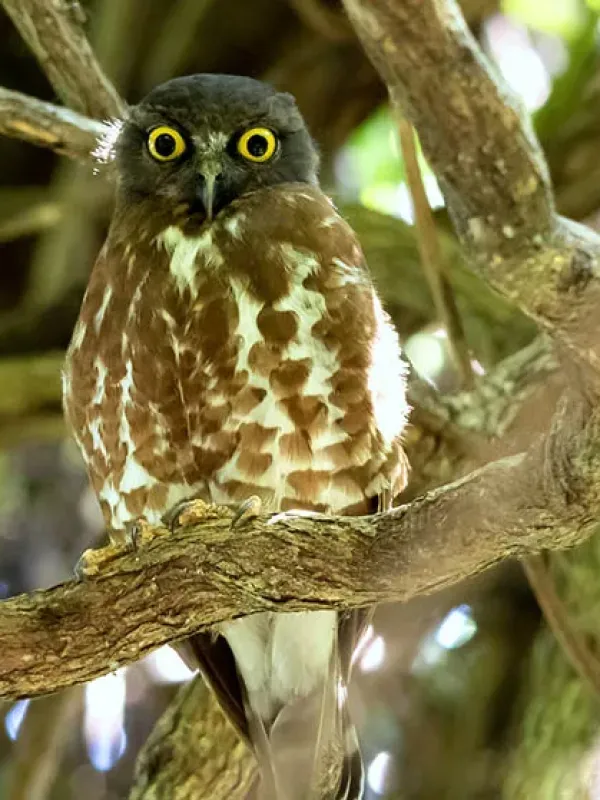
Description
How to identify
The Boobook (genus Ninox) belongs to the family Strigidae, commonly known as hawk owls. These birds are easily identified by their relatively small size, lack of a facial disk, and large, piercing yellow eyes.
The plumage of Ninox species is typically mottled with brown, white, and grey tones, providing excellent camouflage against tree bark. Their specific name stems from the stiff, bristle-like feathers that cover their tarsi, which help them grasp slippery prey.
These owls are primarily nocturnal and crepuscular, meaning they are most active during the night and at twilight. They are widely distributed across Asia, Australia, and parts of the Pacific, inhabiting various ecosystems including forests and rural farmlands.
Their behavior is strictly predatory. They rely on their keen hearing and vision to locate prey in low light conditions. They are specialized hunters that have evolved to fill a specific ecological niche as meso-predators.
Biologically, they are obligate carnivores. Their anatomy, including hooked beaks and powerful talons, is specifically designed for subduing and consuming animal prey rather than plant matter.
What it damages
It is important to clarify that the Boobook owl is not an agricultural pest. It does not feed on crops, vegetables, fruits, or grains, and therefore poses zero threat to harvest production.
On the contrary, the presence of these owls in an agricultural setting provides significant benefits. They are highly effective at controlling populations of small rodents, such as field mice and voles, which cause extensive damage to crops.
Furthermore, their diet includes large insects, such as beetles and locusts, which can be significant pests if left unchecked. By regulating these populations, the owls act as a natural, biological control agent on the farm.
There is no economic damage associated with the Boobook; rather, they save farmers costs by reducing the need for rodenticides and insect control measures.
Recognizing the beneficial nature of these raptors is a key component of modern, sustainable agricultural management and ecosystem health maintenance.
Control measures
There are no control measures directed against the Boobook owl, as they are considered beneficial biodiversity assets in agricultural landscapes. Their protection is encouraged by environmental guidelines.
Farmers can enhance the effectiveness of these owls by preserving nesting trees and installing artificial nest boxes near fields. This practice helps stabilize the population of rodent-preying birds in the area.
To ensure the health of these raptors, it is advisable to practice integrated pest management (IPM) that minimizes the use of toxic pesticides which can cause secondary poisoning in birds of prey.
If interaction with infrastructure is undesirable, passive deterrents such as visual scaring devices can be used, ensuring that they do not harm the bird physically.
Maintaining a balanced ecosystem where raptors like the Ninox thrive is a proactive strategy for achieving sustainable long-term results in crop protection.
Taxonomy
- Latin name
- Ninox
- Family
- Strigidae
- EPPO code
- NINOSP
Discussion
No discussions yet — be the first.