
Brown planthopper
Nilaparvata lugens
Description
How to identify
The Brown planthopper (Nilaparvata lugens) is a notorious pest belonging to the Delphacidae family, specifically recognized for causing severe damage to rice crops worldwide.
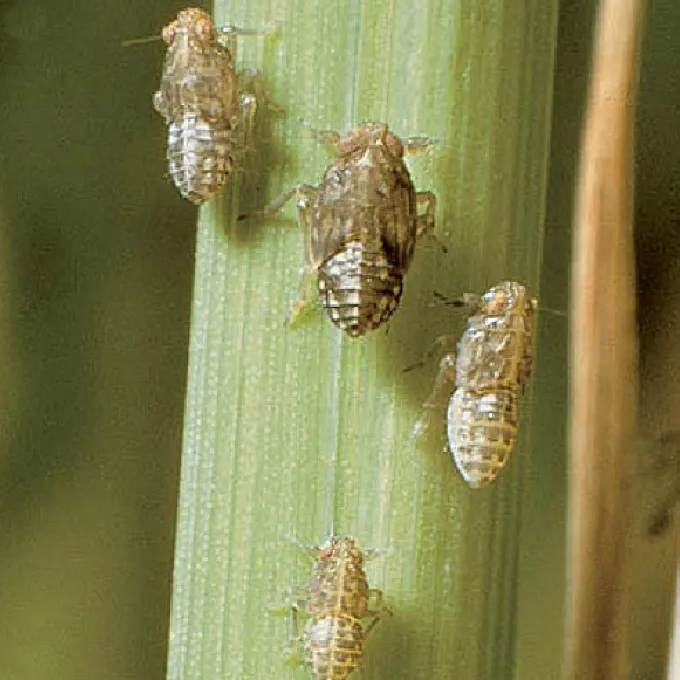
Adults are small, measuring about 3 to 5 mm in length, and vary in color from light brown to dark chocolate brown. They have distinct sensory organs on their heads.
This species displays a dimorphism characterized by macropterous (long-winged) and brachypterous (short-winged) forms, with the long-winged ones capable of long-distance migration.
The life cycle consists of three main stages: egg, nymph, and adult. Development takes place primarily in the lower sections of the rice plant near the water line.
Populations are known for their rapid growth rates under high humidity and temperature, leading to sudden outbreaks that can devastate large agricultural areas.
What it damages
The Brown planthopper damages rice by sucking plant sap directly from the phloem, which starves the plant of vital nutrients and water.
Beyond direct feeding, it is a primary vector for viral diseases, including Rice Grassy Stunt and Rice Ragged Stunt, which prevent grain formation.
Severe infestations lead to "hopperburn," a condition where large patches of rice plants turn brown and wither completely due to sap depletion.
Indirect damage occurs via the growth of sooty mold on the honeydew excreted by the hoppers, which inhibits photosynthesis on the leaf surface.
Economic losses are cumulative, starting from reduced growth rates and ending with total crop failure if the population density is not controlled in time.
When it appears
Planthopper outbreaks are closely linked to warm, humid tropical and subtropical climates, where they can reproduce continuously throughout the year.
The pest typically thrives during the mid-to-late growth stages of rice when the canopy provides a dense, humid microclimate protected from direct sun.
Migration events are often triggered by seasonal shifts in monsoon winds, which carry winged adults into new, previously uninfested rice cultivation zones.
Each generation completes its cycle quickly, often within 20 to 30 days, allowing for multiple generations during a single cropping season.
Water management plays a critical role in seasonal activity; stagnant water or improper drainage promotes survival and faster population buildup.
Signs of infestation
Initial symptoms are often subtle, presenting as stunted plant growth and a slight yellowing of the lower leaves within the canopy.
Closer inspection of the stem base reveals clusters of nymphs and adults that scuttle away or hop when disturbed, indicating an active population.
The presence of honeydew deposits on the foliage acts as an attractant for ants and promotes the dark, crusty appearance of sooty mold on stems.
As the infestation progresses, circular patches of "burnt" or dead rice plants emerge, which expand rapidly as the insects move outward.
Empty or poorly filled panicles are a clear indicator of infestation during the grain-filling stage, reflecting the loss of plant vigor.
Control measures
Integrated Pest Management (IPM) is essential, starting with the use of host-plant resistant rice varieties developed specifically to deter the hopper.
Agronomic practices like alternate wetting and drying of rice paddies can effectively disrupt the insect's life cycle and reduce its survival rate.
Avoiding the overuse of nitrogen-based fertilizers is crucial, as they promote lush, succulent plant growth that makes the crop more susceptible.
Conservation of natural enemies, such as mirid bugs, spiders, and parasitic wasps, provides a biological buffer against population spikes.
Targeted chemical applications should only be utilized as a last resort, choosing selective insecticides that do not harm the beneficial predatory insect population.
Taxonomy
- Latin name
- Nilaparvata lugens
- Order
- Hemiptera (bugs, aphids, leafhoppers)
- Family
- Delphacidae
- EPPO code
- NILALU
Discussion
No discussions yet — be the first.