
Brown planthopper
Nilaparvata
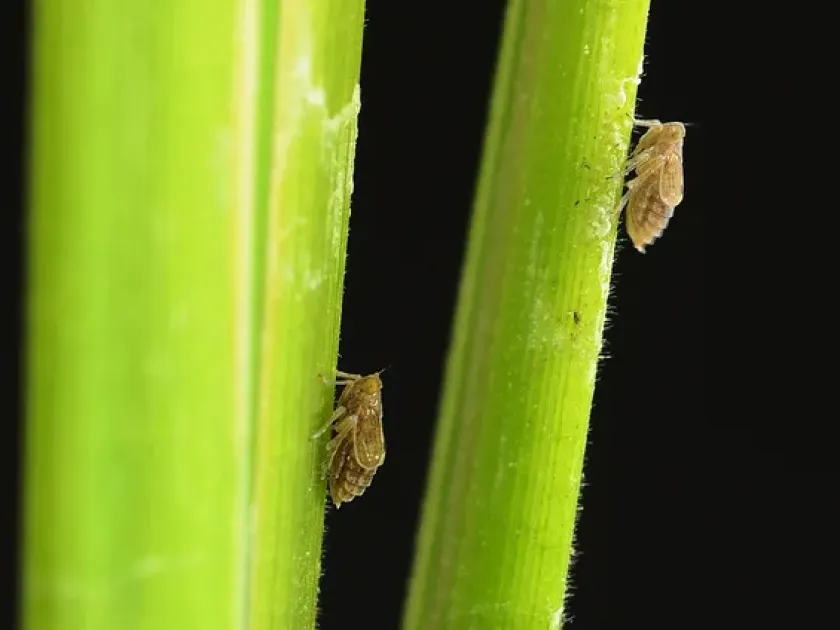
Description
How to identify
The Brown planthopper (Nilaparvata lugens) is a significant insect pest belonging to the order Hemiptera and the family Delphacidae. It is considered one of the most destructive pests of rice crops globally.
Adults are small, measuring about 3–5 mm in length. There are two distinct morphs: macropterous (long-winged) adults, which are migratory, and brachypterous (short-winged) adults, which are adapted for rapid local reproduction.
The body coloration ranges from light brown to dark brown, which provides camouflage against the rice stems where they spend most of their life cycle.
Nymphs go through five developmental stages (instars) before reaching adulthood. They closely resemble the adults but lack functional wings, making them highly dependent on the immediate environment of the rice plant.
Eggs are typically inserted into the leaf sheaths or the stem tissue of the rice plant, making them difficult to detect and protect them from predators and many pesticide applications.
What it damages
The Brown planthopper is a phloem feeder, meaning it relies almost exclusively on rice plants (Oryza sativa) as a host for nutrition.
By inserting its stylet into the phloem, the insect extracts vital nutrients, which leads to the weakening of the plant, stunting of growth, and reduced yield capacity.
The pest is a primary vector for viral diseases, including rice grassy stunt virus and rice ragged stunt virus, which cause severe yield losses.
Direct damage often results in "hopperburn," a phenomenon where large sections of the rice field turn brown and wither due to the massive feeding pressure from thousands of insects.
The damage is cumulative; as the population increases, the metabolic stress on the rice crop leads to total crop failure if intervention is not timely.
When it appears
The life cycle of Nilaparvata lugens is highly dependent on climate, with population peaks occurring during periods of high humidity and moderate-to-high temperatures.
Migration events often coincide with prevailing wind patterns, allowing the pest to infest new geographical areas rapidly during the rice growing season.
In tropical and subtropical regions, multiple overlapping generations occur throughout the year, sustaining the population density in active rice fields.
The pest's density typically increases exponentially during the tillering and elongation stages of the rice crop, coinciding with the plant's peak nutritional availability.
Survival during the off-season or winter months depends on the presence of alternative grass hosts or favorable microclimates in stubble and weeds.
Signs of infestation
The initial signs of an infestation include the yellowing of the lower leaves of the rice plant, often overlooked by farmers until the population density becomes high.
Closer inspection of the base of the stems reveals large colonies of nymphs and adults that scurry away when the plant is disturbed.
The presence of honeydew on the leaves and water surface is a diagnostic indicator; this sugary substance encourages the growth of sooty mold.
Sooty mold growth results in a black, powdery coating on the lower parts of the rice plants, which further inhibits photosynthesis.
- Development of hopperburn patches in the field.
- Presence of black sooty mold on stems.
- Easy uprooting of infested plants due to root damage.
- Delayed or failed panicle emergence.
- Increased proportion of unfilled grains (chaff).
Control measures
Integrated Pest Management (IPM) is the most effective approach to control Brown planthopper, emphasizing host plant resistance and natural biological control.
Farmers are advised to plant rice varieties that carry resistance genes to minimize the reliance on chemical insecticides which can disrupt natural predator populations.
Proper water management, such as alternate wetting and drying, can help reduce the humidity at the base of the plants, creating a less favorable environment for the insects.
Balanced fertilization, particularly avoiding excessive nitrogen, helps maintain stronger plant tissues that are less susceptible to rapid pest colonization.
Chemical control should be applied using systemic insecticides targeted at the base of the plant only when the economic threshold is reached, ensuring that beneficial insects like spiders and mirid bugs are preserved.
Taxonomy
- Latin name
- Nilaparvata
- Order
- Hemiptera (bugs, aphids, leafhoppers)
- Family
- Delphacidae
- EPPO code
- NILASP
Discussion
No discussions yet — be the first.