
Common spangle gall wasp
Neuroterus quercusbaccarum
Description
How to identify
The common spangle gall wasp, known scientifically as Neuroterus quercusbaccarum, is a small insect belonging to the family Cynipidae. It is widely recognized for its ability to induce complex gall formations on oak trees.
Adult wasps are very small, typically measuring only 2-3 mm. Due to their dark coloration and diminutive size, they are rarely observed in the canopy, making the identification of the species primarily dependent on the galls they produce.
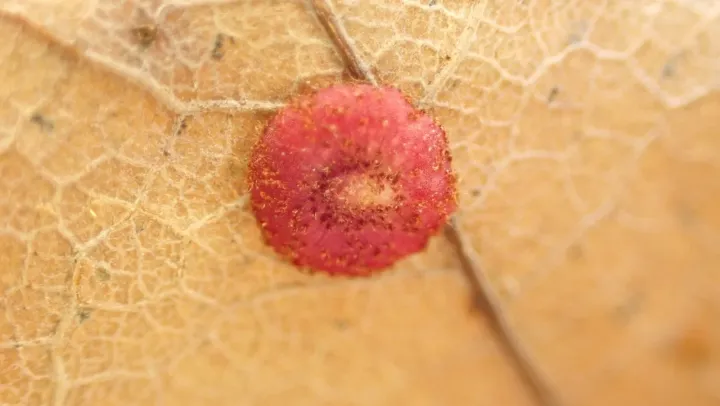
The galls produced by this species are distinct, often referred to as "spangle galls" because of their flattened, disc-like appearance on the underside of oak leaves, or "currant galls" when they appear on catkins.
The life cycle involves an alternation of generations. There is an asexual generation consisting entirely of females and a sexual generation producing both males and females, which alternate throughout the year.
Each generation requires specific host tissues to complete its development, showing a remarkable adaptation to the phenology of the oak tree.
What it damages
The primary host for this wasp is the pedunculate oak (Quercus robur). The larvae feed on the nutritive tissues within the galls, which are created by the plant in response to secretions from the insect.
While a few galls do not harm a mature, healthy oak tree, significant infestations can result in a massive diversion of the tree's metabolic resources, potentially slowing growth rates.
High densities of galls can lead to premature leaf yellowing and shedding, which impairs the tree's photosynthetic capacity during the peak of the growing season.
Young trees in nurseries or newly planted saplings are the most vulnerable to the stress caused by these wasps, as they lack the resource reserves of mature trees to compensate for the tissue loss.
Furthermore, weakened trees may become susceptible to secondary infections or other pests that take advantage of the reduced vitality caused by heavy gall infestation.
When it appears
The sexual generation emerges in the spring, coinciding with the flowering of the oak. Adults lay eggs into the developing catkins, resulting in small, fleshy currant-like galls.
In early summer, the adults of this sexual generation emerge and lay eggs on the leaves, initiating the asexual generation that develops throughout the summer months.
By mid-to-late summer, the characteristic spangle galls are clearly visible on the underside of the leaves, where they grow and harden as the season progresses.
As autumn arrives, the leaves fall to the ground with the galls attached. The larvae remain inside these galls during the winter months, successfully overwintering in the leaf litter.
The cycle completes the following spring when adults emerge from the overwintering galls to infect the newly developing oak catkins once again.
Signs of infestation
The most prominent sign of infestation is the appearance of numerous small, circular, disc-shaped structures on the undersides of leaves during summer.
These galls often feature a central bump and can range in color from pale green or yellow to shades of red or brown, depending on their maturity and exposure to sunlight.
In cases of heavy infestation, the foliage may appear sparse or show early signs of senescence, with leaves turning yellow or drying out before the natural autumn period.
The presence of fleshy, globular galls on oak catkins during the spring is another indicator that the sexual generation is active within the tree's canopy.
Inspecting the leaf litter beneath the trees in late autumn reveals the hardened, brown galls, confirming that the wasp population is present in the local environment.
Control measures
The most effective management practice in residential settings is the thorough collection and removal of fallen leaves during the autumn, which eliminates the overwintering larvae.
Chemical control is generally not recommended for large oak trees due to the difficulty of application and the limited impact on established populations.
Encouraging biodiversity in the garden helps maintain populations of natural predators and parasitoids that serve as biological control agents for the wasp.
Ensuring trees receive adequate water and nutrients helps them maintain their vigor, allowing them to better withstand the pressure from gall wasp infestations.
- Clear leaf litter from under trees in late autumn.
- Maintain tree health through proper fertilization and watering.
- Avoid unnecessary pesticide use that might kill natural beneficial insects.
Taxonomy
- Latin name
- Neuroterus quercusbaccarum
- Order
- Hymenoptera
- Family
- Cynipidae
- EPPO code
- NEUTQU
Discussion
No discussions yet — be the first.