
Two-horned gall wasp
Andricus bicornis
Description
How to identify
The two-horned gall wasp (Andricus bicornis) is a member of the Cynipidae family within the Hymenoptera order. It is a tiny insect known for causing pathological growths, known as galls, on oak trees.
Adult wasps lead a cryptic life, focusing their activity on laying eggs within the host's young tissues. This process triggers the plant to develop specialized structures that house and feed the developing larvae.
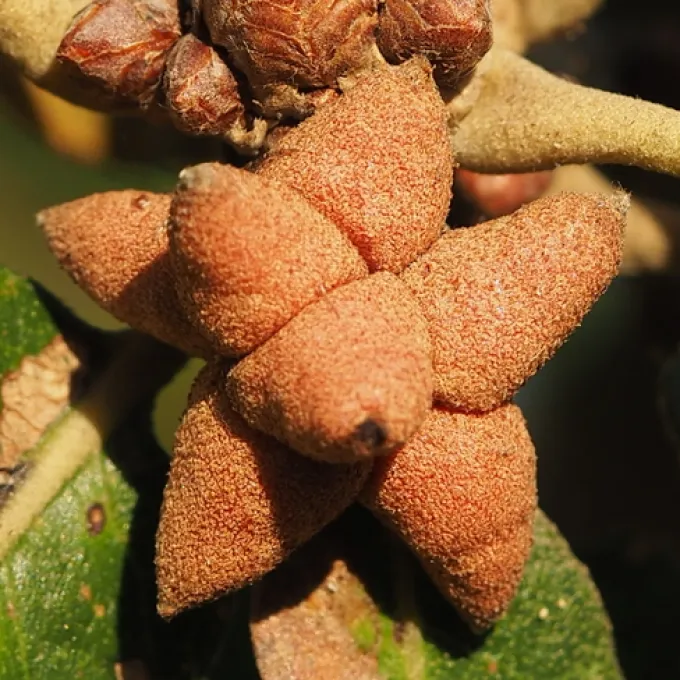
The galls are highly distinctive due to their two-horned shape, which serves as a primary diagnostic feature. Their color transitions from light green to reddish-brown as the wasp larva matures inside.
Identifying this pest requires examining the buds and young shoots of oak trees. The species often exhibits a complex life cycle, involving alternating generations that may differ significantly in appearance and behavior.
The biology of this species is intricately linked to its host. Being protected inside a hardened gall makes the larvae resilient to external environmental conditions, complicating traditional pest management efforts.
What it damages
The primary host for this pest is the oak (Quercus). The wasp prefers laying eggs in developing leaf tissues or buds, leading to severe morphological changes in these plant organs.
Infestation of buds negatively impacts the tree's growth potential. As the larvae feed, the tree redirects essential nutrients toward the gall instead of healthy branch development, resulting in stunted shoots.
Heavy infestations can lead to premature leaf drop and a significant decline in the aesthetic value of the trees. Young nursery saplings and forest plantations are particularly vulnerable to these physiological stresses.
While a single gall rarely kills a mature tree, cumulative damage reduces the host's overall vigor. This makes the oak more susceptible to secondary pests and various opportunistic fungal pathogens.
The damage also includes metabolic disruption of the infested branches. The tree is forced to invest energy into maintaining the gall, which reduces the resources available for wood density and overall canopy strength.
When it appears
The insect's activity begins in the spring, coinciding with the budding of oak trees. This is when adult wasps emerge and deposit their eggs into the soft tissues of the emerging buds.
Galls develop progressively throughout the growing season. Larvae feed internally, causing the gall to expand in volume as they consume the plant tissue provided by the host response.
The emergence of adult wasps from the galls can be staggered over a long period. Certain generations may enter a dormant state, ensuring the species' survival across different environmental challenges.
During the summer, the galls reach their full size and become highly visible on the branches. This is the optimal window for monitoring population levels and conducting damage assessments.
The cycle often concludes in autumn or winter, depending on the specific generation's biology. Overwintering occurs primarily in the larval stage, either inside the galls or within the leaf litter/soil.
Signs of infestation
The most reliable sign of an infestation is the presence of distinctive two-horned growths on the oak leaves or buds. These structures are unmistakable manifestations of the wasp's presence.
- Presence of numerous galls with characteristic "horns" on twigs or leaves.
- Visible deformation and twisting of young shoots.
- Premature yellowing and desiccation of specific leaves.
- Reduced growth rates in saplings during high-density outbreaks.
- Exit holes on the galls, indicating that the adult wasp has successfully emerged.
Regular visual inspections of the tree canopy during the early spring are essential for detecting outbreaks early. Special attention should be paid to young or ornamental oaks in parks and gardens.
Control measures
Chemical control is largely ineffective against the two-horned gall wasp because the larvae are safely shielded by the thick, woody walls of the gall. Management relies heavily on cultural practices and enhancing tree immunity.
Sanitary pruning and the removal of infested branches are effective measures for small-scale infestations. Collecting and destroying fallen leaves and galls at the end of the season helps to limit the next year's population.
In nurseries, biological control methods, such as encouraging the presence of natural parasitoids that target gall wasp larvae, are recommended to maintain ecological balance.
Ensuring optimal growing conditions, including proper irrigation and fertilization, boosts the oak's inherent resistance. A healthy tree is better equipped to compensate for the tissue loss caused by the galls.
Preventive monitoring is the key to preventing mass outbreaks. Upon finding the first set of galls, manual removal and destruction of the infected material should be prioritized to prevent the spread of the next generation.
Taxonomy
- Latin name
- Andricus bicornis
- Order
- Hymenoptera
- Family
- Cynipidae
- EPPO code
- ANDIBI
Discussion
No discussions yet — be the first.