
Oak felt gall wasp
Neuroterus floccosus
Description
How to identify
The oak felt gall wasp Neuroterus floccosus is a small hymenopteran insect belonging to the family Cynipidae, known for its ability to induce complex gall formations on oak trees.
Adult wasps are tiny and elusive, often difficult to spot in the forest canopy, making the identification of the species primarily based on the galls they create.
Like many species in its family, it exhibits a complex life cycle involving alternating generations, which is a specialized survival strategy within the forest ecosystem.
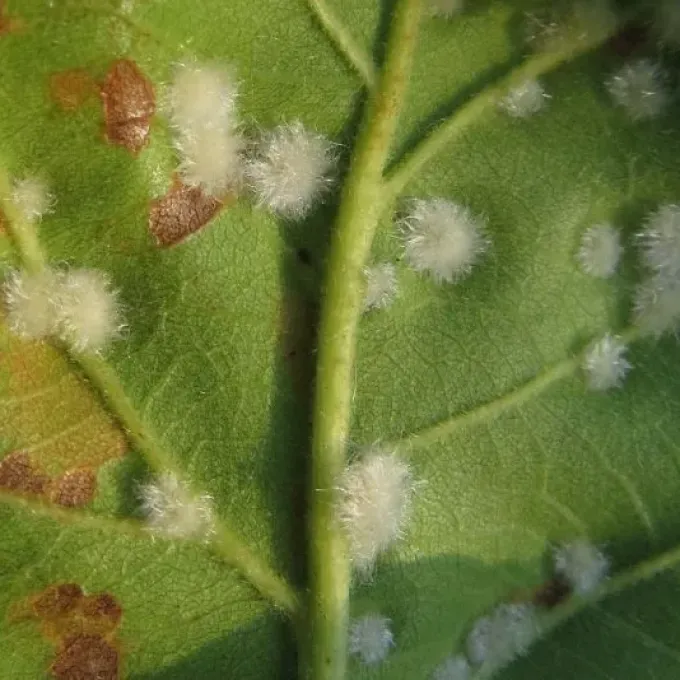
The name floccosus refers to the woolly or felt-like appearance of the galls, which the female wasp initiates by injecting substances into the plant tissue.
These wasps are highly host-specific, primarily targeting members of the genus Quercus, where they spend most of their developmental stage protected inside the gall.
What it damages
The primary hosts for this wasp are various oak species, including the pedunculate oak and sessile oak, where the larvae develop within leaf tissues.
The creation of galls diverts nutrients from the plant to the developing larva, leading to localized physiological changes in the affected leaf area.
While the impact on an individual healthy tree is usually minimal, a severe infestation can result in reduced leaf area and diminished photosynthetic efficiency.
Trees that are already suffering from environmental stress or drought may show reduced vigor when burdened by significant gall wasp activity.
In nurseries, repeated attacks on young saplings can affect their growth rates and overall health, necessitating closer management and monitoring efforts.
When it appears
The life cycle begins in spring, with the emergence of adult wasps that lay eggs into the developing buds or young leaves of the oak host.
During the summer months, the galls grow rapidly as the larvae feed and develop, sheltered within the characteristic woolly structures on the underside of leaves.
By late summer or early autumn, the larvae complete their development, and the adult wasps emerge, marking the end of the current generation cycle.
Environmental conditions, such as temperature and humidity during the spring, play a crucial role in the survival rate of the offspring.
Tracking the appearance of new galls allows for an accurate assessment of the infestation pressure within a given year for local forest management.
Signs of infestation
The most diagnostic sign of the oak felt gall wasp is the presence of numerous small, felt-like, or woolly galls on the undersides of oak leaves.
These structures often change color from light yellow to brownish as they mature, providing a distinct visual marker for the presence of the insect.
- Woolly or felt-like patches on the underside of leaf blades.
- Curling or abnormal growth of the leaf tissues near the gall sites.
- Yellowing of leaves in heavily infested canopy areas.
- Exit holes visible on the surface of mature, empty galls.
Visual inspection of the foliage is the most reliable method for detecting the species in ornamental gardens and urban oak plantings.
If many galls are found, it indicates that the local environmental conditions have been favorable for the wasp's reproductive cycle during the current season.
Control measures
In most natural forest settings, control measures for the oak felt gall wasp are typically unnecessary, as the insect rarely threatens the life of mature trees.
Promoting overall tree vigor through proper watering and soil management helps the oaks withstand the impact of gall formation more effectively.
For high-value trees or garden specimens, manually pruning and destroying infested leaves before the adult wasps emerge can help reduce the population.
Biological control agents, such as parasitoid wasps that hunt gall wasp larvae, are essential for keeping populations in balance in healthy ecosystems.
The use of chemical insecticides is rarely recommended due to the difficulty of targeting these insects and the potential harm to beneficial predatory species.
Taxonomy
- Latin name
- Neuroterus floccosus
- Order
- Hymenoptera
- Family
- Cynipidae
- EPPO code
- NEUTFL
Discussion
No discussions yet — be the first.