
Long-headed froghopper
Neophilaenus longiceps
Description
How to identify
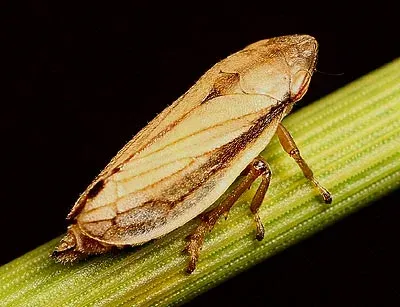
Neophilaenus longiceps belongs to the family Aphrophoridae (order Hemiptera). This small insect, reaching 5–7 mm in length as an adult, is easily identified by its characteristically elongated head.
The coloration of the adult typically ranges from light brown to yellowish-brown, often featuring longitudinal stripes. Like other members of its family, it possesses powerful hind legs designed for jumping.
The nymphs lead a cryptic lifestyle, surrounding themselves with a protective froth, commonly known as "cuckoo spit," which shields them from desiccation and predators. Adults are more mobile and observable.
These insects prefer damp habitats, including meadows and agricultural fields with dense grass cover. The life cycle consists of egg, nymph, and adult stages, adapted to temperate climates.
While often unnoticed, the species can reach high population densities under favorable weather conditions, particularly in years with high humidity and moderate temperatures.
What it damages
Neophilaenus longiceps primarily feeds on various cereal crops and wild grasses. By using its piercing-sucking mouthparts, it extracts vital cell sap from the host plant's tissues.
Significant damage occurs during the plant's active growth phases. The loss of nutrients leads to stunted development, leaf chlorosis, and a general reduction in plant vigor and final yield.
Beyond direct mechanical damage, these froghoppers are known to be potential vectors for various plant viruses and phytoplasmas. Their feeding activity can trigger the spread of diseases throughout a crop.
Visible symptoms include leaf curling, discoloration, and deformation of vegetative organs. In severe cases, the affected tillers may wither and die before maturity.
Monitoring the population density is crucial, especially during the heading stage, to prevent qualitative and quantitative losses that impact the market value of the harvest.
When it appears
The life cycle is strictly seasonal and tied to environmental conditions. The insect overwinters primarily in the egg stage, deposited within plant tissues or debris near the soil surface.
Nymphs emerge in the spring once temperatures stabilize. They undergo several molting stages, spending most of their time feeding and developing within their protective foam nests.
Adults typically appear in early summer. The population peaks during mid-summer, which coincides with the mating period and the subsequent deposition of overwintering eggs for the following season.
Typically, there is one generation per year, though partial second generations may occur in warmer climates. Warm, wet springs provide the most favorable conditions for rapid population growth.
As autumn approaches, adult activity declines, and the population shifts to the egg-laying phase to ensure the species' survival through the harsh winter months.
Signs of infestation
The most reliable sign of an infestation is the presence of the white, foamy "spittle" on stems and leaf axils. These bubbles are a clear indicator of nymphal presence on the crop.
Visual inspections may reveal small, chlorotic spots on leaves resulting from the insect's feeding punctures. Over time, these spots can merge, leading to necrotic areas on the leaf blades.
Affected plants often appear weaker or more stunted than those in non-infested areas. In cases of high infestation, the overall crop uniformity is significantly compromised.
During the cooler hours of the day, adults can be seen jumping away when disturbed. Using an insect net is an effective method for calculating population density in large-scale farming.
Discarded nymphal skins found on foliage are further evidence of a recent or ongoing infestation, signaling that the pest has successfully completed its development on the crop.
Control measures
Cultural control practices include crop rotation and the management of field margins to reduce alternative host grasses that harbor the pest. Regular mowing of weeds helps prevent migration into the crop.
Chemical control is advised when population levels exceed the economic threshold. Insecticides with contact and systemic action are effective, provided they are applied during the early nymphal stages.
The froghopper's foam acts as a natural barrier to pesticides, so incorporating adjuvants into the spray solution is recommended to ensure better coverage and efficacy of the treatment.
Biological control relies on maintaining habitats for natural predators and parasitoids, such as predatory bugs and wasps, which can naturally regulate froghopper numbers.
Yellow sticky traps are excellent for monitoring adult flight patterns. Early detection allows for timely interventions, preventing the spread of the pest and protecting the yield potential of the fields.
Taxonomy
- Latin name
- Neophilaenus longiceps
- Order
- Hemiptera (bugs, aphids, leafhoppers)
- Family
- Aphrophoridae
- EPPO code
- NEOPLO
Discussion
No discussions yet — be the first.