
Brown spittlebug
Aphrophora permutata
Description
How to identify
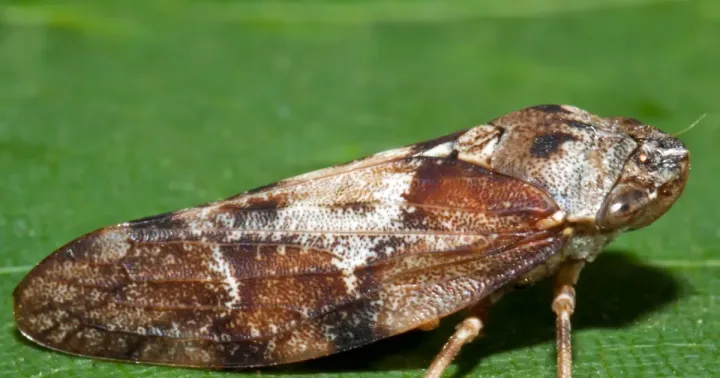
The brown spittlebug is an insect from the Aphrophoridae family, order Hemiptera. The adult has an elongated body about 10–12 mm long, colored in brown or dark shades, often with an indistinct pattern on the forewings.
A distinctive feature of the species is its ability to jump using powerful hind legs. Externally, adults resemble small cicadas, and their chitinous cover is quite dense, providing protection against adverse conditions.
The larvae are significantly different from the adults: they have a soft, yellowish-white body and live inside a foamy substance. This mass, which resembles saliva, protects them from dehydration and predators.
The insect's development involves incomplete metamorphosis, meaning there is no pupal stage. Nymphs emerge from eggs laid in plant tissues and go through several stages before reaching the adult form.
In nature, the brown spittlebug prefers humid habitats, often occurring in shrubbery, forest edges, and dense vegetation, from where they can migrate to cultivated crops.
What it damages
This pest is a polyphage capable of damaging a wide range of vegetation, including ornamental shrubs, berry crops, and various forest tree species.
The primary damage is caused by the larvae, which attach themselves to young shoots and leaves, sucking out cell sap. This leads to stunted growth and the suppression of the plant's physiological processes.
Heavy infestation causes leaf deformation: leaves curl, develop yellow or brown spots, and fall prematurely. The disruption of plant tissue integrity creates entry points for various fungal and bacterial infections.
During mass outbreaks, the yield of berry crops is significantly reduced, and ornamental plants lose their aesthetic appeal due to shoot curling and loss of turgor.
Adults also feed on plant sap, although their activity is less noticeable than the constant local damage caused by larvae clustering on specific parts of the stem.
When it appears
The life cycle of the brown spittlebug is closely linked to seasonal temperatures. The eggs typically overwinter in bark tissues or under bud scales of host plants, showing high resistance to frost.
Larvae appear in spring, during the period of active sap flow and bud break, which provides them with an ideal food source from their first days of life.
The active feeding stage of the larvae lasts for several weeks, from May to June, when they form their characteristic foamy nests on stems.
Adults (imagos) appear in mid-summer, usually in July, and remain active until the end of August or early autumn, continuing to feed and migrating to nearby areas.
Egg-laying for the winter occurs in autumn; a single female can place her eggs in bark crevices, ensuring the survival of the next generation until spring arrives.
Signs of infestation
The most obvious sign of a spittlebug's presence is the appearance of white foamy clumps on stems and in leaf axils, commonly referred to as "spittle".
Visual inspection of plants allows one to notice curled or discolored leaves that appear sickly compared to healthy neighboring branches.
When touching damaged shoots, the foamy mass can be washed away, revealing the larva—a small, mobile, light-colored creature.
In areas of pest infestation, necroses are often observed on stems, caused by both the insect's feeding and subsequent fungal infection of the wounds.
The presence of large numbers of jumping insects when shaking bushes during the summer is an indirect indication of a high pest population density on the site.
Control measures
Agrotechnical measures include regular weeding, as many weeds act as reservoirs for spittlebug larvae before they move onto cultivated crops.
In small gardens, mechanical collection or washing the foam clumps off with a strong stream of water is effective, as it destroys the larvae by removing their protective environment.
Autumn removal of fallen leaves and pruning of damaged shoots can drastically reduce the number of overwintering eggs and limit the population size for the next season.
In cases of severe infestation, systemic chemical insecticides are applied, which penetrate the plant sap and provide long-lasting protection against sap-sucking pests.
- Use of biological products based on entomopathogenic fungi.
- Timely fertilization to boost plant immunity.
- Attracting beneficial insects (entomophages) that are natural enemies of the spittlebug.
Taxonomy
- Latin name
- Aphrophora permutata
- Order
- Hemiptera (bugs, aphids, leafhoppers)
- Family
- Aphrophoridae
- EPPO code
- APHRPE
Discussion
No discussions yet — be the first.