
Pine spittlebug
Aphrophora parallela
Description
How to identify
The pine spittlebug (lat. Aphrophora parallela) is a member of the Aphrophoridae family, commonly known for its distinctive nymphal stage.
Adult bugs are approximately 10–12 mm long, characterized by a brownish mottled appearance that provides excellent camouflage against tree bark.
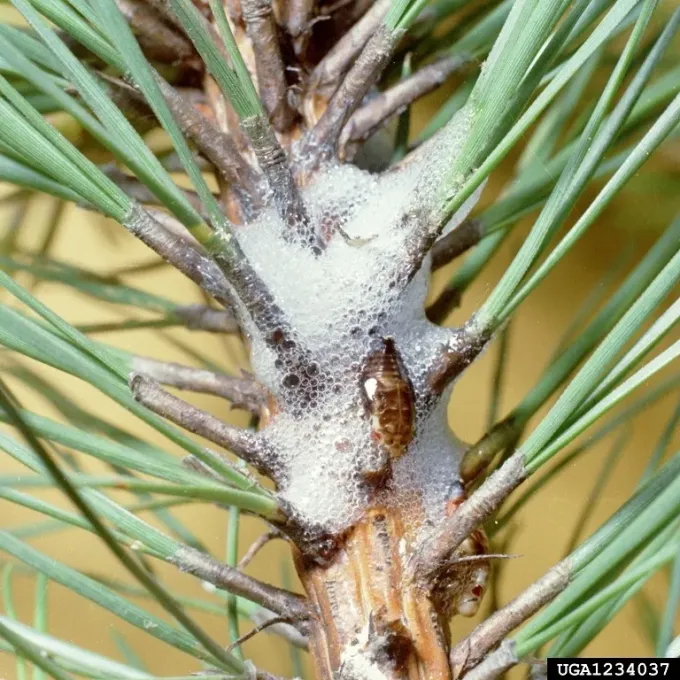
The nymphs are famous for producing masses of frothy, saliva-like foam, which protects their soft bodies from desiccation and various predators.
These insects have a single generation per year, with eggs serving as the overwintering stage, carefully placed within crevices of young pine bark.
The life cycle involves several nymphal instars before the insects transform into mobile adults capable of jumping and flight.
What it damages
The pine spittlebug primarily attacks pine species, including the Scots pine and Austrian pine, though it can impact other conifers.
Young plantations and nurseries are particularly vulnerable, as the insect's feeding behavior can severely retard the growth of developing trees.
By inserting their mouthparts into the phloem, nymphs and adults extract vital tree fluids, causing physiological stress to the host.
Severe infestations can lead to needle yellowing, branch deformity, and in extreme cases, the death of the affected branches or the whole tree.
Additionally, the feeding wounds serve as entry points for secondary pathogens and fungal diseases that further degrade tree health.
When it appears
Nymphal activity begins in early spring when larvae hatch from overwintered eggs, often coinciding with the initial seasonal sap flow.
During late spring and early summer, the frothy white "spittle" masses are most visible on the current year's shoots of the trees.
Adults emerge mid-summer and remain active through the autumn, feeding on twigs and branches before laying eggs for the next cycle.
The synchronization of the lifecycle with the host plant's growth phases makes this insect a persistent challenge during the spring flush.
Weather patterns, particularly warm and dry springs, can accelerate development and increase the density of the spittlebug population.
Signs of infestation
The most obvious indicator of a spittlebug presence is the white, bubbly foam covering the nymphs on young pine shoots.
Yellowing, stunted, or drooping needles on specific branches often indicate that the insect has been feeding on the branch for an extended period.
Twisted or deformed terminal growth is a common structural sign of damage caused by the accumulation of feeding sites.
Large populations of adult insects on the stems and foliage can be observed during the late summer months as they move to feed.
Visible decline in the overall vigor of young trees, characterized by reduced needle density and sparse crowns, points to chronic infestation.
Control measures
Management strategies often involve the application of systemic or contact insecticides during the peak of nymphal emergence.
Maintaining healthy, well-spaced trees in plantations can reduce the suitability of the habitat for large-scale infestations.
In nurseries, manual removal of infested branches can be an effective control method if the infestation is caught early.
Biological control, including the protection of native predators, helps to naturally regulate the population levels of the pine spittlebug.
- Application of approved chemical insecticides.
- Sanitation pruning to remove heavily infested material.
- Monitoring to detect early signs of egg-laying.
- Encouraging bird and insect predator habitats.
Taxonomy
- Latin name
- Aphrophora parallela
- Order
- Hemiptera (bugs, aphids, leafhoppers)
- Family
- Aphrophoridae
- EPPO code
- APHRPA
Discussion
No discussions yet — be the first.