
Willow spittlebug
Aphrophora pectoralis
Description
How to identify
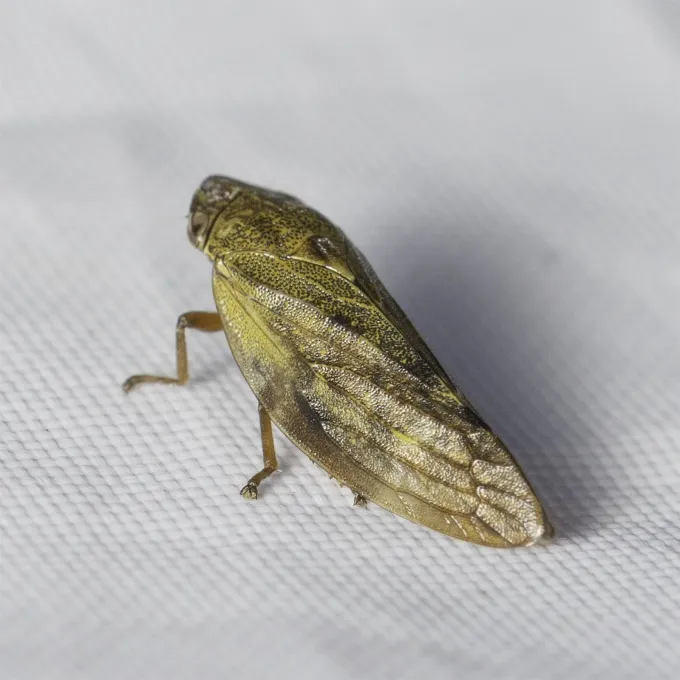
The willow spittlebug (Aphrophora pectoralis) belongs to the order Hemiptera and the family Aphrophoridae. Adults are approximately 8–10 mm long with a robust body, typically brownish or yellowish-brown, featuring distinctive patterns on their wings.
Larvae are famous for their secretive lifestyle, living inside a protective foam mass often referred to as "cuckoo spit." This foam provides essential moisture and thermal protection against predators and harsh environmental conditions.
A defining physical characteristic of this species is their powerful jumping hind legs, common to all members of the spittlebug family. Adults can jump rapidly to escape threats, making them difficult to spot on tree branches.
The life cycle encompasses the egg stage, five larval instars, and the adult stage (imago). The species overwinters as eggs laid beneath the bark or in the root zone during the autumn months.
Visually, the adult resembles a small cicada but has a more robust head and thorax. Their cryptic coloration allows them to blend in perfectly with the bark and foliage of host plants.
What it damages
The primary hosts of the willow spittlebug are trees within the genus Salix (willows). They thrive in moist environments where these trees grow in natural stands or commercial plantations.
When populations reach high densities, the insects may spread to other nearby deciduous trees and shrubs. Damage is inflicted by both the nymphs, who feed within the foam, and the adults moving through the canopy.
Feeding occurs by piercing plant tissues and extracting sap from young shoots and leaves. Extensive feeding interferes with the plant's metabolic processes, resulting in stunted growth and development.
Damaged tissues become susceptible to secondary infections, including fungal pathogens and bark bacteria, which can lead to premature leaf drop and twig death.
Economic impact is most significant in nurseries, where the aesthetic quality and growth rate of willow specimens are severely compromised by the pest's activity.
When it appears
Larvae emerge in the spring, typically coinciding with bud break, and begin producing their protective foam immediately. The larval development period lasts throughout May and June.
Adults emerge in mid-summer, usually in July, and remain active until late autumn. During this time, they are highly mobile, moving across the canopy to feed on plant juices.
Adults are most active during warm, sunny days. In overcast or cooler weather, they tend to hide within branch forks or underneath leaves, becoming less visible.
Mating and egg-laying occur in late August and September. This is the peak period for adult population density, as they prepare for the following season's generation.
Temperature significantly impacts the duration of the life cycle: hot summers accelerate larval development, whereas cooler temperatures lead to a slower maturation process.
Signs of infestation
The primary visual sign of infestation is the presence of white, frothy foam on the branches, twigs, and leaf axils of the willow tree, which results from larval feeding activity.
Inspection of the shoots often reveals curling, twisting, or significantly slower growth compared to healthy branches. Chlorosis (yellowing) of leaf tissues is also common in heavily infested areas.
A large accumulation of "spittle" on a shrub indicates a high infestation level, requiring prompt action to prevent long-term stress and damage to the host plant.
Adult insects exhibit a distinct jumping behavior when disturbed by movement or close human proximity, which serves as an additional indicator of their presence in the canopy.
By the end of the season, bark necrosis may appear in areas where larvae were previously concentrated or where eggs were laid, indicating potential entry points for secondary infections.
Control measures
Preventive measures include sound silvicultural practices: removing dead or heavily damaged branches where eggs might overwinter and thinning out dense canopy growth to improve airflow.
- Application of systemic insecticides during the peak larval emergence period (May-June).
- Manual removal of foam masses if the infestation is localized or on small, individual plants.
- Promotion of biological control by encouraging natural predators such as birds and parasitic insects.
- Frequent monitoring of plantations throughout the entire growing season.
- Maintaining optimal irrigation to prevent drought stress, which makes trees more attractive to pests.
Chemical control should be applied responsibly. Use contact or systemic insecticides registered for sap-sucking insects, strictly following label dosage instructions to minimize environmental impact.
Biological management relies on fostering a diverse ecosystem that supports natural enemies, which effectively regulates spittlebug populations in parks and gardens without heavy chemical use.
Taxonomy
- Latin name
- Aphrophora pectoralis
- Order
- Hemiptera (bugs, aphids, leafhoppers)
- Family
- Aphrophoridae
- EPPO code
- APHRPC
Discussion
No discussions yet — be the first.