
Exclamation froghopper
Neophilaenus exclamationis
Description
How to identify
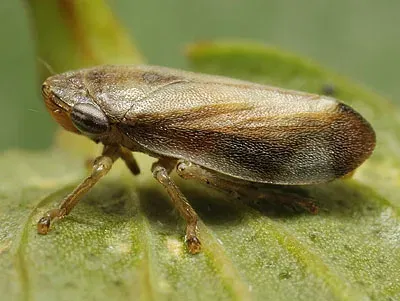
The Exclamation froghopper (Neophilaenus exclamationis) is a small insect belonging to the order Hemiptera and the family Aphrophoridae. It is named for the distinctive pattern on its forewings, which resembles an exclamation mark.
Adults typically measure between 5 and 7 mm in length. Their coloration ranges from pale yellow to brownish, providing excellent camouflage against the stems and leaves of their host plants.
The nymphs are famous for their unique habit of creating a protective foam mass. They exude a liquid that they whip into a froth, providing a humid microclimate that protects them from desiccation and predators.
Their life cycle includes egg, five nymphal instars, and the adult stage. The species overwinters in the egg stage, with eggs deposited within plant tissues or surface debris.
The development cycle is univoltine, meaning there is only one generation per year. However, high population densities can lead to significant economic losses in infested fields.
What it damages
Both nymphs and adults are harmful to plants, as they possess piercing-sucking mouthparts. They feed primarily on the phloem sap of grasses and cereal crops.
Commonly affected crops include wheat, barley, oats, and various forage grasses. In many cases, these insects are found in high concentrations in permanent pastures and hayfields.
Feeding damage causes physiological stress to the host plant, leading to stunted growth, leaf deformation, and reduced overall crop vigor. Severe infestations can significantly lower grain yield.
In addition to direct feeding, Neophilaenus exclamationis is considered a vector for various phytoplasmas and viruses. These pathogens can cause systemic diseases that are far more damaging than the feeding activity itself.
The cumulative effect of poor nutrition and secondary infection often results in visible patches of necrotic or discolored vegetation within an otherwise healthy crop.
When it appears
Egg hatching typically begins in late spring, as temperatures rise consistently. This coincides with the rapid early-season growth phase of most cereal crops.
Nymphal development occurs throughout the spring and early summer, lasting approximately 4 to 6 weeks depending on local climatic conditions.
Adults appear in early summer, usually June or July. During this stage, they are highly mobile and start colonizing new host plants, facilitating the spread of the population across larger areas.
As summer draws to a close, adults begin the process of mating and oviposition. The eggs are then left to survive the winter dormant period.
Because the eggs are well-protected within plant tissues, they are highly resistant to winter frost, ensuring the continuation of the cycle the following spring.
Signs of infestation
The most diagnostic sign of infestation is the presence of frothy foam masses, commonly called cuckoo-spit, found on the stems and leaf axils of host plants.
Leaves of infested plants may exhibit curling, yellowing, or whitening as a direct result of sap extraction and the injection of salivary enzymes by the insects.
Adult froghoppers are very alert and jump away quickly when disturbed, making them difficult to observe unless the vegetation is swept with an insect net.
Infested fields often show patchy development, with specific areas appearing less vigorous or showing early signs of senescence compared to uninfested zones.
If viral transmission has occurred, signs such as mosaic patterns, chlorosis, or reddening of the leaf margins may appear, signaling a systemic infection.
Control measures
Management strategies focus on reducing the overwintering success of the pest, primarily through good field hygiene and the removal of host weeds.
Deep plowing or stubble cultivation after harvest helps destroy eggs deposited in plant residues, significantly reducing the starting population for the next season.
Crop rotation remains one of the most effective methods to prevent the buildup of local froghopper populations in a specific area.
Chemical control, when necessary, involves the application of insecticides targeting the early nymphal stages before they reach adulthood and spread.
- Regular monitoring with sweep nets to assess population density.
- Managing field borders to remove alternate weed hosts.
- Using systemic insecticides if thresholds for damage are exceeded.
Taxonomy
- Latin name
- Neophilaenus exclamationis
- Order
- Hemiptera (bugs, aphids, leafhoppers)
- Family
- Aphrophoridae
- EPPO code
- NEOPEX
Discussion
No discussions yet — be the first.